

Latest Industry Research on Motivation Factors, Recognition, and Contingency Management
Findmojo Motivation Assessment Survey Highlights Key Engagement Activators and Advice
O.C. Tanner State of Recognition Report Highlights Key Trends
Contingency Management in Health Care May Explain Impact of Tangible, Intangible Rewards in Business As Well
Click here to subscribe to the ESM weekly e-newsletter.
The following reports from Findmojo, OC Tanner, and a New York Times article on the use of rewards in drug treatment shed different perspectives on motivation, engagement, rewards and recognition.
Findmojo Motivation Assessment Survey Highlights Key Engagement Activators and Advice 
A report by a Findmojo, a Lehi, UT-based motivational assessment firm for business and personal use, identifies what it says are the key considerations for effective engagement design. For this report, it analyzed the results of about 100,000 people participating in its assessment survey to identify what truly drives people. The report includes both findings and recommendations, which include:
Engagement isn’t a one-size-fits-all proposition. The company has identified 23 different motivators which exist in different combinations in each person. Leadership will achieve better results by understanding each stakeholder’s motivators. The report identifies the percentage of people motivated by the various identified motivation factors.
Millennials and GenZ have different motivators than older generations. They have a greater interest in impact, learning, family, creativity, and challenge.
Employees are motivated by helping others succeed. Many get satisfaction and happiness working to develop the growth of team members.
The report provides recommendations for each finding.
O.C. Tanner State of Recognition Report Highlights Key Trends 
The annual O.C. Tanner State of Recognition Report highlights key trends and recommendations in recognition and engagement based on a survey of 2,815 individuals in the US, Canada, Australia, India, and the United Kingdom by OC Tanner, the Salt Lake City-based recognition firm.
The research highlights several key trends:
Employees still value in-person recognition and view AI in a supporting role to improve the experience and craft better, personalized messages.
Recognition is most impactful when it’s personal and purposeful, the report finds. Awards linked to company purpose are 10 times more meaningful; those that highlight an employee’s impact are 11-times more meaningful; and when an award symbolizes that someone is truly valued, meaningfulness increases by 10 times. Custom awards also drive results – recipients say they are five-times more likely to do great work and four times more likely to be engaged.
Recognition may be a workplace norm, but far from universal. Most organizations recognize service anniversaries (75%) or top performers (63%), but many employees still go unrecognized.
Recognition must be inclusive and fully integrated to succeed: While nearly 61% of employees use digital platforms for recognition, success requires more than just technology – especially for offline and frontline workers. Employees with limited tech access are 57% less likely to believe their program is equally accessible to all, and 46% more likely to feel recognition is an empty gesture.
Multi-generational workforces value different kinds of recognition, and symbolism plays a powerful role for younger employees. Millennial and Gen Z leaders are three-times more likely than their Baby Boomer counterparts to say that receiving a meaningful symbolic award is a career highlight. The survey finds that younger talent prioritizes recognition that reflects identity, purpose, and impact.
Meaningful recognition fuels culture when it’s authentic and personal. While 61% of employees describe recognition experiences as very meaningful – feeling genuinely seen and connected to a shared purpose – there’s a critical caveat, the authors emphasize. Even in workplaces with formal recognition programs, 54% of employees say the recognition they receive still feels like an empty gesture. To make it meaningful, organizations must go beyond the award itself. Custom awards that are exclusive to an organization are eight-times more impactful than generic ones – and when personalized, that impact jumps 24 times, the study authors assert.
Contingency Management in Health Care May Explain Impact of Tangible, Intangible Rewards in Business As Well 
Desperate to find a treatment for methamphetamine addiction, for which there are no effective medications, case workers are increasingly resorting to the concept of contingency management for maintaining drug abstinence. This recent article in the New York Times by Jan Hoffman reports that the concept, while controversial, has gained ground because it is providing better outcomes than therapy alone.
Continency management is the field’s term for the process of rewarding patients for maintaining drug abstinence.
The article mentions that programs with greater rewards and longer duration produce better results. A program in Pennsylvania’s Allegheny County rewards patients up to $1,000 a year. The rewards typically include store vouchers, prizes, or debit card cash, with a cumulative value of nearly $600 for most programs to remain below 1099 reporting.
While the idea of paying addicted people not to take drugs is controversial, it appears to work better than therapy, Hoffman reports. After a year, half of patients have remained off of drugs in one study.
The research cited in this article was not conducted in the workplace. However, it appears to support the power of positive reinforcement, suggesting it could have just as much application in the workplace as in drug treatment.
Enterprise Engagement Alliance Services
 Celebrating our 15th year, the Enterprise Engagement Alliance helps organizations enhance performance through:
1. Information and marketing opportunities on stakeholder management and total rewards:
- ESM Weekly on stakeholder management since 2009. Click here to subscribe; click here for media kit.
- RRN Weekly on total rewards since 1996. Click here to subscribe; click here for media kit.
- EEA YouTube channel on enterprise engagement, human capital, and total rewards since 2020
 Management Academy to enhance future equity value for your organization.
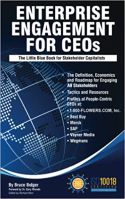
3. Books on implementation: Enterprise Engagement for CEOs and Enterprise Engagement: The Roadmap.
4. Advisory services and research: Strategic guidance, learning and certification on stakeholder management, measurement, metrics, and corporate sustainability reporting.
5. Permission-based targeted business development to identify and build relationships with the people most likely to buy.
Contact: Bruce Bolger at TheICEE.org; 914-591-7600, ext. 230.