

Part 2: Transforming HR From Cost Center to Value Engine through TQM and ISO 10018 Engagement
Why Traditional HR Must Evolve
Total Quality Management Meets HR Practice
Introducing ISO 10018: People Engagement Standards
Aligning Tactics with Stakeholder Interests
Measuring Value Creation
Conclusion: A Strategic Imperative
Click here to subscribe to the ESM weekly e-newsletter.
In an era where organizational performance is inseparable from human experience, human resources (HR) can transcend traditional administrative roles and evolve into a strategic value-creation engine. Total Quality Management (TQM) and ISO 10018 people engagement standards provide a structured, measurable pathway for HR to do just that — aligning workforce potential with organizational purpose, stakeholder value, and sustainable performance. Best of all, the processes have been tested for decades in factories around the world and are generally known to fail primarily when management overlooks the people components.
At its core, stakeholder management — as championed by the Enterprise Engagement Alliance — recognizes that organizational success depends on harmonizing the interests of all who contribute to value creation: employees, customers, partners, communities, and investors alike. Sustainable success, therefore, parallels the principles that once transformed manufacturing quality: systematic measurement, continuous improvement, and proactive involvement of those who create the work.
Why Traditional HR Must Evolve 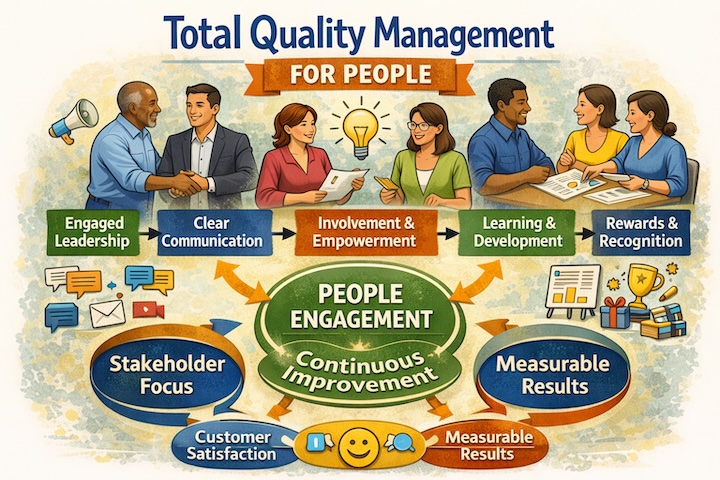
Traditionally, HR has been viewed as a cost center — a necessary support function measured by efficiency in payroll, compliance, and staffing. However, this view obscures HR’s potential to influence outcomes that drive competitive advantage: employee engagement, customer satisfaction, innovation, retention, and productivity. Current stakeholder and sustainability reporting requirements — such as the European Union’s Corporate Sustainability Reporting Directive (CSRD) — now mandate disclosure on human capital strategies, pressuring organizations to demonstrate measurable performance beyond financials.
Total Quality Management Meets HR Practice
TQM is a holistic, systematic philosophy first applied in manufacturing but equally applicable to human systems. Its essence is continuous improvement driven by data, customer focus, and leadership commitment. When applied to HR, TQM shifts the mindset from isolated transactions to integrated, stakeholder-oriented processes. In practice, HR applying TQM involves:
- Leadership commitment: HR must secure C-suite buy-in for a strategic people management system aligned with organizational purpose.
- Process orientation: Standardizing and measuring HR practices (recruitment, onboarding, development, performance management) so they deliver consistently for all stakeholders.
- Data-driven decisions: Using analytics to tie HR actions directly to outcomes such as engagement scores, performance metrics, customer satisfaction, and retention.
- Continuous Improvement: Encouraging iterative feedback loops with employees and managers to refine systems and eliminate waste or friction.
- This alignment ensures HR becomes an engine of continuous improvement rather than a reactionary unit — a foundation for measurable organizational value.
Introducing ISO 10018: People Engagement Standards
While ISO 9001 defines quality in terms of consistent, fit-for-purpose products and services, ISO 10018:2020 extends quality management into the human domain by providing guidance for people engagement. The standard emphasizes the emotional commitment that people have to the organization’s or team's purpose and goals — engagement that goes beyond compliance or paycheck motives.
ISO 10018 endorses quality management principles that directly empower HR to shift from transactional functions to strategic, stakeholder-focused practices. These include:
- Leadership and communication: Engaging employees in the organizational mission and providing clarity about how their daily work contributes to shared objectives.
- Involvement and empowerment: Enabling people at all levels to contribute ideas, identify improvement opportunities, and participate in decision-making.
- Competence and development: Systematic investment in capabilities that both satisfy strategic needs and enrich employee experience.
- Aligned practices: Integration of engagement tools — communications, learning, job design, recognition — in ways that reinforce organizational values and goals.
- Measurement and feedback: Using quantitative and qualitative measures to understand engagement and improvement impact.
Aligning Tactics with Stakeholder Interests
To succeed in this transformation, HR must view its practices through the lens of stakeholder engagement, where every tactic serves a broader purpose aligned with all others:
- Communication: Clear, purpose-driven messaging strengthens alignment between individual efforts and organizational goals.
- Learning and development: Structured pathways drive competence and signal investment in employee growth, contributing to engagement and retention.
- Job design: Intentional roles and workflows improve autonomy, accountability, and meaning in work.
- Rewards and recognition: Reinforcement systems that reflect shared values and outcomes motivate desired behaviors and reinforce commitment.
- Metrics: Analysis of all tactics and actions for their contribution to value creation.
Measuring Value Creation
A central critique of traditional HR has been the challenge of demonstrating ROI. TQM and ISO 10018 provide tools and metrics to make HR contributions quantifiable and accountable:
- Engagement indices tied to performance outcomes
- Use of metrics such as human capital value add and ROI applied to marketing as well
- Correlation of learning investments with productivity increases
- Measurement of turnover costs versus retention program impact
- Analysis of customer satisfaction relative to frontline employee engagement
Conclusion: A Strategic Imperative
For HR to transform from a cost center into a source of competitive advantage, it must adopt a strategic, stakeholder-focused, quality-driven approach. TQM provides the architecture of continuous improvement; ISO 10018 supplies the human-centric guidance to engage people meaningfully. Together, they enable HR to create measurable value that resonates with customers, employees, and investors alike.
HR’s future is not in managing costs — it is in managing experiences and outcomes that fuel sustainable performance.
Enterprise Engagement Alliance Services
 Celebrating our 17th year, the Enterprise Engagement Alliance helps organizations enhance performance through:
1. Information and marketing opportunities on stakeholder management and total rewards:
- ESM Weekly on stakeholder management since 2009. Click here to subscribe; click here for media kit.
- RRN Weekly on total rewards since 1996. Click here to subscribe; click here for media kit.
- EEA YouTube channel on enterprise engagement, human capital, and total rewards since 2020
 Management Academy to enhance future equity value for your organization.
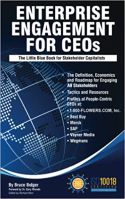
3. Books on implementation: Enterprise Engagement for CEOs and Enterprise Engagement: The Roadmap.
4. Advisory services and research: Strategic guidance, learning and certification on stakeholder management, measurement, metrics, and corporate sustainability reporting.
5. Permission-based targeted business development to identify and build relationships with the people most likely to buy.
Contact: Bruce Bolger at TheICEE.org; 914-591-7600, ext. 230.