

Why Business Media Rarely Presses CEOs on Stakeholder Management and Why That Matters
 The World Economic Forum just completed its annual Davos conference. Despite the WEF’s stated commitment to making the world a better place to live by promoting a business model that harmonizes the interests of all stakeholders, there is no indication from any of the press coverage that people issues were on the minds of journalists questioning the CEOs in attendance other than related to potential disruption by AI. Here are several reasons why that might be the case.
 Why the Silence About People Management
The Questions Journalists Should Ask CEOs But Don’t
Click here to subscribe to the ESM weekly e-newsletter.
There is growing evidence that stakeholder-related factors are central to long-term business success; yet, they remain largely absent from serious business media scrutiny. Decades of research link employee and customer engagement to productivity, quality, retention, and safety; customer trust and loyalty to revenue stability and pricing power; and resilient supply chains and community relationships to risk reduction and continuity. In short, how organizations manage people and stakeholders is no longer a “soft” issue—it is material to value creation.Despite this, when business journalists and analysts interview CEOs, earnings calls and strategy discussions still focus overwhelmingly on financial outcomes, market positioning, AI, and short-term performance. When stakeholder issues are raised at all, they are typically framed as matters of values, culture, or reputation—rarely as operating systems with measurable economic consequences.
This gap is striking given the prominence of stakeholder capitalism in public discourse over the past decade. The World Economic Forum, for example, elevated stakeholder capitalism to the center of its agenda with its 1973 Davos Manifesto, yet relatively little attention has been paid to how organizations actually implement, measure, or govern it. The conversation largely stalled at aspiration. Several factors help explain why.
Why the Silence About People Management
Unless a strike looms or some other major issue affecting large numbers of employees or customers, business journalists rarely question CEOs about their customer, employee and other stakeholder engagement efforts and outcomes.
One is narrative convenience. Financial metrics are standardized, comparable, and familiar. They lend themselves to clear scorecards and headline-driven storytelling. Stakeholder outcomes—such as productivity, engagement, trust, quality, and resilience—are more complex, interdependent, and long-term. They do not fit neatly into quarterly reporting cycles or simple narratives. Very few executives, let alone journalistsor analysts, are educated on the significance of such metrics as human capital ROI or human capital value add; revenues and profits per customer or employee, quality and productivity, or the concept of a Human Capital Factor ™, a measurement created by the research firm Irrational Capital that aims to predict future equity value creation based on the level of an organization’s employee commitment.
Another factor is measurement uncertainty. While rigorous methods exist to assess engagement, turnover, productivity, quality, customer loyalty, and supply-chain resilience, these measures lack the universal standardization of financial metrics. This makes them harder to compare across firms and more challenging for journalists to cover with confidence.
There is also discomfort. Pressing CEOs on stakeholder management requires moving beyond vision statements into process, accountability, and evidence. Many leaders are far more comfortable discussing intentions than explaining operating systems. Media interviews, by design, often avoid lines of questioning that expose uncertainty, inconsistency, or gaps in practice.
This creates a measurement paradox. Because many organizations do not systematically integrate stakeholder metrics into executive decision-making, leaders often lack clear answers. When CEOs cannot readily explain how they track and manage the effects of strategy on employees, customers, or partners, journalists may avoid asking the questions altogether—reinforcing the cycle of superficial coverage.
Time horizons compound the problem. Stakeholder capitalism unfolds over years, not quarters. Its outcomes rarely align with fast media cycles that prioritize immediacy, novelty, and short-term results.
The result is a persistent blind spot. We debate capitalism’s legitimacy, inequality, trust deficits, and corporate purpose without routinely asking executives how their strategies affect the very stakeholders who determine long-term performance.
The Questions Journalists Should Ask CEOs But Don’t
If business media were to press more deeply, it might begin with questions like these:
- Why did the World Economic Forum elevate stakeholder capitalism as a priority, and why after 53 years has so little attention been paid to how it is executed? How do you define productivity and quality in your organization beyond financial output?
- What evidence do you track regarding employee and customer engagement, turnover, well-being, and capability—and how does that data influence strategy?
- Do you believe customer and employee engagement are concrete contributors to value creation? If so, how do you measure and manage them?
- How do you assess the health and resilience of your supply chain partnerships?
- What trade-offs exist among customer, employee, investor, and community interests, and how are those trade-offs managed over time?
- How are you addressing the needs of local communities that might wish to hire Hispanic, Spanish-speaking people for their retail locations in Hispanic communities.
- How do you know whether your stakeholder strategies are working—or failing?
Until business media routinely explores the economics, processes, and metrics behind stakeholder management, discussions of stakeholder capitalism will remain rhetorical. And a critical opportunity—to connect how organizations treat people with how they perform—will continue to be missed. These questions are not about assigning blame. It is about elevating the conversation to match the stakes and opportunity.
Enterprise Engagement Alliance Services
 Celebrating our 17th year, the Enterprise Engagement Alliance helps organizations enhance performance through:
1. Information and marketing opportunities on stakeholder management and total rewards:
- ESM Weekly on stakeholder management since 2009. Click here to subscribe; click here for media kit.
- RRN Weekly on total rewards since 1996. Click here to subscribe; click here for media kit.
- EEA YouTube channel on enterprise engagement, human capital, and total rewards since 2020
 Management Academy to enhance future equity value for your organization.
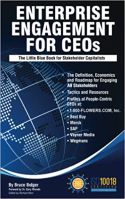
3. Books on implementation: Enterprise Engagement for CEOs and Enterprise Engagement: The Roadmap.
4. Advisory services and research: Strategic guidance, learning and certification on stakeholder management, measurement, metrics, and corporate sustainability reporting.
5. Permission-based targeted business development to identify and build relationships with the people most likely to buy.
Contact: Bruce Bolger at TheICEE.org; 914-591-7600, ext. 230.