

Applying Total Quality Management to Enhancing Customer Loyalty and Experience
 Here is a stakeholder-based approach to sustainable growth through customer engagement. In short, loyalty efforts require a holistic approach that involves almost everyone in your organization in a systematic way.
Customer Loyalty as a Quality Outcome, Not a Program
The Stakeholder Ecosystem Behind Customer Experience
Leadership: Setting the Conditions for Loyalty
Employees as Co-Creators of the Customer Experience
Designing Processes Around the Customer Journey
Partners and Suppliers as Extensions of the Brand
Measurement: From Satisfaction Scores to System Health
Balancing Short-Term Performance and Long-Term Trust
Customer Loyalty as a Shared Value Creation Process
Click here to subscribe to the ESM weekly e-newsletter.
Customer loyalty and experience are often discussed as marketing or customer service challenges. In reality, they are enterprise-wide outcomes that depend on the coordinated actions of multiple stakeholders across the organization and its value chain. Total Quality Management (TQM), long associated with operational excellence, provides a powerful — and still underutilized — framework for designing customer loyalty and experience strategies that are sustainable, measurable, and scalable.In an era of rising expectations, rapid transparency, and lowering switching costs, customer loyalty cannot be engineered through isolated initiatives. For maximum impact, it must be earned through systems that consistently deliver value across all stakeholders.
Total Quality Management provides the discipline, structure, and mindset required to do this at scale. By aligning leadership, employees, partners, processes, and measurement around customer value, organizations can build loyalty that is resilient, authentic, and economically sustainable.
Customer loyalty, in the end, is not a campaign. It is the natural outcome of a well-managed, stakeholder-aligned enterprise.
TQM’s central insight is simple but profound: quality is not a department; it is a system. When applied to customer loyalty and experience, this system must integrate leadership, employees, customers, partners, processes, technology, and measurement — all aligned toward delivering consistent value to customers over time.
Customer Loyalty as a Quality Outcome, Not a Program
TQM reframes customer loyalty from something that can be “created” through incentives, promotions, or messaging into something that emerges naturally from well-designed, continuously improving systems. Loyal customers are the result of reliable processes, engaged employees, trusted partners, and leadership committed to long-term value creation rather than short-term transactions.
In a TQM context, customer loyalty is:
- The cumulative result of every interaction a customer has with the organization
- A lagging indicator of process quality, not a leading marketing tactic
- A shared responsibility across all internal and external stakeholders
The Stakeholder Ecosystem Behind Customer Experience
Enhancing customer loyalty requires recognizing that customers are only one part of a broader stakeholder ecosystem. TQM emphasizes understanding how each stakeholder group influences quality outcomes. Key stakeholders include:
- Customers, whose expectations define quality
- Employees, who deliver the experience
- Leaders, who set priorities and allocate resources
- Partners and suppliers, who are critical to consistency and reliability
- Shareholders and investors, who influence time horizons and risk tolerance
- Communities and regulators, who affect trust and legitimacy
Leadership: Setting the Conditions for Loyalty
TQM begins with leadership. Customer loyalty cannot be delegated to marketing or customer service; it must be embedded in the organization’s purpose, strategy, and governance. Leaders applying TQM to customer experience:
- Define customer value clearly and consistently
- Align incentives, metrics, and decision-making with long-term customer outcomes
- Resist strategies that sacrifice trust for short-term gains
- Model customer-centric behaviors internally, so that internal customers are equally the focus of external customers
Employees as Co-Creators of the Customer Experience
TQM recognizes employees not as costs to be controlled, but as sources of quality, insight, and improvement. Customer loyalty is profoundly shaped by how employees experience the organization themselves. Key TQM principles applied to employees include:
- Empowerment: Employees closest to customers should have the authority to resolve issues and improve processes.
- Capability building: Training focuses not only on tasks, but on problem-solving, collaboration, and customer impact.
- Recognition: Employees are acknowledged for behaviors that improve customer outcomes, not just short-term metrics.
- Culture: TQM only works when it becomes part of the organization or team's culture, which requires a combination of both appreciation and recognition.
Designing Processes Around the Customer Journey
TQM shifts attention from individual touchpoints to end-to-end processes. Customers do not experience departments; they experience journeys that cut across functions. Applying TQM to customer experience requires:
- Mapping customer journeys across departments and partners, not just the external customer experience
- Identifying process failures, handoff breakdowns, and sources of variability
- Redesigning processes to reduce friction, delays, and errors
- Standardizing where consistency matters and customizing where it adds value
Partners and Suppliers as Extensions of the Brand
In many industries, customers interact as much — or more — with partners and suppliers as with the organization itself. TQM treats these external stakeholders as integral parts of the quality system. To enhance loyalty:
- Partners are selected not only on cost, but on reliability, values, and customer impact
- Quality expectations are clearly defined and jointly managed
- Feedback loops extend beyond the organization to include suppliers and distributors
Measurement: From Satisfaction Scores to System Health
Traditional customer experience metrics often focus on snapshots — satisfaction surveys, Net Promoter Scores, or complaint volumes. TQM encourages a broader measurement framework that connects customer perceptions to underlying processes. Effective TQM-based measurement includes:
- Leading indicators (process reliability, employee engagement, response times)
- Lagging indicators (customer retention, repeat purchases, referrals)
- Qualitative insights from customers and employees
- Trend analysis over time, not just point-in-time scores
Balancing Short-Term Performance and Long-Term Trust
One of TQM’s greatest strengths is its emphasis on long-term thinking. Customer loyalty is built over time through consistent delivery of value and integrity.
Organizations applying TQM to customer experience:
- Avoid manipulative or misleading practices or terms and conditions that erode trust
- Design policies that favor fairness and transparency
- Recognize that loyalty is fragile and cumulative
Customer Loyalty as a Shared Value Creation Process
Ultimately, TQM reframes customer loyalty as co-created value. Customers are not passive recipients but active participants whose feedback, behaviors, and choices shape the organization. Organizations that excel:
- Invite customers into improvement processes
- Treat complaints as opportunities for learning
- Communicate openly about changes and trade-offs
- Align customer success with employee and organizational success
- Have CEOs and senior management actively experiencing the service themselves in some kind of mystery shopper capacity
Enterprise Engagement Alliance Services
 Celebrating our 17th year, the Enterprise Engagement Alliance helps organizations enhance performance through:
1. Information and marketing opportunities on stakeholder management and total rewards:
- ESM Weekly on stakeholder management since 2009. Click here to subscribe; click here for media kit.
- RRN Weekly on total rewards since 1996. Click here to subscribe; click here for media kit.
- EEA YouTube channel on enterprise engagement, human capital, and total rewards since 2020
 Management Academy to enhance future equity value for your organization.
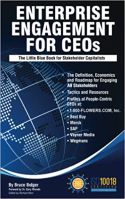
3. Books on implementation: Enterprise Engagement for CEOs and Enterprise Engagement: The Roadmap.
4. Advisory services and research: Strategic guidance, learning and certification on stakeholder management, measurement, metrics, and corporate sustainability reporting.
5. Permission-based targeted business development to identify and build relationships with the people most likely to buy.
Contact: Bruce Bolger at TheICEE.org; 914-591-7600, ext. 230.