

Impact Measurement in Action: A Brief History of the Forum for People Performance Management and Measurement
.png) During the 2000s, leaders in the incentive, rewards, and recognition field supported an academic effort to demonstrate the impact of engagement on organizational performance. Its research helped set the stage for the growing focus on strategic stakeholder engagement across the enterprise. If you've heard of the importance of integrating CX (customer experience) and EX (employee experience), the Forum was among the first to investigate it through academic research in the 2000s.
During the 2000s, leaders in the incentive, rewards, and recognition field supported an academic effort to demonstrate the impact of engagement on organizational performance. Its research helped set the stage for the growing focus on strategic stakeholder engagement across the enterprise. If you've heard of the importance of integrating CX (customer experience) and EX (employee experience), the Forum was among the first to investigate it through academic research in the 2000s. The History
The Industry Context
What the Forum’s Research Collectively Demonstrated
Key Studies Conducted by the Forum (Timeline and Summaries)
Click here to subscribe to the ESM weekly e-newsletter.
Why would the IRR (incentive, rewards, and recognition) industry’s leading trade show, multiple associations, and some of the leading and incentive and recognition companies have funded The Forum for People Performance Management and Measurement for over a decade when both the original Incentive Research Foundation joined later by the SITE Foundation already conducted research on the use of incentive, rewards, and recognition?
The History .jpg)
The Forum was established in the late 1990s at the Medill School of Journalism, Integrated Marketing Communications (IMC) Department, Northwestern University by the Incentive Performance Center. It was conceived of by Bruce Bolger (EEA founder), who was head of an industry outreach group at the time with seed funding from Pete Erickson and Hall Erickson, a trade show management firm that produced the Motivation Show for over 80 years until it closed during the Great Recession.
.jpg)
Under the direction of Bolger, EEA Founder, The Forum recruited Professors Don E. Schultz (deceased) and Frank J. Mulhern, who were early leaders in integrated marketing, internal marketing, and people-performance research, to head up research. The Forum also folded during Great Recession, two years after one of the associations assumed management and Bolger’s departure.
In addition to the leading associations involved with The Motivation Show at the time, the Forum had the support of Carlson Marketing Group (now defunct) EGR International, ITA Group, Hallmark Insights, The Incentive Group, Michael C. Fina Rewards, now Halo Branded Solutions, Next Level Performance, Maritz, Marketing Innovators, Motivaction (now Augeo), and Motivation Excellence. Supporting associations included Incentive Marketing Association, Incentive Research Foundation, Promotion Marketing Association (now part of ANA), Promotional Products Association International, and Recognition Professionals International.
Its creation reflected a growing concern among the industry’s leaders that while organizations were investing heavily in people-related initiatives—incentives, rewards, recognition, communications, training, culture, etc.--there was little rigorous evidence demonstrating their financial impact or most effective practices.
Looking back, the Forum’s purpose was explicit and unusual for its time: to apply independent, academic, empirical research methods to measure how people-related organizational practices affect employee behavior, customer outcomes, and financial performance. Rather than treating engagement as a soft concept or a morale issue, the Forum approached it as a performance management discipline—one that could be studied, measured, and linked to business results.
 The Forum for People Performance Management and Measurement represents a largely forgotten—but important—chapter in the history of engagement of incentives, rewards, and recognition. At a time when much of the industry relied on intuition and advocacy, the Forum pursued academic-based, unbiased measurement, models, and evidence-based strategies for organizations to foster the proactive involvement of all employees, customers, distribution and supply chain partners critical to success.
While only a portion of its research remains easily accessible, the surviving studies continue to support a central conclusion: Engagement is not a simple nor soft concept—it is a measurable organizational system with serious financial impact requiring trained and experienced professionals.
The Industry Context
During the late 1990s and 2000s, the incentive, rewards, and recognition field was in full swing, with a half-dozen magazines focusing on “premiums,” incentives, and incentive travel and two national trade shows featuring the world's leading merchandise, retail, and travel brands. Concepts such as employee engagement, customer engagement, internal marketing, and incentive effectiveness were discussed in the education—but rarely measured in a consistent or integrated way. The IRF and later the SITE Foundation have focused largely on incentives, rewards, and recognition to address the interests of their largely supplier-based members.
The Forum emerged at the time as the only serious attempt to create a research-based foundation for the overall concept of people management and engagement across the enterprise--not just incentives, but all the ways organizations can inspire customers, sales and non-sales employees, channel partners, etc. The vision was to create an industry based on concrete value creation require deep expertise in strategy, tactics, measurement, and C-suite impact. Over about 10 years, it produced multiple empirical studies, executive surveys, and applied research projects that gave birth to the overall concept of engagement—the desired outcome of incentives, rewards, and recognition. The purpose was to identify what organizations needed to improve the results of their engagement efforts, rather than specifically that sponsors wanted to sell.
The Enterprise Engagement Alliance was founded in 2009 based on the findings of the Forum’s work.
What the Forum’s Research Collectively Demonstrated
Across studies conducted between approximately 2001 and 2008 published in EEA’s RRN media, the Forum’s research consistently found that:
1. Employee satisfaction and engagement are measurable constructs influenced by identifiable organizational practices.
2. Organizational communication, HR systems, leadership behavior, job design, and effectively designed rewards and recognition system are among the strongest drivers of engagement and performance.
3. Employee engagement influences customer satisfaction and customer engagement, particularly among customer-contact employees or in any workplace in which some employees are in effect customers of the services of others.
4. Customer engagement is directly associated with financial performance and profitability.
5. Incentive, reward, and recognition initiatives fail when treated as isolated programs; success depends on cross-functional alignment, especially between human resources and marketing.
Together, these findings helped establish engagement as a systemic, enterprise-wide discipline, rather than standalone human resources initiative, marketing or internal communications initiatives.
Key Studies Conducted by the Forum (Timeline and Summaries)
Here are the studies that remain of the Forum work still available on EEA’s RRN media platform, which published the reports at the time.
1. 2003: Linking Performance Strategies to Financial Outcomes: The Interaction Between Marketing and Human Resources
Purpose: To study how alignment—or misalignment—between HR and marketing affects the motivation, measurement, and incentives of customer-contact employees.
Conducted by: Forum for People Performance Management and Measurement; research associated with Frank J. Mulhern and colleagues.
Methodology: Mail survey of HR and marketing executives and analysis of 175 responses.
Key Findings:
- HR and marketing frequently disagreed on who key customer-contact employees were.
- Organizations with stronger HR–marketing alignment demonstrated better customer orientation and performance indicators.
- Engagement requires integrated systems, not siloed functions.
2. 2004–2005. The Road to an Engaged Workforce: Determinants of Employee Satisfaction and Engagement
Purpose. To move beyond identifying engagement outcomes and focus on managerial and organizational levers that drive satisfaction and engagement.
Conducted by: Forum for People Performance Management and Measurement.
Methodology. Expanded organizational survey examining HR systems, role clarity, training, autonomy, and managerial behavior.
Key Findings:
· HR systems such as training, performance management, and compensation shape culture and engagement.
· Engagement was strongly influenced by reduced role conflict, effective training, autonomy, and managerial power use.
· Some organizational factors affected both satisfaction and engagement simultaneously.
Significance:
Shifted the conversation from whether engagement matters to how organizations can actively create it.
3. 2005: Internal Marketing Best Practices Study
Purpose: To identify and document best practices in internal marketing across organizations.
Conducted by: Medill IMC graduate students under Forum auspices
Findings: Effective internal marketing requires leadership involvement, cross-functional coordination, and alignment with HR systems.
Significance: Provided practical context to support the Forum’s empirical findings.
4. 2006. Match Employee Awards to Specific Organizational Objectives for Optimal Success: Tactical Tips from Awards Selection—Insights From Managers
Purpose. To identify which employee reward and recognition tactics—cash and non-cash—are considered most effective in achieving specific organizational objectives.
Conducted by: The Forum for People Performance Management and Measurement, with analysis by Dr. Jimmy Peltier, Dr. Don Schultz, and Dr. Martin Block.
Methodology. The study used a survey of 235 managers who were active users of employee reward and recognition programs. Data were collected at four national industry conferences in 2005, representing a broad range of industries and organizational roles.
Key findings.
- Non-cash rewards, particularly employee recognition, are preferred and more effective for most organizational objectives, including culture, teamwork, morale, retention, and customer satisfaction.
- Cash rewards are most effective for short-term, results-driven goals, especially increasing sales.
- Effectiveness varies by organizational context, reinforcing the importance of aligning reward strategies with specific business objectives.
5. 2007. Study Examines the Link Between Hotel Employee Performance and Guest Satisfaction
Purpose. The article “Study examines the link between hotel employee performance and guest satisfaction” was published on Quirk’s. Its purpose was to investigate whether employee attitudes and engagement behaviors could be aligned with guests’ expectations to create measurable “future value” for hotel brands. The article emphasized two central planning questions: whether employee engagement could be linked to guest expectations in ways that would predict financial value, and how hotels could avoid commoditization by enhancing guest loyalty through better employee performance. Because the study occurred 19 years ago, it can be reported that the study was conducted with Hyatt hotels.
Findings. The authors noted that the study was rare in that an international hospitality brand provided actual guest financial and behavioral data, which allowed the research to correlate employee engagement and performance with guest perceptions and outcomes. It concluded that engagement and behavior alignment at experiential touchpoints is a key differentiator for competitive advantage and profitability in the hotel industry.
Conducted by: Frank Mulhern, then Chairman of the Integrated Marketing Communications Department at the Medill School of Journalism, Northwestern University, and Robert Passikoff, Founder and President of Brand Keys Inc. It appeared as part of a research overview in October 2007 that explored the connection between hotel employee engagement and guest experience outcomes.
6. 2008: The 2008 Empirical Study Linking Employee and Customer Engagement to Profitability
Purpose: To test, at scale, whether employee engagement and customer engagement are measurably connected to profitability.
Conducted by: Forum for People Performance Management & Measurement, Northwestern University; research lead, James Oakley
Method: Data from approximately 100 companies, 5,600 employees, 269 work groups, and 37,000 customers.
Key Findings:
- Employee engagement was strongly linked to customer engagement.
- Customer engagement was directly associated with financial performance and profitability.
- High-engagement work groups consistently outperformed others.
Special Reports
The Path to Employee Engagement, a report highlighting the seven key pathways to employee engagement identified in the media company study.
The Birth of a Needed New Profession: People Performance Management. An overview of the implications of the research and focus on the forum on people performance, engagement and integration of marketing and human resources.
The Economic Case for People Performance Management and Measurement. Summary of work linking internal performance strategies to market and financial outcomes.
Enterprise Engagement Alliance Services
 Celebrating our 17th year, the Enterprise Engagement Alliance helps organizations enhance performance through:
1. Information and marketing opportunities on stakeholder management and total rewards:
- ESM Weekly on stakeholder management since 2009. Click here to subscribe; click here for media kit.
- RRN Weekly on total rewards since 1996. Click here to subscribe; click here for media kit.
- EEA YouTube channel on enterprise engagement, human capital, and total rewards since 2020
 Management Academy to enhance future equity value for your organization.
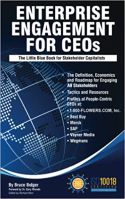
3. Books on implementation: Enterprise Engagement for CEOs and Enterprise Engagement: The Roadmap.
4. Advisory services and research: Strategic guidance, learning and certification on stakeholder management, measurement, metrics, and corporate sustainability reporting.
5. Permission-based targeted business development to identify and build relationships with the people most likely to buy.
Contact: Bruce Bolger at TheICEE.org; 914-591-7600, ext. 230.