

Research Finding: Its Not Just What Leaders Do, Its Their Intent
 This surprising study finds that investors price not only what companies do into their valuations but their publicly stated reasons.
 Key Findings: The “Intention Premium”
Implications for Management
A report recently published in the Harvard Law School Forum for Corporate Governance newsletter based on a 2026 study, Corporate Intent, finds that the accepted notion that sustainable and responsible behavior pays off because it improves long-term performance is not enough. Shareholders price in not only what companies do, but why they say they do it.
Augustin Landier is a Professor of Finance at HEC Paris; Parinitha Sastry is an Assistant Professor of Finance at the Wharton School of the University of Pennsylvania, and David Thesmar is the Franco Modigliani Professor of Financial Economics at the MIT Sloan School of Management.
In a large experimental study, the researchers found that investors were willing to pay meaningfully more for shares in companies whose leaders framed environmentally responsible actions as motivated by genuine social concern rather than pure profit maximization—even when cash flows and environmental outcomes were identical. The implication is striking for boards and CEOs: corporate intent is not neutral. How leaders articulate purpose can directly create—or destroy—value, the study finds.
The experiment involved 1,399 US participants in an online experiment with repeated stock-valuation tasks. Participants valued stocks with fixed dividends and specified environmental impacts across 18 rounds. CEO intent statements varied across conditions involving environmental praise, blame, and ambiguity. Participants consistently updated their beliefs about firm motives in response to these statements.
For senior leaders, the message is clear: purpose is no longer cheap talk, the authors write. Markets, employees, and consumers increasingly respond to perceived intent, not just measurable outcomes. ESG (Environmental, Social, Governance) strategies that rely solely on the “doing well by doing good” logic risk backfiring if leaders over-emphasize the instrumental profit motive. In today’s corporate environment, how executives explain their choices is itself a source of value—or liability. The era in which intent could be ignored has quietly come to an end.
Key Findings: The “Intention Premium”
The study’s central finding is the existence of an intention premium.
- When firms take the same environmentally beneficial action and generate the same financial returns, investors value them differently depending on management’s stated motivation.
- Expressing prosocial intent (e.g., concern for the environment) commands a valuation premium.
- Explicitly framing the same action as driven by profit maximization alone leads to a valuation discount.
- On average, investors were willing to pay about 7 cents more per share—roughly 3% of the stock’s cash value—for firms led by executives expressing prosocial motives.
Implications for Management
1. ESG Is Not Just About Outcomes—It’s About Motives
The findings undermine the comforting “no trade-off” narrative that shareholder value and stakeholder value naturally align whenever ESG initiatives are profitable. When companies present sustainability primarily as an instrument for profit, stakeholders become less willing to make the sacrifices—lower returns, higher prices, employee commitment—that underpin ESG success, the authors believe.
2. Communication Can Create or Destroy Value
Executives often assume that transparency about profit motives is harmless. This research suggests otherwise. Making profit maximization too salient can erode goodwill and reduce stakeholder willingness to support responsible initiatives, even when those initiatives are objectively beneficial.
3. Dual Objectives Are Credible—Ambiguity Is Not
Firms that explicitly acknowledge both profitability and social responsibility are rewarded nearly as much as firms claiming purely prosocial intent. Stakeholders appear comfortable with multiple goals. What they punish is half-hearted execution. Firms that mix “good” and “bad” actions—such an operating both clean and dirty divisions—lose much of the goodwill generated by positive outcomes.
4. Stakeholder Reactions Are Not Uniform
Sensitivity to corporate intent varies systematically:
- Investors with deontological (strict) moral views care more about motives.
- Politically liberal stakeholders price intent more heavily than conservatives.
- Women respond more strongly to prosocial framing and are more punitive toward profit-only narratives.
- Collectivist stakeholders place greater value on both social outcomes and prosocial intent.
The researchers find that intent statements shape beliefs about managerial character. Participants inferred that CEOs who emphasized prosocial motives were more likely to act ethically in unrelated domains—donating to environmental causes, ensuring product safety, and refraining from fraud. Profit-only statements sharply reduced these perceptions.
Crucially, these beliefs cannot affect financial payoffs in the experiment: the stock pays a one-time, guaranteed dividend. The valuation effect therefore reflects a direct preference (or aversion) to owning shares in firms led by managers with certain moral traits, the authors emphasize.
Enterprise Engagement Alliance Services
 Celebrating our 17th year, the Enterprise Engagement Alliance helps organizations enhance performance through:
1. Information and marketing opportunities on stakeholder management and total rewards:
- ESM Weekly on stakeholder management since 2009. Click here to subscribe; click here for media kit.
- RRN Weekly on total rewards since 1996. Click here to subscribe; click here for media kit.
- EEA YouTube channel on enterprise engagement, human capital, and total rewards since 2020
 Management Academy to enhance future equity value for your organization.
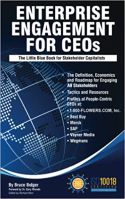
3. Books on implementation: Enterprise Engagement for CEOs and Enterprise Engagement: The Roadmap.
4. Advisory services and research: Strategic guidance, learning and certification on stakeholder management, measurement, metrics, and corporate sustainability reporting.
5. Permission-based targeted business development to identify and build relationships with the people most likely to buy.
Contact: Bruce Bolger at TheICEE.org; 914-591-7600, ext. 230.