

Why Has HR Moved on from Engagement Just When the Data Shows It Drives Equity Value
.jpeg) Employee engagement is at record lows, yet research from the Said Business School at Oxford University, Irrational Capital, and Professor Alex Edmans shows a clear link between workforce engagement, well being, and long-term stock performance. Why has HR de-prioritized engagement when the financial case has never been stronger.
Employee engagement is at record lows, yet research from the Said Business School at Oxford University, Irrational Capital, and Professor Alex Edmans shows a clear link between workforce engagement, well being, and long-term stock performance. Why has HR de-prioritized engagement when the financial case has never been stronger.By Gary Rhoads
Rhoads is the Academic Director the Enterprise Engagement Alliance Impact Academy; Stephen Mack Covey Professor Emeritus, Marketing and Entrepreneurship, Marriott School of Business, Brigham Young University; Adjunct Professor, Marketing, Utah State University, and Chairman of Skavengerz, a consumer engagement app.
Engagement Is at Record Lows—and the Waste and Unhappiness Are Enormous
The Financial Markets Have Already Connected the Dots
So Why Isn’t Engagement a Core HR Function Anymore?
The Playbook Already Exists: Total Quality Management
It’s Not Too Late
At the very moment employee engagement has fallen to historic lows—with rising costs in turnover, burnout, waste, and lost productivity—engagement is rarely mentioned as a core HR function these days. Instead, it has been fragmented into communications, surveys, perks, well-being apps, and culture initiatives. Yet, the research is increasingly clear: the ability to systematically engage people is not a “soft” activity. It is a measurable driver of long-term equity value creation. If engagement fuels financial performance, why has HR moved on from owning it strategically to burying it amidst other tasks?
One simple answer: decades of talk and ad hoc reactions to the engagement issue and a failure to measure outcomes led to little to no results, based on the latest Gallup surveys on employee engagement. So the baby got thrown out with the bath water.
Engagement Is at Record Lows—and the Waste and Unhappiness Are Enormous 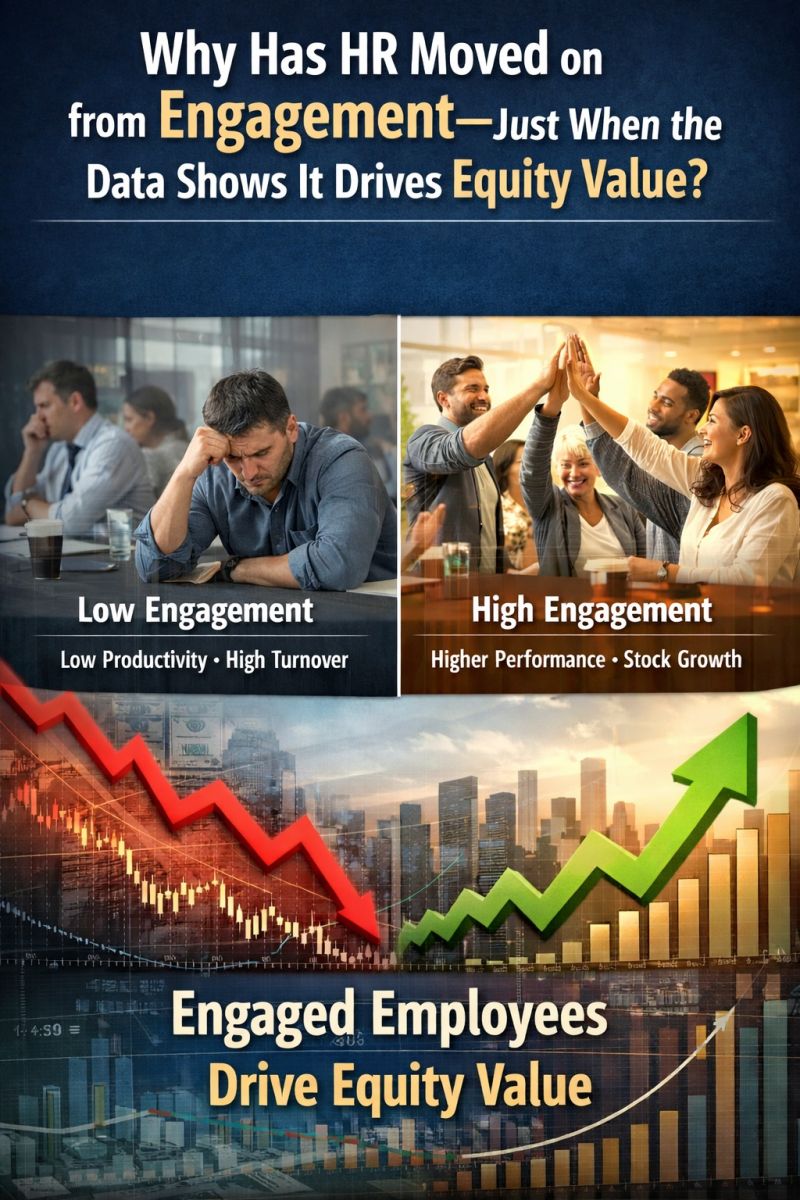
Gallup and others continue to report troubling declines in employee engagement, with growing disengagement and “quiet quitting.” The implications are not abstract. Disengaged organizations experience higher absenteeism, safety incidents, quality defects, customer churn, and turnover, and less innovation—each representing significant economic waste and human unhappiness.
The Enterprise Engagement Alliance has long argued that engagement is not a program but a management discipline—one that integrates leadership, communication, recognition, rewards, performance management, and customer experience into a coherent system Yet in many HR departments today, engagement has been reduced to an annual survey score, recognition platforms, incentive programs, pizza parties, days off. The strategic function of designing systems that align people with purpose, goals, and continuous improvement is often absent.
The Financial Markets Have Already Connected the Dots
While HR debates terminology, capital markets have begun pricing human engagement as a forward-looking indicator of performance. Professor Alex Edmans of London Business School demonstrated in his landmark research, “The Stock Market Fully Values Intangibles: Employee Satisfaction and Equity Prices,” that companies listed in Fortune’s “100 Best Companies to Work For” outperformed their peers by 2–3% per year over the long term. His findings suggest that employee satisfaction predicts superior future stock returns—evidence that markets initially undervalued the power of engagement. Click to find the latest list of financial results.
Similarly, research from the Wellbeing Research Centre at Oxford’s Saïd Business School found that firms with higher employee wellbeing significantly outperformed market benchmarks in stock returns and profitability. Their 2023 working paper, “Workplace Wellbeing and Firm Performance,” provides robust evidence linking employee experience to financial results
Irrational Capital has gone further by developing a “Human Capital Factor” investment strategy based on workforce sentiment data. According to the firm, companies with stronger employee engagement and culture metrics demonstrate superior long-term equity performance. In other words, engagement is not simply an HR outcome—it is an asset class signal. Collectively, this research re-frames engagement as a leading indicator of enterprise value creation.
So Why Isn’t Engagement a Core HR Function Anymore?
Despite the mounting financial evidence, engagement is rarely positioned as a central, strategic HR capability akin to talent acquisition, compensation, or compliance. Instead, it is often treated as a subset of culture, internal communications, or wellbeing. Look at the new human resources frameworks coming out of the HR industry and you will not find one that feature enterprise engagement as a primary function. This begs the question: how can any HR initiative have any major benefit to the organization unless it fosters the active involvement of all stakeholders in the purpose, mission, goals, objectives, and values of an organization or its mission?
One reason for the neglect may be definitional confusion. Engagement is frequently conflated with satisfaction or happiness, rather than understood as the alignment of people’s discretionary effort with organizational purpose and measurable objectives.
Another reason is structural. True engagement requires cross-functional integration—leadership behavior, recognition systems, performance management, quality processes, and customer experience must all align across the enterprise. That level of systems thinking often extends beyond traditional HR silos.
Ironically, HR may have stepped back from engagement precisely because it is hard with few serious impact measures in use or has lacked C-suite support. But difficulty or CEO neglect does not diminish strategic importance. If anything, it increases it, along with the need to demonstrate to CEOs the enormous amount of waste and unhappiness that comes with having disengaged employees.
The Playbook Already Exists: Total Quality Management
The good news is that organizations do not need to invent new methodologies. The processes for systematically engaging people have been proven for decades within Total Quality Management (TQM) and continuous improvement systems.TQM emphasizes leadership commitment, clear objectives, employee involvement, feedback loops, recognition of contributions, and measurable outcomes—precisely the architecture required for engagement at scale. Engagement, in this context, is not a bright shiny object; it is a management system.
ISO 10018, “Quality management — Guidance for people engagement,” codifies this approach, offering structured guidance for embedding engagement into leadership, strategy, and operational processes. The standard explicitly involves CEO leadership and links people engagement to achieving organizational objectives with meaningful metrics and sustained success. In other words, the discipline already exists. Engagement can be operationalized.
It’s Not Too Late
If capital markets are increasingly valuing human capital signals, and if academic research confirms the relationship between engagement and financial performance, HR has a historic opportunity.
Reclaiming engagement as a strategic function would mean moving beyond surveys toward systemic design: aligning purpose, goals, incentives, recognition, communication, and continuous improvement into a cohesive enterprise engagement strategy.
The choice is clear. HR can allow engagement to remain a declining metric measured annually—or it can treat engagement as a disciplined capability that fuels productivity, innovation, retention, customer loyalty, and ultimately, clear shareholder value.
The research from Alex Edmans, Oxford’s Wellbeing Research Centre, and Irrational Capital suggests the market rewards organizations that engage their people. Total quality principles show how to do it. The ISO 10018 provides a framework.
Engagement is not passé. It is undervalued. And for HR leaders willing to elevate it back to its rightful place—as a core driver of future equity value creation—the opportunity has never been greater.
Enterprise Engagement Alliance Services
 Celebrating our 17th year, the Enterprise Engagement Alliance helps organizations enhance performance through:
1. Information and marketing opportunities on stakeholder management and total rewards:
- ESM Weekly on stakeholder management since 2009. Click here to subscribe; click here for media kit.
- RRN Weekly on total rewards since 1996. Click here to subscribe; click here for media kit.
- EEA YouTube channel on enterprise engagement, human capital, and total rewards since 2020
 Management Academy to enhance future equity value for your organization.
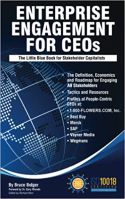
3. Books on implementation: Enterprise Engagement for CEOs and Enterprise Engagement: The Roadmap.
4. Advisory services and research: Strategic guidance, learning and certification on stakeholder management, measurement, metrics, and corporate sustainability reporting.
5. Permission-based targeted business development to identify and build relationships with the people most likely to buy.
Contact: Bruce Bolger at TheICEE.org; 914-591-7600, ext. 230.