

Reorganizations Work Best When Employees Help Design Them Not Just Endure Them
.jpeg) Traditional consulting-driven reorganizations often focus on structures, financials, and efficiency models developed by outside experts. Enterprise engagement offers a different path: start with a clear purpose, involve employees in defining solutions, and analyze findings against proven engagement and performance practices. The result is not only a smarter design but also stronger alignment, trust, and implementation.
Traditional consulting-driven reorganizations often focus on structures, financials, and efficiency models developed by outside experts. Enterprise engagement offers a different path: start with a clear purpose, involve employees in defining solutions, and analyze findings against proven engagement and performance practices. The result is not only a smarter design but also stronger alignment, trust, and implementation.By Gary Rhoads
Rhoads is the Academic Director of the Enterprise Engagement Alliance Impact Academy; Stephen Mack Covey Professor Emeritus, Marketing and Entrepreneurship, Marriott School of Business, Brigham Young University; Adjunct Professor, Marketing, Utah State University, and Chairman of Skavengerz, a consumer engagement app.
The Traditional Consulting Model
The Enterprise Engagement Approach
What the Engagement Process Looks Like
The Message Each Approach Sends
Better Decisions—and Better Execution
Organizations with a business operating system often require fewer or no reorganizations because change is built into day-to-day processes designed for continuous improvement. That said, dramatic changes in organizational size, finances, product or service offerings, the economy, etc. can mandate a dramatic need for change. The choice is often between hiring an outside consulting firm to determine the strategy or to proactively involve stakeholders in the process, hiring an outside consulting firm only to facilitate the process.
When organizations undertake a reorganization, the process often reveals as much about their leadership philosophy as it does about their structure. Is the goal simply to redesign reporting lines and processes as efficiently as possible? Or is it to create a system that aligns people, strategy, and culture to produce better results over time?
The difference often comes down to approach. Traditional management consulting models typically begin with outside experts analyzing structures, financial data, and processes to determine what the organization “should” look like. Enterprise engagement begins somewhere else entirely: by clearly defining the purpose, goals, objectives, and values driving the reorganization—and by involving employees and other stakeholders when appropriate in helping design the solution. That distinction can make all the difference in whether a reorganization produces lasting improvement or simply another round of disruption.
The Traditional Consulting Model .jpg)
The classic consulting-led reorganization follows a familiar pattern. An outside consulting firm is hired to evaluate the organization and recommend changes. Consultants conduct interviews with executives and selected employees, review financial and operational data, analyze organizational charts, and study existing processes. They may apply benchmarking, financial modeling, workflow analysis, and industry comparisons to identify inefficiencies. Tools such as span-of-control analysis, cost structure modeling, process mapping, and performance metrics help them determine where redundancies exist and how responsibilities should be redistributed. After gathering and analyzing information, the consulting team develops recommendations—often including a new organizational structure, revised reporting relationships, consolidated functions, and cost reductions.
From a purely analytical standpoint, this approach can be powerful. Consultants bring external expertise, structured methodologies, and experience across multiple industries. Their analysis can uncover inefficiencies that internal teams may overlook.
On the other hand, the process also sends an implicit message: that solutions are most likely to come from outside experts rather than from the people working inside the system every day. Employees may be interviewed, but their role is largely informational rather than participatory. The result can be recommendations that look compelling on paper yet fail to reflect the operational realities and cultural dynamics that determine whether change occurs.
Perhaps most importantly, buy-in can suffer. When employees feel that decisions have been made about them rather than with them, even well-designed changes may face resistance, skepticism, or passive noncompliance.
The Enterprise Engagement Approach
Enterprise engagement begins with a different premise: the people inside the organization are not just sources of data—they are essential partners in designing effective solutions. The process begins by clearly defining the purpose and goals of the reorganization. What problem is the organization trying to solve? Is it improving customer experience, accelerating innovation, reducing costs, adapting to market shifts, integrating new technologies, or figuring out how to reduce the workforce, if necessary, in the most sustainable way to ensure long-term recovery.
Equally important is clarifying the organization’s values. How should decisions reflect the company’s culture, mission, and long-term strategy? This clarity creates the foundation for a participatory process in which employees help identify problems, evaluate options, and shape solutions.
Outside expertise can still play an important role. Consultants or facilitators may guide the process, structure the analysis, and ensure that recommendations align with effective practices in organizational design and performance management. Rather than imposing solutions, they help the organization gather and analyze insights from the people who understand its operations best. In some cases, they can help objectively make the difficult decisions related to apply recommendations to actual layoffs, if necessary.
An enterprise engagement approach does not necessarily eliminate the need for layoffs, and no employee should be asked to sacrifice his or her job as part of a process, so an outside consultant can sometimes help make the final tough decisions.
When employees are involved in the transformation process, most undoubtedly will understand the need for the change and at least feel as if they were part of the process if the recommendations eliminate some jobs. Business and life for that matter often require painful tradeoffs.
What the Engagement Process Looks Like
An enterprise engagement approach to reorganization typically involves several stages. First, leadership defines and communicates the strategic purpose of the change. Transparency about why change is necessary helps reduce uncertainty and establishes trust. Next comes structured employee involvement. Cross-functional teams, surveys, workshops, and collaborative problem-solving sessions allow employees to identify inefficiencies, barriers, and opportunities.
Employees often know where processes break down, where decisions get delayed, and where resources are misallocated. They understand the informal networks and practical realities that formal organizational charts rarely capture. These insights are then analyzed against proven practices in organizational effectiveness, performance management, and engagement. The goal is not simply to collect opinions but to evaluate them through disciplined analysis.
Because employees participate in diagnosing problems and developing solutions, the resulting recommendations are often more practical and easier to implement. Just as important, employees feel ownership of the outcome.
In addition to facilitating an organized process, consultants can also ensure rigorous independent analysis of the recommendations, which includes asking good questions and at times making painful recommendations employees might be hesitant to make.
The Message Each Approach Sends
The two approaches also communicate very different messages. A consultant-driven reorganization suggests that the most reliable solutions come from external experts. While this may bring analytical rigor, it can unintentionally signal that internal knowledge and perspectives have less value.
The enterprise engagement approach communicates something else entirely: that employees and other stakeholders matter, that their insights are valuable, and that they are trusted partners in shaping the organization’s future. This message is not just symbolic. It has measurable implications for trust, motivation, and execution.
This research study and others suggest that people are far more committed to changes they help create. Participation builds understanding. Understanding builds trust. And trust accelerates implementation.
Better Decisions—and Better Execution
Reorganizations are often judged by the elegance of the design or the projected cost savings. But the real test is whether the new structure improves performance over time. That requires more than analysis. It requires alignment.
Enterprise engagement recognizes that organizational performance is driven not only by structures and processes but also by the people who operate them. When employees are involved in shaping change, organizations benefit from deeper insight, stronger commitment, and smoother implementation.
In other words, the most effective reorganizations are not just designed—they are co-created. And in an era when employees increasingly expect transparency, voice, and purpose in their work, that difference may determine whether a reorganization succeeds or struggles to take hold over the longer term.
Enterprise Engagement Alliance Services
 Celebrating our 17th year, the Enterprise Engagement Alliance helps organizations enhance performance through:
1. Information and marketing opportunities on stakeholder management and total rewards:
- ESM Weekly on stakeholder management since 2009. Click here to subscribe; click here for media kit.
- RRN Weekly on total rewards since 1996. Click here to subscribe; click here for media kit.
- EEA YouTube channel on enterprise engagement, human capital, and total rewards since 2020
 Management Academy to enhance future equity value for your organization.
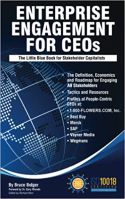
3. Books on implementation: Enterprise Engagement for CEOs and Enterprise Engagement: The Roadmap.
4. Advisory services and research: Strategic guidance, learning and certification on stakeholder management, measurement, metrics, and corporate sustainability reporting.
5. Permission-based targeted business development to identify and build relationships with the people most likely to buy.
Contact: Bruce Bolger at TheICEE.org; 914-591-7600, ext. 230.