

Pulse Experiential Travel Case Study: Building a Permission-Based Media Platform for Trust and Growth
.png) This case study illustrates a path to marketing efficiency and measurement popularized by the work of Seth Godin in the 1990s but rarely practiced: identifying and building relationships with the people most likely to buy. While marketing races ahead to chase the next bright shiny object, AI, this company builds its business by building relationships and helping, not selling.
This case study illustrates a path to marketing efficiency and measurement popularized by the work of Seth Godin in the 1990s but rarely practiced: identifying and building relationships with the people most likely to buy. While marketing races ahead to chase the next bright shiny object, AI, this company builds its business by building relationships and helping, not selling. By Bruce Bolger
A Holistic Marketing Philosophy
Precision-Based Audience Building
A Content Strategy Based on Helping, Not Boasting
Creating a Proprietary Media Channel
Measuring Engagement and Influence
Identifying the Most Engaged Relationships
Building Long-Term Trust
Lower Marketing Costs, Higher Strategic Value
Lessons for Business Development
Click here to subscribe to the ESM weekly e-newsletter.
Case studies provide the clearest way to learn from effective practices, but too often companies consider their strategies a competitive advantage and do not care to share them. Marc Matthews, Founder and CEO of Pulse Experiential Travel, agreed to share his strategy because, as he says, it’s easier said than done.
In an era when marketing costs continue to rise and buyers increasingly ignore promotional messaging, Pulse Experiential Travel has taken a different path. Rather than relying primarily on paid advertising, aggressive sales outreach, or trade-show promotion, the company has built what is effectively its own media platform—one rooted in a clear, audited business purpose statement, permission-based communication, thought leadership, helpful insights, consistent value creation for its audience, and metrics that track process and outcomes.
The result is a marketing program that minimizes costs and trade show logistics, deepens relationships with business decision-makers and influencers, and positions Pulse Experiential Travel as a trusted advisor and friend in the business rather than as simply another vendor hawking its products and services.
This case illustrates how a holistic, purpose-based, research-driven marketing strategy—combined with targeted personal relationship building and measurable engagement—can produce sustainable business development results and build the trust necessary to succeed in the travel industry.
For disclosure purposes: Pulse Experiential Travel is a client of the Enterprise Engagement Alliance’s engagement agency.
A Holistic Marketing Philosophy 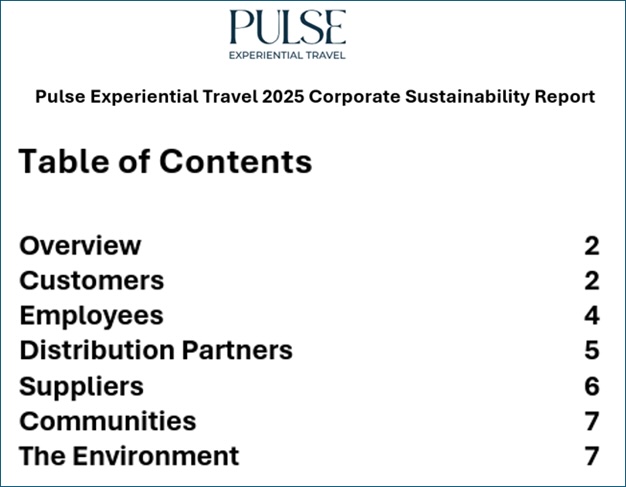
Pulse Experiential Travel’s marketing program begins with clarity of purpose: a focus on creating pre-curated bucket list and event experiences for the valued performers, customers, or other guests—usually for the participants in the incentive, recognition, and loyalty programs of its partners in the incentive, rewards, recognition, and marketing fields. It believes that travel can be a force for enhanced performance, personal discovery, and a way to spread prosperity to off-the-beaten track tourism locations. A family-run business, it aims to be a friend in the business to anyone seeking to gift or reward meaningful experiences to the people most important to their organizations or in their lives.
Because there is no seasonality to its business and no feasible way to know when a customer’s need might arise, Pulse Experiential Travel’s strategy is to demonstrate throughout the year its commitment to helping, not selling.
To clarify its principles, the company publishes a sustainability report that articulates its purpose, values, goals, and operational principles. While not subject to the EU Corporate Sustainability Reporting Directive, Pulse Experiential Travel opted to use its general framework, since many of its clients are large global organizations subject to the European Union law. Importantly, the report transparently outlines the opportunities and risks that the company’s services create for its key stakeholders—including customers, employees, distribution partners, supply chain partners, and the communities where events and travel programs take place.
This sustainability report, published on its web site, establishes a transparent framework for how Pulse Experiential Travel operates and signals that the company views business development as part of a broader system of responsibility and long-term relationship building. It gives all stakeholders a transparent way to evaluate its commitments.
Marketing, in this model, is not promotion. It is the outward expression of the company’s values and its commitment to being a trusted partner to clients by providing reliable information. Pulse Experiential Travel wants clients to trust that when they appear late at night at a beautiful hotel in an ancient historic city, they don't suddenly learn that it's a 100-yard walk up a steep hill to the entrance. Beyond sharing insights on all aspects of incentives, recognition, loyalty and travel, Matthews always makes time to share insights with the business media, such as his recent contributions to this article in Smart Meetings on the art to getting World Cup soccer tickets, his recent contribution to Enterprise Engagement Alliance YouTube shows on gift card effective practices and meaningful meetings formats, or this article last year in Sales & Marketing Management. Although most of the industry associations involve mostly other reward suppliers, Pulse Experiential Travel supports the Incentive Research Foundation, Incentive Marketing Association US, Incentive Marketing Association Europe, SITE, and Promotional Products Association, for sharing of effective practices and industry relationships.
Over the years, rather than broadcasting messages widely, Pulse Experiential Travel carefully identifies and cultivates relationships with the people most likely to benefit from its services and adds them to the company’s communication ecosystem through newsletters, social media connections, and personal interactions at industry events. The names of these people come from every possible touchpoint: anyone who can benefit from its services becomes a subscriber with the ability to opt-out in a second.
Each time the company participates in conferences, meetings, or other gatherings, the people it's team meets are invited into this communication network. Over time, this has created a highly relevant, engaged and audience the size of an average trade publication.
The mailing list itself is carefully segmented by customer type and prospect category. This segmentation allows messages to be tailored to different audiences, ensuring that content remains relevant rather than generic. The result is a communications environment in which the company speaks directly to the people most likely to benefit from its expertise.
A Content Strategy Based on Helping, Not Boasting .png)
Because Pulse Experiential Travel is a family business with a culture of direct connections, all content is selected and written by industry experts. AI is used to find the latest information and summarize it, but industry experts make the final selections and craft the text into useful snippets rather than sales pitches.
The tone of Pulse Experiential Travel’s communication strategy is deliberately different from traditional marketing. Rather than emphasizing promotional claims, the company’s newsletters and social media channels focus on helping its audience understand important trends shaping incentive travel, motivational events, and corporate recognition programs. This is especially helpful because many of the company’s customers are only involved with incentive, rewards and recognition planning a couple of times a year. Content frequently highlights:
- Relevant industry research
- Economic signals affecting incentive travel
- News and analysis from credible sources
- Reports from industry associations
- Thought leadership on the future of engagement and experiential rewards
- Useful information produced by others in the business
- Destination trends and insights and intriguing venues
- Special pricing from Pulse Experiential Travel on event tickets
In practice, this approach positions Pulse Experiential Travel as a friend in the business—a reliable and trusted source of information that helps clients and prospects make better decisions. Both the familiarity bred by regular communications and the focus on helping rather than selling increases the chance that Pulse Experiential Travel will get the call when someone is in need of experiential rewards or tickets to even the most coveted events on short notice. With little seasonality in this business, it’s critical to have built a relationship with a prospect long before they seek to buy.
Creating a Proprietary Media Channel
Over time, Pulse Experiential Travel’s communication ecosystem has become more than a marketing tool. It has evolved into what is essentially its own proprietary media platform, an increasingly valuable asset it owns. Through its newsletters and LinkedIn presence, the company communicates directly with thousands of professionals in the incentive travel and corporate engagement ecosystem each month in a highly measurable way.
This strategy dramatically reduces dependence on external media channels or paid advertising, or even on Linkedin, whose algorithms do not reliably deliver the posts to all followers. Instead of renting attention through advertising, Pulse owns a direct communication channel with its audience through email with highly trackable open rates and other data it owns.
This shift represents a powerful structural advantage: the company can continuously educate, inform, and engage prospects at minimal incremental cost with no dependencies on third-party social or related platforms.
Measuring Engagement and Influence .png)
Another defining characteristic of Pulse Experiential Travel’s marketing program is its emphasis on measurable engagement. The company’s communication platforms, enhanced with AI, generate a rich set of analytics. LinkedIn provides detailed metrics on how many and who engage by type of content:
- View posts
- Like content
- Comment
- Share information
- Pulse newsletters typically achieve open rates between 20% and 30%, with click rates of up to 7–8%.
- Engagement is substantial in absolute numbers. Newsletter campaigns routinely generate 3,000–4,000 unique readers per send, with peaks exceeding 5,000 readers during periods of heightened interest.
- Even more important, the audience includes a significant number of senior corporate leaders.
- Analysis of newsletter readers shows that more than 3,300 executives, vice presidents, and C-level leaders opened at least one campaign a month, demonstrating that the communication channel reaches high-level decision makers.
Identifying the Most Engaged Relationships
- Because Pulse Experiential Travel tracks both LinkedIn engagement and newsletter readership, it can identify its most engaged audience members with remarkable precision.
- The company can overlay its customer list, LinkedIn connections with its newsletter subscriber list to identify correlations of customers and communications engagement.
- These individuals represent the core of Pulse Experiential Travel’s relationship network—professionals who repeatedly read, share, and interact with the company’s content.
- In addition, the active communications list can be compared directly with the customer list to identify overlap between existing clients and highly engaged prospects.
- The company can identify the types of topics that get the most engagement with the targeted audience.
- This creates a powerful feedback loop: marketing communications continuously reveal which individuals are most interested in the company’s insights and services.
Building Long-Term Trust
One of the most rewarding outcomes of this strategy is qualitative rather than quantitative. At industry events, Pulse Experiential Travel management frequently encounters professionals who approach the company to comment on the quality and usefulness of its newsletters and research summaries.These conversations illustrate the real value of the strategy: the company has become a trusted source of industry intelligence. Instead of cold introductions, business development conversations often begin with familiarity and credibility. Prospects already know the company, trust its insights, and view it as a thought leader, making it more likely Pulse Experiential Travel will get the call when those coveted World Cup tickets are sought this summer.
Lower Marketing Costs, Higher Strategic Value
- By cultivating its own communication ecosystem, Pulse Experiential Travel has dramatically reduced traditional marketing costs, especially costly trade shows.
- Rather than paying for attention through extensive advertising or sponsorships, the company has built its own subscription list of professionals who have voluntarily chosen to receive its content. This is the essence of permission-based marketing.
- Because the audience has opted in to receive information, the company’s messages arrive in a context of trust rather than interruption.
- Over time, this approach has helped effectively transformed Pulse Experiential Travel into a small but highly focused media company of its own right—one that communicates directly with its most valuable audience segments.
Lessons for Business Development
The Pulse case demonstrates several important principles for modern B2B business development:
- Permission beats interruption. When audiences voluntarily subscribe to useful content, engagement and trust increase dramatically.
- Thought leadership builds credibility. Research, analysis, and industry insights generate far more engagement than promotional messaging.
- Segmentation improves relevance. Targeted content increases the likelihood that messages will resonate with the right audience.
- Owned media reduces marketing costs. Direct communication channels eliminate reliance on expensive external platforms.
- Authenticity is a differentiator. People know AI and marketing speak when they see it. Every word Pulse Experiential writes is selected and finalized by the hand of a human and is always designed to help and inform, not hype or boast.
- Measurement strengthens relationships. Engagement analytics reveal which individuals are most interested in the company’s insights and services.
The result is a sustainable marketing model and a valuable asset based on permission, insight, and long-term relationship building. In a marketplace increasingly saturated with promotional noise, Pulse Experiential Travel’s approach offers a compelling reminder: the most effective marketing often begins with simply being useful.
Enterprise Engagement Alliance Services
 Celebrating our 17th year, the Enterprise Engagement Alliance helps organizations enhance performance through:
1. Information and marketing opportunities on stakeholder management and total rewards:
- ESM Weekly on stakeholder management since 2009. Click here to subscribe; click here for media kit.
- RRN Weekly on total rewards since 1996. Click here to subscribe; click here for media kit.
- EEA YouTube channel on enterprise engagement, human capital, and total rewards since 2020
 Management Academy to enhance future equity value for your organization.
3. Books on implementation: Enterprise Engagement for CEOs and Enterprise Engagement: The Roadmap.
4. Advisory services and research: Strategic guidance, learning and certification on stakeholder management, measurement, metrics, and corporate sustainability reporting.
5. Permission-based targeted business development to identify and build relationships with the people most likely to buy.
Contact: Bruce Bolger at TheICEE.org; 914-591-7600, ext. 230.