

Why I’ve Joined the Enterprise Engagement Alliance Academy Team as Chief Analytics Advisor
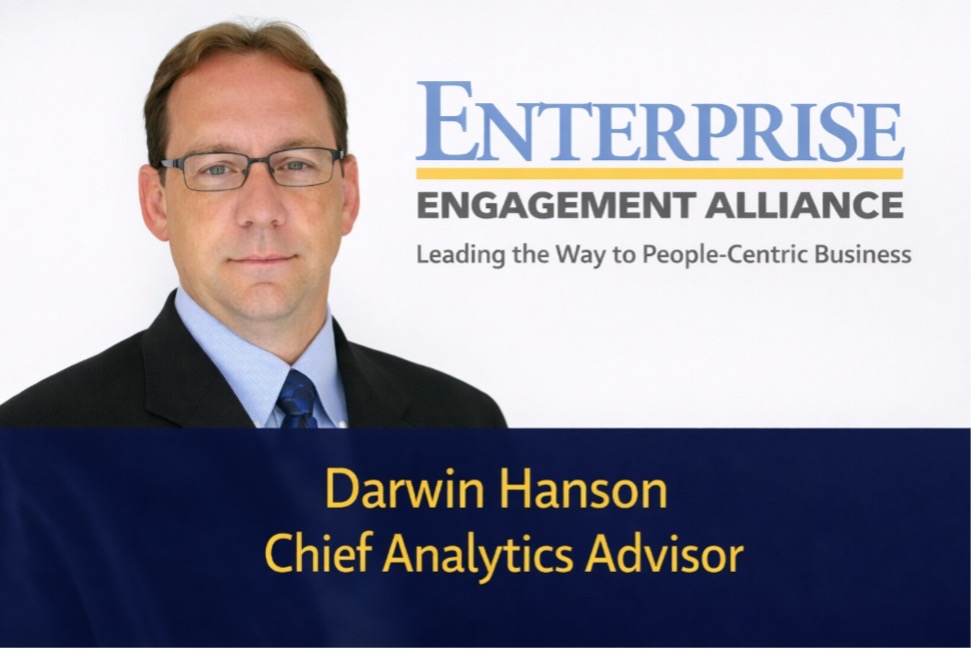 By Darwin Hanson
Chief Analytics Advisor, Enterprise Engagement Alliance; President and CEO at Talent Management Evolution, and CEO of the International Center for Enterprise Engagement.
Engagement Is a System, Not a Silo
When “Impact” Becomes a Buzzword
Bringing Human Capital Analytics to Engagement
The People Value Impact Calculator
Why Measurement Matters Now
Advancing a More Scientific Approach to Engagement
Click here to subscribe to the ESM weekly e-newsletter.
Just when the human resources field appears to be walking away from the need to foster the proactive involvement of all employee and other stakeholders, I believe the time has come to double-down on the topic. Employee and customer engagement levels are near record lows, and it's now more possible than ever to measure the actual waste and opportunities involved with people management.
For most of my career working in compensation strategy and human capital analytics, I have focused on a fundamental question: How do organizations measure the real value created by investments in people?
Companies spend enormous resources in employees, customers, channel partners, and other stakeholders. They fund recognition programs, engagement initiatives, customer loyalty strategies, leadership development, and culture-building activities, almost all of it carried as an expense on their books not as an investment. Yet despite the scale of these expenditures, organizations often struggle to answer a simple question: What measurable value do these efforts actually create? You won't find the answers in most financial reporting.
That question is what led me to join the Enterprise Engagement Alliance (EEA) Academy team as Chief Analytics Advisor, along of course with my current roles as CEO of Talent Management Evolution, my compensation firm, and of the International Center of Enterprise Engagement, in which I have acquired an interest to help clients and solution providers implement metrics long proven in total quality management to continuously improve performance.
The EEA has long been one of the few if only organizations advocating for a systematic, enterprise-wide approach to engaging people across the entire stakeholder ecosystem—employees, customers, distribution partners, and communities. What drew me to the organization is its recognition that engagement is not just about internal culture; it is about the entire value chain of relationships that drive enterprise performance.
Engagement Is a System, Not a Silo
In many organizations, engagement strategies are fragmented. Employee engagement sits in HR. Customer engagement sits in marketing. Channel programs sit in sales. Events and recognition programs operate somewhere in between. Culture may rest in the hands of one team; training in another; communications perhaps in multiple teams; job design somewhere else; rewards and recognition in another office, divided by sales and non-sales employees; finance and marketing almost a world apart.
But from a value-creation perspective, these are not separate systems. They are all part of the same equation: how effectively an organization engages the people who create its value.
Internal engagement influences employee performance, innovation, and retention. External engagement influences customer loyalty, partner performance, and brand trust. These forces reinforce one another. Organizations with highly engaged employees often deliver better customer experiences. Companies that understand their customers deeply are better able to motivate employees around meaningful outcomes. Yet despite this interconnected system, measurement often remains fragmented.
When “Impact” Becomes a Buzzword
Over the past decade, the word impact has become an increasingly popular term across corporate communications, ESG reporting, and engagement programs. But as I’ve written elsewhere, there is an important difference between real impact measurement and marketing language. True impact measurement requires the ability to connect investments in people to measurable outcomes—financial performance, productivity, retention, customer experience, or long-term enterprise value.
Too often, organizations rely on proxy indicators: survey scores, participation levels, or anecdotal feedback. While those indicators can be useful, they do not always tell us whether a program changed behavior or improved performance. Worse yet, often organizations do not even know what to do or act upon the surveys, because it isn't always clear who is in charge of addressing issues that often traverse silos. This is the measurement and implementation gap that has interested me throughout my career.
Bringing Human Capital Analytics to Engagement 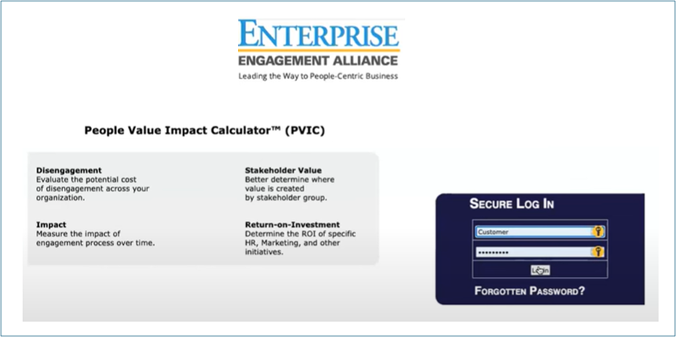
Through my work at TM Evolution, I have spent many years helping organizations analyze compensation structures, workforce data, and leadership effectiveness to better understand how human capital decisions influence business outcomes. Compensation professionals, in particular, have long relied on analytics and modeling to determine how incentives influence behavior. That discipline—linking people investments to measurable outcomes—is something the broader engagement industry increasingly needs.
The Enterprise Engagement Alliance is uniquely positioned to advance this conversation because its framework looks at engagement across the entire stakeholder ecosystem. Employees, customers, and partners are not independent variables. They are interconnected drivers of enterprise value.
The People Value Impact Calculator
One of the reasons I chose to work closely with the EEA is the opportunity to expand the the use of a platform that makes it easy to important and correlate data from across the enterprise.
The People Value Impact Calculator (PVIC) helps organizations better understand how investments in people translate into measurable outcomes. The platform allows organizations to analyze relationships between:
- Workforce engagement
- Customer and partner relationships
- Engagement activities
- External market data
- Financial performance
- Organizational productivity and growth
Why Measurement Matters Now
The need for credible measurement has never been greater. Investors, regulators, and stakeholders are increasingly focused on human capital risks, opportunities, and disclosures, ESG performance, and workforce transparency. At the same time, organizations themselves are recognizing that the quality of relationships—with employees, customers, and partners—has a profound influence on long-term success. Yet many organizations still lack practical tools to measure, let alone management, these relationships in a meaningful way. If engagement is truly a strategic driver of enterprise performance, then it must be treated with the same management discipline and analytical rigor applied to finance, operations, and supply chains.
Advancing a More Scientific Approach to Engagement
My role with the Enterprise Engagement Alliance Academy is to focus on helping advance that analytical discipline. This includes contributing to research, thought leadership, and tools that help organizations better measure the outcomes of their engagement strategies—across employees, customers, and partners.
The goal is not to reduce engagement to spreadsheets. The goal is to ensure that organizations understand how relationships with people create measurable enterprise value. Because at the end of the day, organizations do not succeed solely because of strategy, technology, or capital. They succeed because of the people who believe in their mission, deliver value to customers, and build trust across the marketplace. Understanding—and measuring—that value is one of the most important management challenges of our time. That is why I am excited to work with the Enterprise Engagement Alliance to help advance the field of impact measurement in enterprise engagement.
Enterprise Engagement Alliance Services
 Celebrating our 17th year, the Enterprise Engagement Alliance helps organizations enhance performance through:
1. Information and marketing opportunities on stakeholder management and total rewards:
- ESM Weekly on stakeholder management since 2009. Click here to subscribe; click here for media kit.
- RRN Weekly on total rewards since 1996. Click here to subscribe; click here for media kit.
- EEA YouTube channel on enterprise engagement, human capital, and total rewards since 2020
 Management Academy to enhance future equity value for your organization.
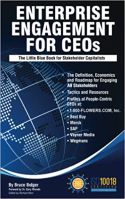
3. Books on implementation: Enterprise Engagement for CEOs and Enterprise Engagement: The Roadmap.
4. Advisory services and research: Strategic guidance, learning and certification on stakeholder management, measurement, metrics, and corporate sustainability reporting.
5. Permission-based targeted business development to identify and build relationships with the people most likely to buy.
Contact: Bruce Bolger at TheICEE.org; 914-591-7600, ext. 230.