

Companies Still Miss an Obvious Path to Growth: Connecting Customer and Employee Experience
An Ongoing Source of Waste
Addressing the Silo Challenge
The Often Overlooked Need to Connect Impact Data
Has HR Moved Beyond the Topic of Engagement?
Click here to subscribe to the ESM weekly e-newsletter. WorkProud is a featured sponsor of this show and article.
.jpg) business is the systematic connection between what happens inside an organization and how customers experience it. This recent YouTube discussion addresses the opportunity and what it takes to address it.
business is the systematic connection between what happens inside an organization and how customers experience it. This recent YouTube discussion addresses the opportunity and what it takes to address it.Click here to watch or listen to the show for the full insights.
Guests are Gary Rhoads, PhD, Academic Director, Enterprise Engagement Alliance Academy, Professor Emeritus, Marketing and Entrepreneurship, Marriott School of Business, Brigham Young University; and Dave Ulrich, PhD, Rensis Likert Professor, Ross School of Business, University of Michigan, and Co-founder and Principal, The RBL Group, an advisory firm focused on what Ulrich calls stakeholder HR and the EEA calls stakeholder management. The host is Bruce Bolger, Founder of the Enterprise Engagement Alliance and Impact Academy.
Click here for a recent article in RRN on practical ways to holistically use engagement processes to make the CX-EX connection in your organization.
An Ongoing Source of Waste
Rhoads makes the case that organizations continue to underperform not because they lack strategies or initiatives, but because they fail to align employee experience with customer outcomes. According to Ulrich, the issue is not awareness—most leaders agree that people matter—but execution. According to Rhoads, companies often try to fix customer problems externally when the root causes are internal. Both emphasized that progress depends on fostering the proactive involvement of all stakeholders on the needs of the customer (external and internal) and measuring what truly drives customer value. The research behind this connection is well established.
As Ulrich noted, decades of data show a strong relationship between employee engagement and customer engagement, particularly at the frontlines. Customers do not experience strategies or organizational charts—they experience people. The quality of interactions with employees remains one of the most powerful drivers of customer perception, loyalty, and growth. Rhoads reinforces this from the customer side. According to Rhoads, organizations frequently invest in customer-facing tactics—promotions, messaging, loyalty programs—without addressing the internal conditions shaping those interactions. Leadership quality, work environment, recognition, and operational friction all influence how employees behave, and those behaviors ultimately define the customer experience. In many cases, declining customer satisfaction can be traced back to issues inside the organization rather than outside it.
Addressing the Silo Challenge
A central challenge is that companies continue to operate in silos. CX is often managed by marketing or customer experience teams, while EX sits within
 HR. Operations, finance, and other functions pursue their own priorities and metrics. According to Ulrich, this fragmented approach limits impact because customer outcomes are shaped across the entire enterprise. A billing process, a delivery system, or a service interaction can each influence trust and loyalty, yet they are rarely managed as part of a unified experience.
This is why he is such an advocate for what he calls stakeholder HR. Strategic HR looks in the mirror and aligns people to the business strategy. Stakeholder HR looks out the window—to customers, investors, and communities—and builds the organization to deliver value to them. That’s the shift that matters...Strategic HR helps execute the strategy. Stakeholder HR starts with the customer and asks: what do we need inside the company to get them to buy, stay, and trust us?”
Ulrich argues that organizations must move beyond traditional approaches to HR and adopt a broader, stakeholder perspective. Rather than focusing only on internal alignment, leaders should look outward—understanding what customers, investors, and communities expect—and then design internal systems accordingly. In this view, employees are not simply the company’s most important asset; they are the customer’s most important asset. How they are managed, supported, and engaged directly affects whether customers choose to buy, stay, or leave.
The Often Overlooked Need to Connect Impact Data
Rhoads reached a similar conclusion through his work in customer engagement. According to Rhoads, companies that successfully improve customer outcomes tend to connect internal and external data—linking employee engagement, management effectiveness, and workplace conditions to customer satisfaction, loyalty, and share of wallet. Without that connection, organizations tend to optimize around the wrong variables.
Measurement remains a significant barrier. According to Ulrich, organizations often measure what is easy rather than what is meaningful—tracking training hours, participation rates, or survey scores without understanding their impact on customer behavior or financial performance. Rhoads noted that unless companies explicitly link employee metrics to customer outcomes, they will continue to underinvest in the factors that matter most.
What about the role engagement—not as a standalone initiative, but as a system? Both speakers emphasize that engagement becomes invaluable when it aligns people with purpose, clarifies how their roles affect internal and/or external customers, and reinforces behaviors that drive results. That requires more than communication, rewards, recognition, loyalty programs, etc. It requires systems that enable people to contribute, recognition that reinforces the right actions, and leadership that connects daily work to meaningful outcomes.
Has HR Moved Beyond the Topic of Engagement?
Fostering the proactive involvement of all stakeholders becomes foundational when an organization moves to stakeholder HR, the speakers note. Customers define the needs and desires--employees, managers, and functions across the enterprise must understand how their actions influence the customer experience (internal or external) and be equipped to act accordingly. Passive alignment is not enough. Performance improves when people are actively involved in delivering on the organization’s value proposition.
The implications are particularly relevant for organizations investing in learning, communications, incentives, meetings, events, recognition, and engagement initiatives, or in customer promotions, loyalty, and pricing, etc. Without a clear connection to stakeholder interests and desired outcomes, these efforts risk becoming tactical rather than strategic. When aligned with customer and employee experience, however, they can play a critical role in reinforcing purpose, building trust, and driving behavior. Under their reasoning, customer loyalty programs will have far greater impact if they are based on what the customer truly wants across the board, and if the employees passionately reinforce that at any point of contact and continually report back on customer requests.
The gap between CX and EX is no longer a theoretical issue, the panelists agree. It represents a measurable source of lost value—and a significant opportunity for organizations willing to address it.
As Ulrich suggested, the question is not whether engagement, learning, recognition, culture, or experience, loyalty, or promotions matter. The question is whether the organization is designed to align those concepts toward customer value in a measurable way.
Until systems and metrics are built to focus on customers, CX and EX will remain parallel efforts. When they come together, CX and EX become a single, integrated strategy for sustainable performance, the panelists agree.
Enterprise Engagement Alliance Services
 Celebrating our 17th year, the Enterprise Engagement Alliance helps organizations enhance performance through:
1. Information and marketing opportunities on stakeholder management and total rewards:
- ESM Weekly on stakeholder management since 2009. Click here to subscribe; click here for media kit.
- RRN Weekly on total rewards since 1996. Click here to subscribe; click here for media kit.
- EEA YouTube channel on enterprise engagement, human capital, and total rewards since 2020
 Management Academy to enhance future equity value for your organization.
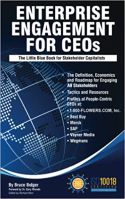
3. Books on implementation: Enterprise Engagement for CEOs and Enterprise Engagement: The Roadmap.
4. Advisory services and research: Strategic guidance, learning and certification on stakeholder management, measurement, metrics, and corporate sustainability reporting.
5. Permission-based targeted business development to identify and build relationships with the people most likely to buy.
Contact: Bruce Bolger at TheICEE.org; 914-591-7600, ext. 230.