

Engagement Won't Become a Movement Until the Waste Hits the Bottom Line
Economics, Not Evidence, Drives Change
Engagement Management Fails When Treated as a Program
The Tipping Point Will Come from Competition
Click here to subscribe to the ESM weekly e-newsletter.
.jpeg) From the outset, Thomas Bertels frames the paradox. “Decades of research have shown again and again that engagement matters,” he notes, pointing to its links to productivity, retention, and profitability. Yet, unlike Total Quality Management (TQM), engagement has never become a true organizational movement. Why?
From the outset, Thomas Bertels frames the paradox. “Decades of research have shown again and again that engagement matters,” he notes, pointing to its links to productivity, retention, and profitability. Yet, unlike Total Quality Management (TQM), engagement has never become a true organizational movement. Why?Bolger’s answer is direct: “At the end of the day,” he says, “what really moved the needle… was competition… economics is what drove it.” Bruce Bolger is Founder of the Enterprise Engagement Alliance and Impact Academy. Thomas Bertels is Founder and Principal of Purpose Works Consulting, which focuses on helping organizations design more meaningful jobs. He also hosts a podcast series, Work Matters.
.jpeg) Click here to watch or listen to the show.
Click here to watch or listen to the show. Economics, Not Evidence, Drives Change
Looking back at the rise of TQM, Bolger argues that its success was not driven by ideals about quality, but by hard market realities. The turning point came when Japanese manufacturers outperformed their Western counterparts so decisively that poor quality became financially and competitively untenable.
“If the Japanese had not employed TQM as rigorously as they did,” he says, “we’d still be here today with piles of defects… and dissatisfied customers.” Engagement, by contrast, lacks that same urgency. While Gallup global estimates point to trillions in lost productivity, most companies fail to quantify the cost within their own operations. “Companies don’t see what it’s costing them,” Bolger explains. Almost no one is measuring the waste on their own organizations, he says.
Bertels underscores the contrast. Quality management made waste visible through clear methodologies like the cost of poor quality. Engagement has no equivalent discipline. As a result, even compelling data linking engagement to performance remains too abstract to spur action.
“I don’t think there are many CEOs out there who knows what human capital ROI is or its significance to future equity value creation,” Bolger adds, highlighting how little the language of people economics has penetrated executive decision-making.
Engagement Management Fails When Treated as a Program 
The discussion turns to the proliferation of engagement tools—recognition and incentive platforms, surveys, and nudging technologies. Bertels asks whether these offer a shortcut around the harder work of redesigning jobs and culture. Bolger is clear: they do not. “These technologies are amazing,” he says, “but they fail when they’re ad hoc.” Without a coherent system—clear purpose, aligned stakeholders, defined metrics, and accountability—technology becomes just another “bright, shiny object.” Companies end up managing programs rather than improving performance.
For Bolger, engagement must be understood as an operating system, not an initiative. It begins with defining purpose and goals, extends to aligning the interests of all stakeholders, and requires mechanisms—both top-down and bottom-up—to sustain it. “A lot of the employees know how to make the job better,” he notes, pointing to the importance of structures akin to quality circles that enable frontline problem-solving.
Both men return repeatedly to job design as a missing piece. “Recognition programs are not going to help you if people are doing a horrendous, tedious job every day,” Bolger adds, emphasizing that engagement cannot compensate for poorly designed work. “Meaningful work is one of the biggest rewards.”
The Tipping Point Will Come from Competition
Despite the slow progress, both Bertels and Bolger see signs that engagement may yet follow the path of TQM. Bolger points to industries where companies that better align stakeholder interests are beginning to outperform competitors. “When companies begin to see it as a competitive threat,” he says, “that’ll be a factor.”
He also highlights broader forces that could accelerate the shift: growing skepticism toward traditional capitalism, rising transparency, and the amplifying effects of AI and social media. “AI… enables people to get incredible information on companies real fast,” he observes. “There’s little lag.” Likewise, such technology is making it easier to calculate the waste.
Bertels suggests that engagement, like just-in-time manufacturing before it, may simply be counterintuitive—slower to take hold of but powerful once adopted. Bolger agrees, returning to his central thesis: economics will ultimately decide. “Driving change at the end is competition,” he says, and “the bottom line.” Until companies can see—and feel—the financial impact of disengagement as clearly as they once saw the cost of poor quality, engagement will remain on the margins. But once that visibility arrives, history suggests the shift could be both rapid and transformative.”
Enterprise Engagement Alliance Services
 Celebrating our 17th year, the Enterprise Engagement Alliance helps organizations enhance performance through:
1. Information and marketing opportunities on stakeholder management and total rewards:
- ESM Weekly on stakeholder management since 2009. Click here to subscribe; click here for media kit.
- RRN Weekly on total rewards since 1996. Click here to subscribe; click here for media kit.
- EEA YouTube channel on enterprise engagement, human capital, and total rewards since 2020
 Management Academy to enhance future equity value for your organization.
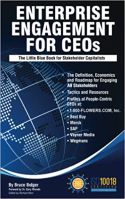
3. Books on implementation: Enterprise Engagement for CEOs and Enterprise Engagement: The Roadmap.
4. Advisory services and research: Strategic guidance, learning and certification on stakeholder management, measurement, metrics, and corporate sustainability reporting.
5. Permission-based targeted business development to identify and build relationships with the people most likely to buy.
Contact: Bruce Bolger at TheICEE.org; 914-591-7600, ext. 230.