

Europe’s Unspoken Engagement Crisis: Only 13% of Employees Engaged—And Customers Aren’t Much Better
.jpeg) New global workplace research from Gallup confirms that employee engagement in Europe has fallen to crisis levels, with just 13% of workers engaged. At the same time, available customer data suggests satisfaction remains moderate but lacks true loyalty—highlighting a broader failure to systematically design and measure stakeholder engagement across organizations in Europe; this, despite the continent’s commitment to well-being and quality of life.
New global workplace research from Gallup confirms that employee engagement in Europe has fallen to crisis levels, with just 13% of workers engaged. At the same time, available customer data suggests satisfaction remains moderate but lacks true loyalty—highlighting a broader failure to systematically design and measure stakeholder engagement across organizations in Europe; this, despite the continent’s commitment to well-being and quality of life. By Bruce Bolger
Enterprise Engagement Alliance Founder
Engagement Stagnation Despite Years of Investment
A Parallel Story: Customers Are “Satisfied Enough,” Not Loyal
A Broader Failure of System Design
The Implication: Engagement Requires a System; Wellbeing Is Not Enough
Click here to subscribe to the ESM weekly e-newsletter.
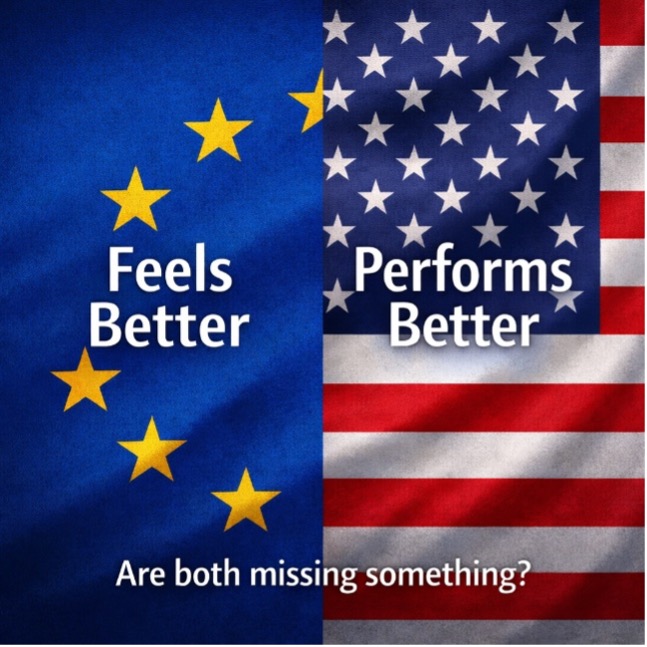 Europe is confronting a growing and largely unaddressed engagement gap—one that extends beyond employees to customers and, ultimately, organizational performance.
The latest Gallup 2026 global workplace findings show that only about 13% of employees in Europe are engaged, the lowest of any major region. That compares with a global average of 21% and roughly 31% in the US, underscoring a significant regional disparity. More concerning, engagement is not only low but trending downward, reflecting a persistent inability to translate decades of investment into measurable improvement.
The 2024 Draghi Report on European Competitiveness overwhelmingly focused on economic and structural diagnosis, making little other reference to people other than identifying low productivity, stagnation and weak innovation in the European Union in comparison with the US.
At the same time, while Europe lacks a single unified measure of customer satisfaction comparable to the American Customer Satisfaction Index, available national benchmarks and proxy measures suggest a similar pattern as in the US. Most customer satisfaction scores across major European economies cluster in the 70–77 range out of 100, indicating that customers are generally “satisfied” at best, but far from loyal or emotionally engaged. Net Promoter Scores across key industries often hover near neutral, with as many detractors as promoters. These scores mirror those in the US.
Together, these data points point to a broader structural issue: both employees and customers in Europe appear to be passively satisfied—but not actively engaged in a land where societal benefits in terms of health care, food safety, and work-life balance far surpass that of the US.
Engagement Stagnation Despite Years of Investment
According to the latest Gallup study, globally, only 21% of employees are engaged, down from 23% the prior year, marking one of the few declines in more than a decade. Meanwhile, 62% of employees are not engaged and 17% are actively disengaged—meaning they are psychologically detached and potentially counterproductive.
The findings highlight a persistent paradox: engagement is widely recognized as critical to performance yet remains stubbornly low. The data suggest that traditional programmatic approaches—perks, recognition initiatives, and periodic surveys—have not addressed the root causes.
In Europe, where engagement levels are lowest, the issue appears even more systemic. The gap between rising employee expectations and organizational capability to meet them is widening, particularly in areas such as leadership effectiveness, workplace design, and career development.
A Parallel Story: Customers Are “Satisfied Enough,” Not Loyal 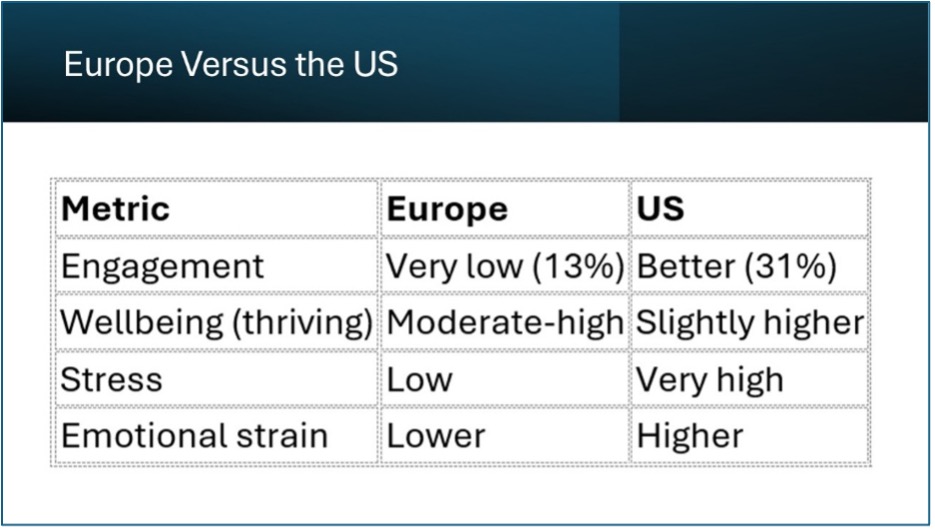
The customer side of the equation tells a strikingly similar story. While Europe does not have a single standardized index, national measures such as the UK Customer Satisfaction Index and Nordic barometers consistently show mid-70s satisfaction scores. On the surface, this appears healthy. However, deeper analysis reveals a lack of strong advocacy or emotional connection.
Net Promoter Score benchmarks across Europe reinforce this point:
- Many industries fall between -10 and +20, indicating weak loyalty
- High advocacy scores (above +50) are rare
A Broader Failure of System Design
Taken together, the data suggests that Europe’s engagement challenge is not isolated to HR or customer experience functions. Instead, it reflects a broader issue similar to that of the US: the absence of a consistent, systematic approach to managing stakeholder engagement as a core business process. Both employee and customer metrics show:
- Moderate baseline satisfaction
- Low emotional commitment
- Limited linkage to measurable business outcomes
The Implication: Engagement Requires a System; Wellbeing Is Not Enough
The findings reinforce a critical conclusion: incremental improvements and isolated initiatives are unlikely to reverse current trends and are not directly related to employee well-being.
The situation in Europe suggests it’s entirely possible for high levels of wellbeing to coexist with—and even inadvertently contribute to—lower engagement. Wellbeing in much of Europe often reflects strong social safety nets, work-life balance, and lower stress, which are undeniably positive. But engagement is not about comfort; it’s about emotional commitment, sense of purpose, and proactive involvement in achieving goals. When systems emphasize stability and security without equally emphasizing performance alignment, accountability, and shared purpose, people may feel satisfied but not compelled to go above and beyond. In contrast, environments with higher pressure—like parts of the US—can sometimes generate higher engagement through urgency and incentives, even if wellbeing suffers. In short, wellbeing answers “How do people feel?” while engagement answers “What are people driven to do?” Without a system that actively aligns people to meaningful goals and outcomes, high wellbeing alone does not translate into high engagement.
Instead, organizations may need to adopt a more systemic approach—one that integrates:
- Leadership capability and accountability
- Workplace and customer experience design
- Continuous measurement tied to business outcomes
Until engagement is treated as a structured, measurable process rather than a series of initiatives, both employee and customer metrics are likely to remain stuck in the same range.
Enterprise Engagement Alliance Services
 Celebrating our 17th year, the Enterprise Engagement Alliance helps organizations enhance performance through:
1. Information and marketing opportunities on stakeholder management and total rewards:
- ESM Weekly on stakeholder management since 2009. Click here to subscribe; click here for media kit.
- RRN Weekly on total rewards since 1996. Click here to subscribe; click here for media kit.
- EEA YouTube channel on enterprise engagement, human capital, and total rewards since 2020
 Management Academy to enhance future equity value for your organization.
3. Books on implementation: Enterprise Engagement for CEOs and Enterprise Engagement: The Roadmap.
4. Advisory services and research: Strategic guidance, learning and certification on stakeholder management, measurement, metrics, and corporate sustainability reporting.
5. Permission-based targeted business development to identify and build relationships with the people most likely to buy.
Contact: Bruce Bolger at TheICEE.org; 914-591-7600, ext. 230.