

Why Leadership Training Is Not Moving the Needle on Engagement The Missing System Behind Record Low Results
.jpeg) After decades of investment in leadership training, coaching, and engagement initiatives, employee engagement remains stubbornly low. The research doesn’t suggest a lack of effort or even understanding. It points instead to something more fundamental: the absence of a systematic approach to managing people, comparable to what Total Quality Management does for quality.
After decades of investment in leadership training, coaching, and engagement initiatives, employee engagement remains stubbornly low. The research doesn’t suggest a lack of effort or even understanding. It points instead to something more fundamental: the absence of a systematic approach to managing people, comparable to what Total Quality Management does for quality.By Bruce Bolger
A Look at What Works: Total Quality Management
Moving From Ad Hoc to Strategic
Click here to subscribe to the ESM weekly e-newsletter.
It is one of the more puzzling contradictions in modern management. Organizations have never invested more in leadership development. Coaching, training, culture initiatives, and employee experience programs have become standard practice fueling an enormous industry of consultants, speakers, authors, etc. And yet, engagement—arguably the most important leading indicator of performance—continues to struggle.
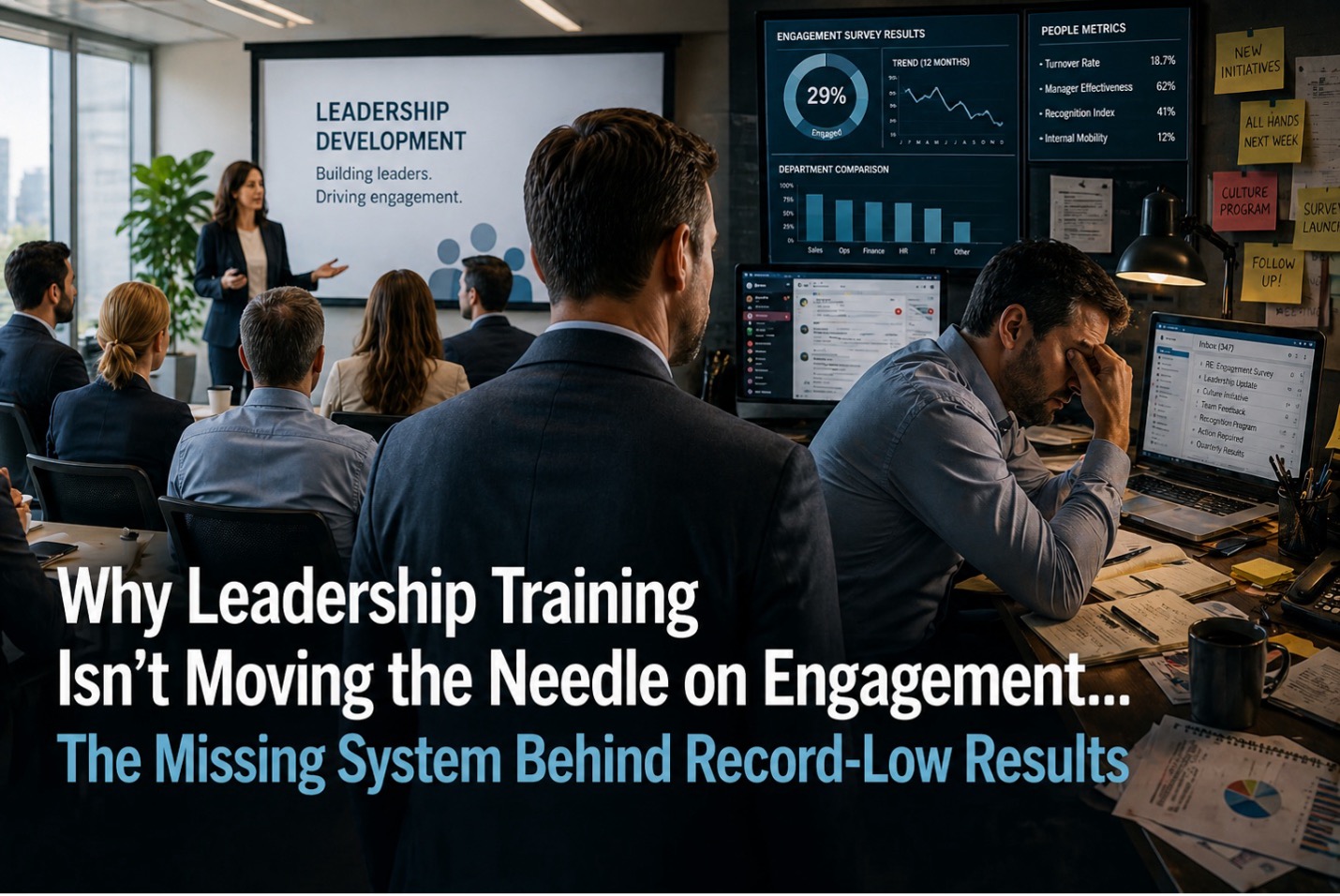
According to Gallup, US employee engagement recently fell to a 10-year low, with only about a third of employees actively engaged at work. Globally, the numbers are even more sobering, hovering near 20% and as low as 13% in Europe. What makes this more striking is not just the low level of engagement, but the trajectory: these declines come after years of increased focus on leadership capability and workplace culture.
The natural assumption is that organizations simply haven’t done enough leadership training, incentive, recognition, communications, or other programs. But the evidence suggests something else. Research consistently shows that companies understand the importance of engagement, measure it frequently, and invest heavily in improving it. The problem is not awareness. It is translation into effective practices.
A growing body of work—from McKinsey & Company to MIT Sloan Management Review—points to a common pattern: leadership development efforts often fail to produce sustained results because they are not embedded in the way organizations actually operate. Training, incentives, recognition, communications, etc. change what people know and do, but systems determine the focus of their attention. When the engagement efforts are misaligned, behavior inevitably reverts.
This helps explain why managers, who are widely recognized as the single biggest driver of engagement, often struggle to apply what they’ve learned about leadership to practical management. Gallup’s research has repeatedly found that managers can become barriers rather than enablers when they lack the structure, tools, and reinforcement to support development. In effect, they are being asked to lead differently inside systems that reward the same old behaviors.
A Look at What Works in Total Quality Management
To understand the gap, it is useful to step outside the human resources domain to see what has worked elsewhere. When organizations sought to improve quality in the late 20th century, they did not rely on training alone. They adopted systems such as Total Quality Management—approaches that embedded continuous improvement, measurement, and accountability into everyday operations. Companies like Toyota and Motorola did not treat quality as a program. They treated it as a process, supported by data, aligned incentives and engagement activities, and organization-wide discipline.
People management, by contrast, is still largely ad hoc and programmatic. Leadership courses are delivered; surveys get conducted; recognition platforms are launched. Each initiative may be well designed, even evidence-based, but they rarely operate as part of a unified system. The result is fragmentation—multiple efforts moving in parallel, with limited connection to business outcomes or to one another.
The difference becomes clearer when viewed side by side.
| Dimension | TQM (Quality) | Typical People Management |
|---|---|---|
| Approach | System-wide, integrated | Program-based, fragmented |
| Measurement | Continuous, process-level | Periodic surveys |
| Accountability | Built into operations | Often unclear |
| Feedback loops | Real-time, closed-loop | Delayed or absent |
| Alignment | Organization-wide | Functional silos |
| Outcome | Predictable improvement | Inconsistent results |
Seen this way, the issue is less about the quality of leadership training and more about the environment in which it is expected to work. Training, incentives, recognition, communications, etc. are episodic. Systems are continuous. Without reinforcement through measurement, incentives, and process design, even the best ideas tend to fade.
Moving From Ad Hoc to Strategic
There are, of course, organizations attempting to close this gap. Several dozen incentive, reward, and recognition, as well as several dozen management consulting firms, offer engagement and recognition technologies and services, well-being practices, and other ad hoc solutions. Yet even most of these efforts tend to stop short of a true operating system for people. They provide tools, methodologies, data—but much less often full integration of objectives, processes, metrics, and continuous improvement loops that define systems like TQM. A few organizations come closer, particularly those that have applied process discipline to service and culture. Companies such as Toyota and The Ritz-Carlton Hotel Company are often cited not just for quality, but for the way they embed expectations, feedback, and accountability into daily work. In these environments, engagement is not a separate initiative; it is a byproduct of how the organization operates.
That distinction may be the most important takeaway. Engagement does not appear to improve in a sustained way when it is treated as a program layered onto existing structures. It improves when it is built into those structures—when objectives and tactics are aligned, behaviors are measured, and feedback is continuous.
Organizations that achieve better outcomes tend to have clearer alignment between what they expect from leaders and stakeholders, how they measure success, and how they reinforce behavior over time.
The implication is straightforward, if not as easy to execute. If engagement is to improve, it will likely require more than better training, recognition, or more frequent surveys. It will require a shift in how organizations manage people altogether—from a collection of initiatives to a coherent system. Until that shift occurs, the paradox is likely to remain: more investment, more effort, and still, too often, the same uneven results.
Enterprise Engagement Alliance Services
 Celebrating our 17th year, the Enterprise Engagement Alliance helps organizations enhance performance through:
1. Information and marketing opportunities on stakeholder management and total rewards:
- ESM Weekly on stakeholder management since 2009. Click here to subscribe; click here for media kit.
- RRN Weekly on total rewards since 1996. Click here to subscribe; click here for media kit.
- EEA YouTube channel on enterprise engagement, human capital, and total rewards since 2020
 Management Academy to enhance future equity value for your organization.
3. Books on implementation: Enterprise Engagement for CEOs and Enterprise Engagement: The Roadmap.
4. Advisory services and research: Strategic guidance, learning and certification on stakeholder management, measurement, metrics, and corporate sustainability reporting.
5. Permission-based targeted business development to identify and build relationships with the people most likely to buy.
Contact: Bruce Bolger at TheICEE.org; 914-591-7600, ext. 230.