

Texas Roadhouse a Golden Rule Company Strong on Customers and Community, Progress Needed on Environment
.png) A review of Texas Roadhouse using the Enterprise Engagement Alliance’s “Golden Rule” stakeholder framework finds the company performing at a high level across most constituencies, particularly customers, employees, and communities. Drawing on company filings, sustainability reports, and third-party research, the analysis suggests Texas Roadhouse meets the threshold for a “Golden Rule” organization—while still facing gaps in environmental strategy and supply chain transparency. Click here for a list of all the EEA Golden Rule companies and leaders to date.
A review of Texas Roadhouse using the Enterprise Engagement Alliance’s “Golden Rule” stakeholder framework finds the company performing at a high level across most constituencies, particularly customers, employees, and communities. Drawing on company filings, sustainability reports, and third-party research, the analysis suggests Texas Roadhouse meets the threshold for a “Golden Rule” organization—while still facing gaps in environmental strategy and supply chain transparency. Click here for a list of all the EEA Golden Rule companies and leaders to date. Customers (5): A Clear Industry Leader
Employees (4): Strong Culture with Measurable Support Systems
Supply Chain (4): Structured but Less Transparent
Communities (5): Significant and Measurable Local Impact
Environment: Progress Evident (3), but Gaps Remain
A “Golden Rule” Organization (21)—With an Opportunity to Lead Further
Click here to subscribe to the ESM weekly e-newsletter.
A detailed review of the family casual restaurant chain Texas Roadhouse through the lens of the Enterprise Engagement Alliance’s Golden Rule framework finds a company that largely aligns its business model around stakeholder value creation, with an overall score of 21 out of 25. According to the company’s latest Form 10-K filings with the US Securities and Exchange Commission, as well as its 2025 annual and sustainability reports, Texas Roadhouse demonstrates consistent investment in employee engagement, customer experience, and community impact, while third-party data from American Customer Satisfaction Index and organizations such as Ceres highlight both strengths and areas for improvement—particularly in environmental performance.
Although stock performance is not used as a criterion for selecting Golden Rule companies, Texas Roadhouse has outperformed the S&P 500 by roughly 40 to 60 percentage points over five years and exceeded its closest casual/family dining competitors by an even wider margin—roughly 80 to 100 percentage points versus the peer group average. Note that the five-year period begins in 2021, when the stock presumably was trading at lows due to the pandemic.
Customers (5): A Clear Industry Leader
Texas Roadhouse earns top marks for customer engagement. According to American Customer Satisfaction Index, the brand ranked No. 1 among full-service restaurants in 2025, reflecting a consistent focus on guest experience. The company’s 10-K underlines the company’s structured feedback loops, including guest surveys, service coaches, and real-time response channels, suggesting a systematic approach rather than ad hoc efforts to gauge and improve customer satisfaction.
Employees (4): Strong Culture with Measurable Support Systems
The company also scores highly on employee engagement, supported by both internal programs and external indicators. The 10-K reports approximately
 101,000 employees and highlights a broad mix of benefits, including tuition reimbursement, parental leave, and performance-based compensation. Notably, the company’s Andy’s Outreach program, cited in its annual report, has distributed over $33 million to employees in need. While employee ratings on platforms like Glassdoor remain solid rather than exceptional, and past legal cases cited by outlets such as ProPublica point to isolated issues, the overall system reflects a sustained investment in workforce engagement. The company gets a 3.8 rating on Glassdoor—restaurants tend to get lower ratings than other categories, perhaps because of the tough work; 70% would recommend to a friend; 80% approve of CEO Gerald Morgan.
 During the Covid pandemic, the company famously found a way to keep its people employed even during the shutdown. When restaurants were once again allowed to open, the company was able to beat its competitors by having employees ready to go while others took weeks or more to gear back up.
Supply Chain (4): Structured but Less Transparent
Texas Roadhouse demonstrates a relatively mature approach to supplier relationships, earning a strong but not top score. Its filings describe long-term partnerships, direct sourcing strategies, and vendor partner expectations covering labor, safety, and compliance. The company also reports third-party audits and collaboration with suppliers on quality and efficiency. However, reliance on a concentrated group of beef suppliers and limited public disclosure on supplier economics or impact measurement suggests room for greater transparency and alignment with leading stakeholder disclosure models.
Communities (5): Significant and Measurable Local Impact
Community engagement emerges as another standout area., particularly because they align with a stated purpose aligned with its stated values. According to the company’s 2025 annual report, Texas Roadhouse contributed nearly $42 million in food and monetary donations, up from $34.9 million the prior year. The company’s stated mission to “leave every community better than we found it,” reinforced through local store-level initiatives and employee involvement, reflects a decentralized but transparent and relatively measurable approach to social impact—consistent with an emphasis on aligning purpose with operational practice.
Environment: Progress Evident (3), but Gaps Remain
Environmental performance remains the company’s weakest category. Texas Roadhouse reports progress in its sustainability disclosures, including a materiality assessment, Scope 3 emissions measurement, recycling initiatives, and participation in the US Roundtable for Sustainable Beef. However, external assessments from Ceres and Interfaith Center on Corporate Responsibility indicate the absence of a comprehensive climate transition plan and limited evidence of value-chain emissions reduction at scale. The foundation is in place, but the system lacks the rigor and measurable outcomes seen in leading organizations.
A “Golden Rule” Organization—With an Opportunity to Lead Further
With a total score of 21 out of 25, Texas Roadhouse meets the Enterprise Engagement Alliance’s threshold for a “Golden Rule” organization—one that demonstrably seeks to harmonize the interests of employees, customers, partners, communities, and shareholders. The company’s performance reinforces a broader theme often highlighted in ESM and RRN media: organizations that achieve strong results do so not through isolated programs, but through increasingly integrated systems of engagement.
At the same time, the analysis underscores a familiar gap. Even among high-performing companies, environmental strategy and supply chain transparency often lag customer and employee initiatives. For Texas Roadhouse, closing that gap could not only improve its stakeholder score—but position it as a true leader in applying a fully integrated, measurable engagement system across all constituencies.
Enterprise Engagement Alliance Services
 Celebrating our 17th year, the Enterprise Engagement Alliance helps organizations enhance performance through:
1. Information and marketing opportunities on stakeholder management and total rewards:
- ESM Weekly on stakeholder management since 2009. Click here to subscribe; click here for media kit.
- RRN Weekly on total rewards since 1996. Click here to subscribe; click here for media kit.
- EEA YouTube channel on enterprise engagement, human capital, and total rewards since 2020
 Management Academy to enhance future equity value for your organization.
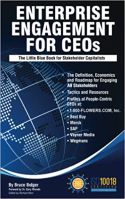
3. Books on implementation: Enterprise Engagement for CEOs and Enterprise Engagement: The Roadmap.
4. Advisory services and research: Strategic guidance, learning and certification on stakeholder management, measurement, metrics, and corporate sustainability reporting.
5. Permission-based targeted business development to identify and build relationships with the people most likely to buy.
Contact: Bruce Bolger at TheICEE.org; 914-591-7600, ext. 230.