

FAQs: Understanding the Enterprise Engagement Index (EEI)
 Why and how the Enterprise Engagement Alliance created a public-data framework to evaluate how organizations create value through people.
What is the Enterprise Engagement Index (EEI)?
Why was the EEI created?
Why use only public financial data?
How were the EEI metrics selected?
Why are the EEI weighting factors structured the way they are?
Why doesn’t the EEI use different scoring systems by industry?
Does the EEI correlate with stock market performance?
Does the EEI correlate with employee or customer satisfaction?
Is there a risk of circular reasoning in the EEI?
Does a high EEI guarantee high profitability?
How can organizations use the EEI internally?
What is the broader purpose of the EEI?
Click here to subscribe to the ESM weekly e-newsletter.
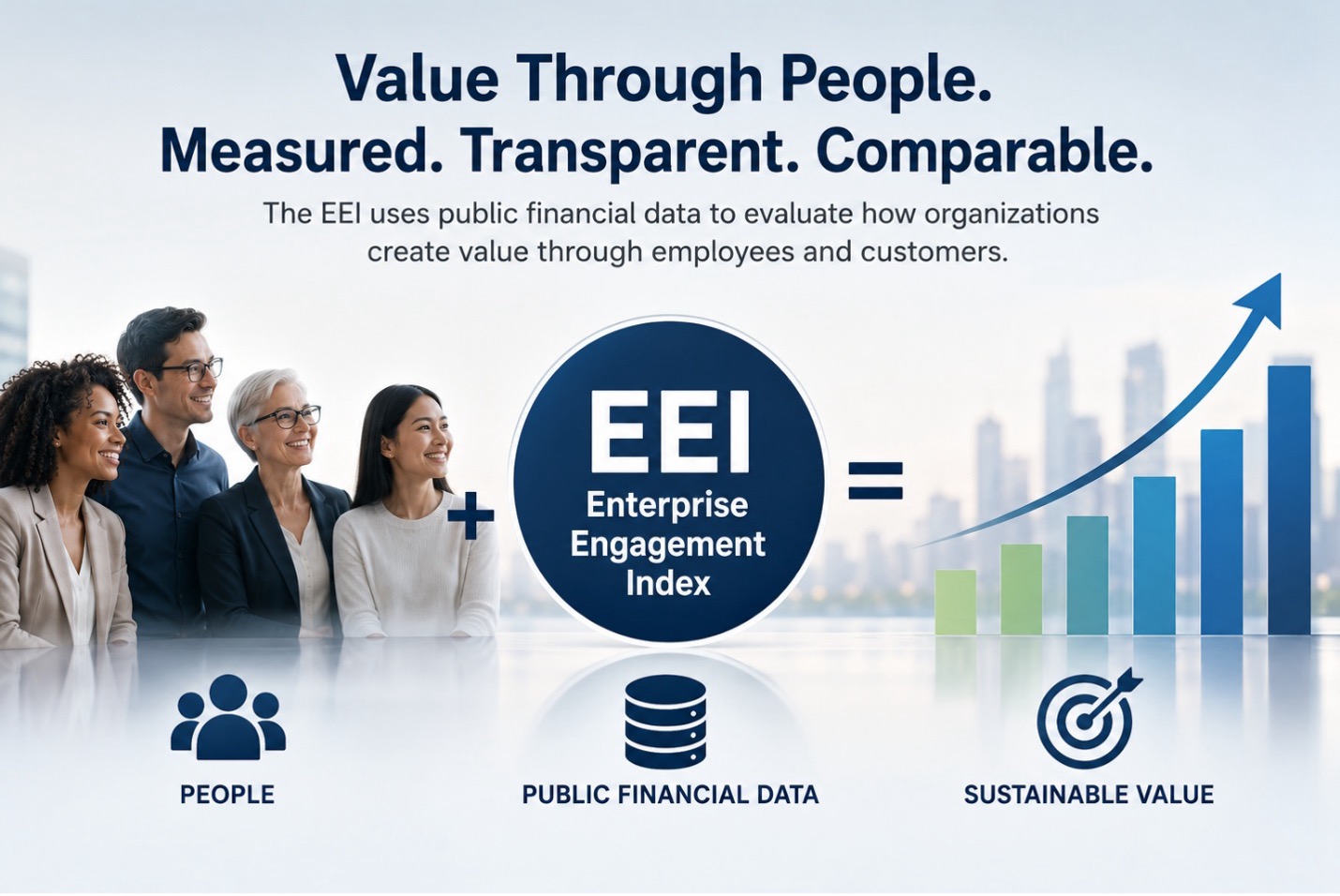
The Enterprise Engagement Index (EEI) was developed by the Enterprise Engagement Alliance to address a longstanding challenge in business analysis: how to evaluate how effectively organizations create value through employees and customers using transparent, publicly available data.
The EEI framework uses audited financial metrics to compare organizations within and across industries, while also enabling researchers, investors, executives, journalists, and solution providers to correlate financial performance with employee engagement, customer satisfaction, culture, leadership, and other stakeholder-related metrics. Below are answers to some of the most common questions about the EEI framework.
What is the Enterprise Engagement Index (EEI)?
The EEI is a public-data-based framework designed to evaluate how effectively organizations create value through employees and customers. Unlike many engagement models that rely primarily on surveys or proprietary methodologies, the EEI uses publicly available financial information to create transparent benchmarks and comparisons across industries.
The framework evaluates organizations using five core metrics:
| Component | What It Measures |
|---|---|
| Revenue per employee | Productivity and workforce leverage |
| Profit per employee | Value creation efficiency |
| Human Capital ROI (HCROI) | Efficiency of people investment |
| Net income-to-revenue ratio | Profitability efficiency |
| Three-year revenue growth | Market validation and sustained demand |
Stock market performance is often compared against EEI scores but is not included directly in the scoring model. Click here for details and an analysis of a growing number of companies in key industries. This article also includes details on the methodology.
Why was the EEI created?
The EEI was developed to create a more objective and transparent way to evaluate organizational effectiveness through people in financial terms. According to the EEA, the goal was to use only audited financial data so the results could be independently verified and consistently benchmarked across public companies. The framework was also designed to help answer broader questions such as:
- Do companies that create value more efficiently through employees and customers outperform over time?
- Is there a relationship between stakeholder engagement and financial performance?
- Can organizations identify measurable links between engagement practices and business outcomes?
Why use only public financial data?
The EEA intentionally focused on public financial information because it is:
- Audited
- Widely available
- Comparable across organizations
- Difficult to manipulate relative to internal engagement surveys
How were the EEI metrics selected?
The EEA says the metrics were chosen because relatively few publicly available, comparable financial indicators directly reflect how organizations create value through people. The selected factors focus on productivity, profitability, growth, and the efficiency of workforce investment, including:
- Revenue generated per employee
- Profit generated per employee
- Human Capital ROI
- Profitability efficiency
- Sustained revenue growth
Why are the EEI weighting factors structured the way they are?
- The weighting system was designed to balance the impact of employees and customers on organizational value creation.
- The model places greater emphasis on employee metrics because they represent a far greater cost than business development.
- The profitability ratios help evaluate how effectively revenue converts into bottom-line performance.
Why doesn’t the EEI use different scoring systems by industry?
- The EEA intentionally chose not to normalize the scoring system by industry. According to the organization, one of the goals is precisely to examine how different business models affect organizational value creation.
- For example, companies with exceptionally high revenues and profits per employee — such as semiconductor equipment manufacturers or certain pharmaceutical firms — naturally achieve higher scores because of the economics of their industries.
- The EEI therefore measures not only people management effectiveness, but also how forgiving or demanding different operating models may be.
Does the EEI correlate with stock market performance?
Early analyses suggest a meaningful correlation between high EEI scores and stronger long-term stock performance, although the relationship is not absolute. The EEA says companies that create value efficiently through employees and customers appear to have a greater probability of stronger shareholder performance over time. However, the framework also recognizes that many external factors affect stock prices, including:
- Macroeconomic conditions
- Patent protections
- Commodity prices
- Geopolitical events
- Interest rates
- Industry cycles
Does the EEI correlate with employee or customer satisfaction?
The EEI is specifically designed to enable those comparisons. The framework can be compared against:
- Glassdoor employee ratings
- American Customer Satisfaction Index customer satisfaction scores
- Google reviews
- Diversity and inclusion reporting
- Incentive and recognition program effectiveness
- Other stakeholder-related metrics
Is there a risk of circular reasoning in the EEI?
The EEA acknowledges this concern and says the framework was intentionally designed to reduce that risk. For example:
- Net income is not directly included in the EEI score
- Stock market performance is not included in the score
- The framework focuses primarily on operational efficiency and growth metrics
This allows researchers and analystis to compare EEI scores separately against profitability and shareholder returns rather than embedding those outcomes directly into the formula.
Does a high EEI guarantee high profitability?
No. One of the emerging findings from the EEA’s ongoing analyses is that organizations can score highly on value creation through people without necessarily generating the highest profits. The framework suggests that profitability can also be heavily influenced by:
- Industry economics
- Business models
- Commodity cycles
- Market structure
- Macroeconomic conditions
In some sectors, companies with exceptionally high-margin business models may be able to sustain weaker employee or customer engagement without immediate financial consequences.
How can organizations use the EEI internally?
Organizations can use the EEI as a benchmarking and correlation tool. Potential applications include analyzing relationships between EEI outcomes and:
- Employee engagement initiatives
- Incentive and recognition programs
- Customer experience and loyalty investments
- Leadership development
- Culture initiatives
- DEI reporting
- Training programs
- Operational improvements
What is the broader purpose of the EEI?
The EEA says the broader objective is to encourage organizations, investors, journalists, and business leaders to pay greater attention to how companies create value through people.
The organization believes that while companies rigorously measure financial and operational performance, many still lack equally rigorous systems for evaluating how effectively they align and engage employees, customers, channel partners, and other stakeholders toward shared goals.
The EEI is designed to provide a transparent starting point for that conversation.
Enterprise Engagement Alliance Services
 Celebrating our 17th year, the Enterprise Engagement Alliance helps organizations enhance performance through:
1. Information and marketing opportunities on stakeholder management and total rewards:
- ESM Weekly on stakeholder management since 2009. Click here to subscribe; click here for media kit.
- RRN Weekly on total rewards since 1996. Click here to subscribe; click here for media kit.
- EEA YouTube channel on enterprise engagement, human capital, and total rewards since 2020
 Management Academy to enhance future equity value for your organization.
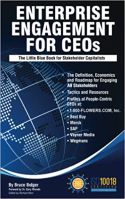
3. Books on implementation: Enterprise Engagement for CEOs and Enterprise Engagement: The Roadmap.
4. Advisory services and research: Strategic guidance, learning and certification on stakeholder management, measurement, metrics, and corporate sustainability reporting.
5. Permission-based targeted business development to identify and build relationships with the people most likely to buy.
Contact: Bruce Bolger at TheICEE.org; 914-591-7600, ext. 230.