

Europes Largest Employee Engagement Conference
.png) Having a more sophisticated marketplace for employee engagement than the US hasn’t led to higher levels of employee engagement in Europe.
Having a more sophisticated marketplace for employee engagement than the US hasn’t led to higher levels of employee engagement in Europe. A Broader View of Employee Engagement
Engagement Beyond Rewards and Recognition
The Contradiction: Sophisticated Engagement Marketplaces, Weak Engagement Results
A Growing Debate Over Measurement and Impact
The 2026 Engage Employee Summit in London last week highlights what may be a far more advanced and holistic employee engagement marketplace than currently exists in the United States. Unlike the US, which does not even have a major national conference specifically focused on employee engagement as a management discipline, the UK event addresses nearly every dimension of engagement, including culture, leadership, communications, wellbeing, AI, employee voice, learning, manager effectiveness, and organizational alignment.
Yet despite this broader and more sophisticated view of engagement, Europe continues to report among the lowest employee engagement levels in the world according to Gallup, with only 13% of employees saying they feel engaged. This suggests that even advanced engagement marketplaces may still lack sufficiently strategic, systematic, and measurable approaches to creating lasting organizational impact.
The 2026 Engage Employee Summit in London says it brought together approximately 3,000 HR, communications, culture, and employee experience professionals to examine the future of workplace engagement, internal communications, AI-driven employee experience, and organizational culture. The event is produced by Engage Employee, a UK-based media and events company focused on employee engagement, internal communications, workplace culture, employee experience content, conferences, webinars, and professional community-building for HR and communications leaders.
Held at Evolution in Battersea Park, London, the conference positions itself as Europe’s largest employee engagement conference and expo, featuring more than 250 speakers and dozens of exhibitors and sponsors focused on engagement technologies, communications platforms, recognition, wellbeing, workforce analytics, culture, leadership, and employee experience.
A Broader View of Employee Engagement
The company says the conference attracted senior HR executives, internal communications leaders, culture and engagement professionals, learning and development executives, and employee experience technology providers. Major participating organizations, it says, included Google, Nestlé, Starbucks, Coca-Cola, Visa, EY, LinkedIn, Rolls-Royce, NHS, Royal Mail, AXA, and Delivero, it says.
Based on the published agenda, what stands out most about the event is its notably broader definition of employee engagement compared with the US marketplace. While the US has conferences dedicated to HR technology, employee benefits, culture, incentives and meetings, recognition, internal communications, and workplace wellness, there is arguably no major national US conference that brings all these disciplines under one roof specifically devoted to employee engagement as a comprehensive management discipline.
Instead, the US marketplace remains highly fragmented, with engagement-related topics often separated into individual categories such as rewards and recognition, employee experience, culture, wellness, communications, leadership, surveys, or HR technology. By contrast, the Engage Employee Summit approaches engagement as more of an integrated organizational challenge involving leadership, communications, culture, manager effectiveness, employee voice, wellbeing, learning, trust, analytics, and business alignment.
Engagement Beyond Rewards and Recognition
Sessions at the event covered topics ranging from AI-enabled personalization and internal communications to burnout, workforce trust, leadership, employee listening, collaboration, culture transformation, and measuring organizational impact. Exhibitors reflected that same broad approach, including companies focused on communications, collaboration, employee listening, analytics, culture management, and wellbeing in addition to recognition and rewards.
In many respects, the conference suggests that the UK and European engagement marketplace may be operating from a more mature conceptual understanding of engagement than much of the US market, where engagement is still frequently treated as a collection of separate tactical functions rather than as a unified operating philosophy.
The Contradiction: Sophisticated Engagement Marketplaces, Weak Engagement Results
At the same time, however, Europe continues to post among the weakest engagement levels in the world. Gallup reports that only 13% of European employees describe themselves as engaged, the lowest regional engagement rate globally and well below the 31% reported in the United States. That reality raises an increasingly important question for the entire engagement profession: if organizations are investing heavily in employee experience, communications, recognition, wellbeing, culture, and engagement technologies, why do engagement levels remain so low even in a region where the concepts are widely talked about?
One possible explanation is that even sophisticated engagement marketplaces may still lack sufficiently strategic and systematic operating models tied to measurable business outcomes. Much of the current engagement marketplace remains focused on activities, tools, platforms, and initiatives that often are siloed, rather than on enterprise-wide systems that align leadership, management practices, communications, recognition, performance management, learning, and stakeholder goals into a coherent operational framework.
A Growing Debate Over Measurement and Impact
The conference did include discussions about impact measurement and organizational effectiveness. Sessions addressed topics such as proving value, measuring what matters, workforce trust, and connecting engagement to business performance. However, publicly available conference materials appeared to devote relatively limited attention to the broader structural issue of why engagement levels remain persistently weak despite decades of investment in engagement initiatives.
That disconnect increasingly fuels debate throughout the engagement profession about whether organizations need to move beyond fragmented engagement tactics toward more integrated management systems with clear goals, alignment mechanisms, accountability structures, and measurable operational outcomes.
The Engage Employee Summit demonstrates that the UK and European engagement marketplace may already be ahead of the United States in viewing engagement as a broad organizational discipline rather than simply a rewards or technology category. The remaining challenge may be whether the profession can evolve from a collection of engagement activities into a more rigorous management system capable of producing measurable improvements in productivity, retention, customer experience, innovation, and long-term organizational performance.
Enterprise Engagement Alliance Services
 Celebrating our 17th year, the Enterprise Engagement Alliance helps organizations enhance performance through:
1. Information and marketing opportunities on stakeholder management and total rewards:
- ESM Weekly on stakeholder management since 2009. Click here to subscribe; click here for media kit.
- RRN Weekly on total rewards since 1996. Click here to subscribe; click here for media kit.
- EEA YouTube channel on enterprise engagement, human capital, and total rewards since 2020
 Management Academy to enhance future equity value for your organization.
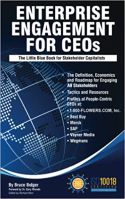
3. Books on implementation: Enterprise Engagement for CEOs and Enterprise Engagement: The Roadmap.
4. Advisory services and research: Strategic guidance, learning and certification on stakeholder management, measurement, metrics, and corporate sustainability reporting.
5. Permission-based targeted business development to identify and build relationships with the people most likely to buy.
Contact: Bruce Bolger at TheICEE.org; 914-591-7600, ext. 230.