

EEI Analysis of 23 Industries: The Future Belongs to Companies With Smaller, Highly Productive Workforces
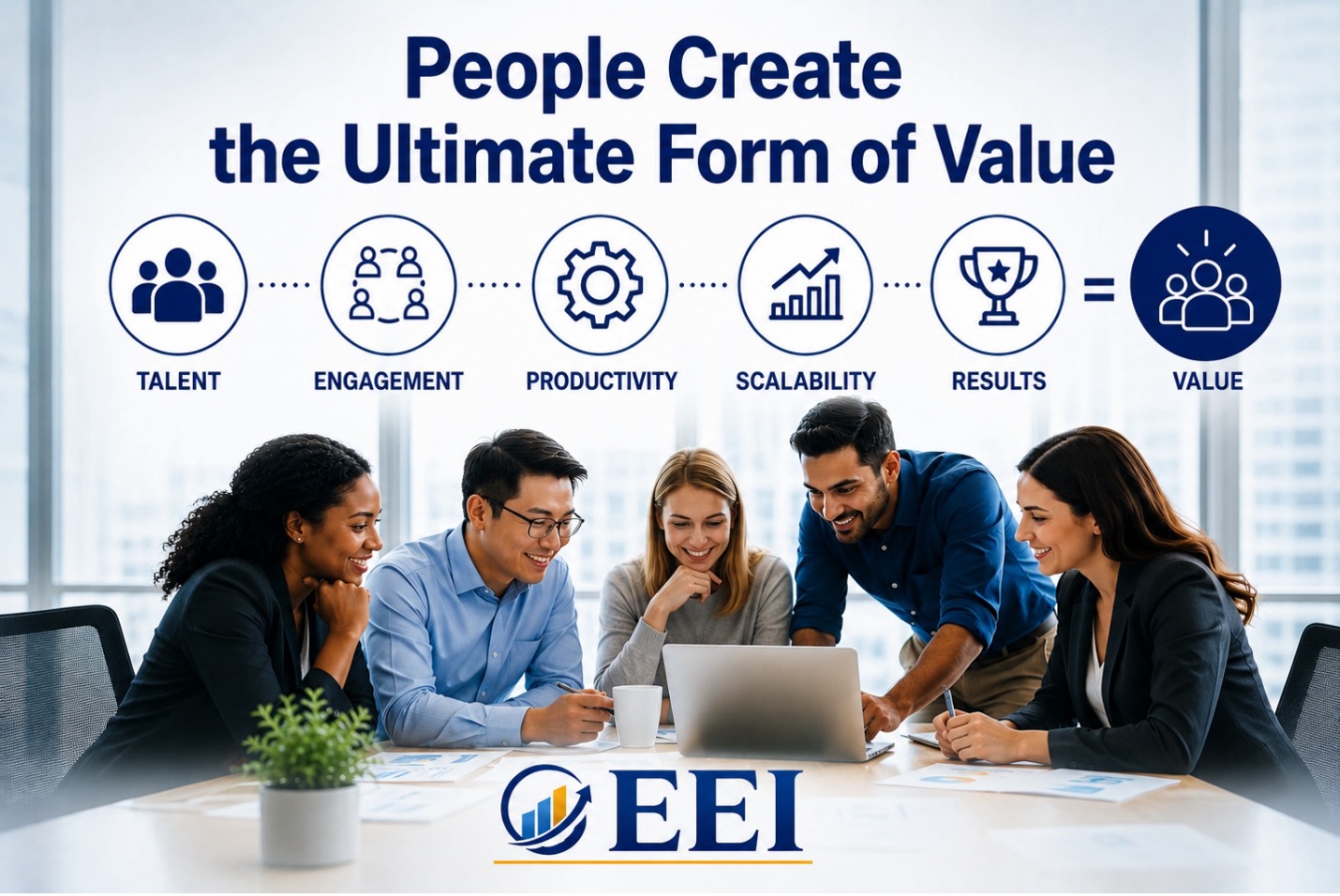 A review of 23 industries using the Enterprise Engagement Index suggests that the strongest long-term opportunities increasingly belong to companies able to combine highly skilled workforces, scalable technology, recurring revenue, and extraordinary productivity--precisely at a time when AI will make this possible for potentially an entirely new breed of business.
 The Biggest Strategic Implication: Productivity Is Becoming the New Competitive Battlefield
Payment Networks May Represent the Strongest Overall Business Model
Semiconductor Infrastructure Sits at the Center of the AI Economy
High-Tech Platforms Continue to Demonstrate Extraordinary Scalability
Biotech Demonstrates the Power of Intellectual Property Scalability
Enterprise Software May Be a Quiet Long-Term Winner
Labor-Intensive Industries Continue to Face Structural Pressure
What the EEI Findings Suggest About the Future of Management
Click here to subscribe to the ESM weekly e-newsletter.
By Bruce Bolger
Bolger is Founder of the Enterprise Engagement Alliance.
One of the most important findings from the Enterprise Engagement Index (EEI) analysis of 23 industries is that the companies and sectors most likely to outperform over the next decade increasingly share the same operating model: they generate extraordinary economic value from relatively small, highly productive workforces supported by scalable technology and strong operational systems.
The introduction of AI likely will accelerate this trend. While major organizations grapple with how to get the best out of AI transformation, in some cases facing enormous disruption as retailers and publishers endured with the Internet, start-ups based on AI will have a significant opportunity unburdened by legacy business models.
The analysis suggests that future competitive advantage may depend less on organizational size and more on productivity architecture—the ability to align people, systems, technology, customer economics, and operational design to produce scalable value without proportionally increasing labor costs. Industries such as digital payments, semiconductor infrastructure, enterprise software, and biotechnology consistently demonstrate the strongest combination of:
- High revenue per employee,
- Strong profit per employee,
- High HCROI,
- Scalable business models,
- Recurring revenue,
- And durable competitive moats.
The Biggest Strategic Implication: Productivity Is Becoming the New Competitive Battlefield
For years, business discussions around employee engagement, stakeholder management, culture, and customer experience have often remained highly qualitative. The EEI analysis suggests those concepts can increasingly be measured through hard operational outcomes. Across nearly every sector studied, the strongest long-term performers shared one defining trait: they produced dramatically more economic value per employee and customers than competitors while sustaining growth and profitability. That pattern appears repeatedly regardless of industry:
- Higher-margin companies tend to generate stronger long-term returns,
- Companies with stronger HCROI generally demonstrate better scalability,
- And firms capable of scaling revenue without proportionally scaling headcount consistently show superior economics.
Payment Networks May Represent the Strongest Overall Business Model
Among all industries analyzed, the credit card and payment network sector emerge as perhaps one of the the strongest overall business models. Even though companies such as Visa and Mastercard gross pennies on the dollar, they demonstrate extraordinary economics, including revenue per employee exceeding $1.3 million, profit per employee reaching as high as $760,000, operating margins above 55%, and HCROI levels above 9x to 11x.
These companies benefit from:
- Powerful network effects,
- Embedded global infrastructure,
- Recurring transaction flows,
- and business models that expand automatically with consumer spending and digital commerce.
Semiconductor Infrastructure Sits at the Center of the AI Economy
The semiconductor production equipment sector also ranks among the strongest industries analyzed, led by ASML and Applied Materials. The importance of this sector extends far beyond semiconductors themselves. AI systems, robotics, cloud computing, autonomous vehicles, defense systems, and advanced manufacturing all increasingly depend on semiconductor innovation.
Dutch-based ASML in particular occupies one of the most strategically powerful positions in global business through its effective, technology-based monopoly in advanced EUV lithography systems required for next-generation chip manufacturing. The economics reflect that leverage:
- Revenue per employee approaching $900,000,
- Profit per employee above $300,000,
- Operating margins exceeding 34%,
- And highest EEI scores in the study--100 representating the top EEI score possible for creating value through customers and employees.
High-Tech Platforms Continue to Demonstrate Extraordinary Scalability
The broader technology platform sector also demonstrate exceptionally strong economics, particularly Microsoft and Alphabet. One of the clearest findings in the analysis is that software and data-driven businesses can dramatically increase revenue without proportionally increasing labor costs. This does not make these companies immune from bad strategic decision-making but does provide greater room for error.
Alphabet generates approximately $2.11 million in revenue per employee and nearly $700,000 in profit per employee in the analysis, while Microsoft also demonstrates elite productivity and profitability metrics. Importantly, these companies also benefit from:
- Massive recurring revenue streams,
- Global customer ecosystems,
- AI and data advantages,
- High switching costs,
- And strong brand power.
Biotech Demonstrates the Power of Intellectual Property Scalability
The biotechnology sector produces some of the most remarkable company economics in the study. Companies such as Vertex Pharmaceuticals and Argenx demonstrate extremely high profitability, rapid growth, and exceptional EEI scores. Argenx in particular shows:
- Revenue CAGR above 100%,
- Profit per employee above $690,000,
- And an EEI score of 100.
Enterprise Software May Be a Quiet Long-Term Winner
Enterprise workflow and cloud software providers such as ServiceNow, Salesforce, and Workday also demonstrate relatively strong EEI characteristics despite more modest recent stock performance and in the case of Salesforce at least, threats from AI. That said, the underlying economics of this field provide more room for error. For instance, one especially interesting finding is that operational metrics often remain strong even during periods of stock underperformance, which historically can signal temporary valuation compression rather than deterioration in underlying business quality. The sector continues to benefit from:
- Recurring subscription revenue,
- High switching costs,
- Scalable digital delivery,
- And expanding AI integration opportunities.
Labor-Intensive Industries Continue to Face Structural Pressure
At the opposite end of the spectrum, several industries studied consistently struggle to achieve strong EEI performance despite competent management and recognized brands. Industries such as airlines, trucking, freight logistics, and advertising agencies demonstrated structurally weaker economics driven by:
- Lower margins,
- Higher labor dependency,
- Commodity pricing pressure,
- Cyclical demand,
- And greater operational complexity.
Advertising agencies also appear increasingly vulnerable to AI disruption and continued pricing pressure.
The evidence supports the notion that in these types of industries, optimal performance depends not only on smart management decisions about products, services, and economics, etc. but the ability to maximize the passion of customers, employees, and other mission-critical stakeholders in the supply chain.
What the EEI Findings Suggest About the Future of Management
The broader implication of the EEI analysis may extend well beyond management investing. The findings increasingly suggest that long-term enterprise value creation is becoming directly tied to how effectively organizations align people, systems, technology, incentives, customer economics, and operational strategy into scalable business architectures. In the elite industries, it means recruiting and retaining the highly educated or talent professionals needed to attract and retain large customers. In the industries more subject to labor, commodity, geopolitical and other constraints, effective management of people becomes a key competitive advantage.
In other words, the future may belong less to the companies with the largest workforces and more to those best able to convert human capital into scalable economic value. That does not diminish the importance of people. In fact, it's the opposite. the strongest-performing industries in the study frequently depend on highly skilled, highly engaged, highly productive employees operating within systems specifically designed to maximize innovation, efficiency, and alignment and labor-intensive industries require highly engaged stakeholders to deliver maximum shareholder value.
The findings reinforce one of the core premises behind enterprise engagement itself: sustainable performance increasingly depends not simply on spending more on people, but on designing organizations capable of systematically converting human capital into measurable economic impact.
Enterprise Engagement Alliance Services
 Celebrating our 17th year, the Enterprise Engagement Alliance helps organizations enhance performance through:
1. Information and marketing opportunities on stakeholder management and total rewards:
- ESM Weekly on stakeholder management since 2009. Click here to subscribe; click here for media kit.
- RRN Weekly on total rewards since 1996. Click here to subscribe; click here for media kit.
- EEA YouTube channel on enterprise engagement, human capital, and total rewards since 2020
 Management Academy to enhance future equity value for your organization.
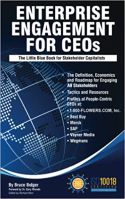
3. Books on implementation: Enterprise Engagement for CEOs and Enterprise Engagement: The Roadmap.
4. Advisory services and research: Strategic guidance, learning and certification on stakeholder management, measurement, metrics, and corporate sustainability reporting.
5. Permission-based targeted business development to identify and build relationships with the people most likely to buy.
Contact: Bruce Bolger at TheICEE.org; 914-591-7600, ext. 230.