

WTW Study: High-Impact Employee Experience Linked to Stronger Revenue Growth, Profitability and Returns
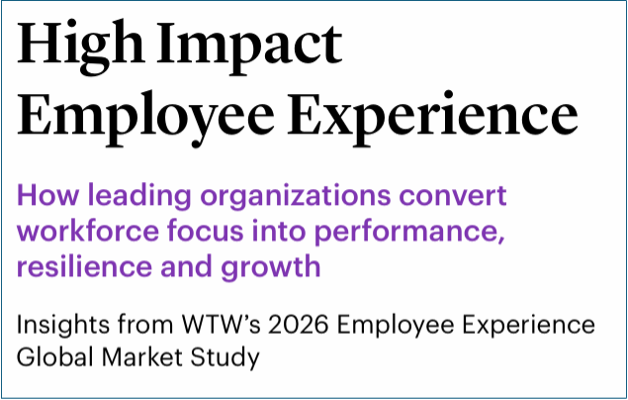 New global research from Willis Towers Watson (WTW) suggests that organizations moving beyond employee engagement to focus on employee impact achieve measurably stronger business performance, including higher revenue growth, profit margins, earnings, and shareholder returns.
From Engagement to Impact
Employees Need to Believe Their Voice Matters
Recognition and Non-Monetary Rewards Gain Importance
Leadership Communication and Change Management Matter
Key Findings
Click here to subscribe to the ESM weekly e-newsletter.
Published in 2026, WTW's High Impact Employee Experience Report examines the relationship between employee experience and organizational performance. The study, conducted by WTW's Employee Experience practice, compares employee perceptions and workplace practices at financially high-performing organizations with those at average-performing organizations.
Researchers analyzed how factors such as leadership communication, employee voice, rewards and recognition, workplace flexibility, and change management correlate with outcomes including revenue growth, profit margins, earnings growth, and return on equity.
Published in 2026, the report compares employee survey results and workplace practices at financially high-performing organizations and average-performing organizations. The research examines how factors such as employee voice, leadership communication, rewards and recognition, workplace flexibility, and change management relate to business outcomes including revenue growth, profit margins, earnings growth, and return on equity.
While the report identifies significant differences between high-performing and average-performing organizations, it provides limited detail regarding sample size, company selection criteria, industry composition, and statistical methodology. As a result, the findings are best viewed as evidence of a meaningful relationship between employee experience and business performance rather than proof of causation. Nonetheless, the study contributes to a growing body of research suggesting that organizations create the greatest value not simply by improving employee engagement, but by translating engagement into aligned behaviors, innovation, adaptability, and measurable business results.
One reason the report is noteworthy is that it reinforces a theme increasingly seen across engagement and performance research: employee attitudes matter, but organizations create the greatest value when they translate engagement into aligned behaviors, innovation, adaptability, and performance. In other words, engagement alone may not be the ultimate objective; the goal is creating an environment in which employees understand organizational priorities, contribute ideas, embrace change, and take actions that improve business results.
From Engagement to Impact
For years, organizations have focused on measuring employee engagement. WTW's latest research argues that engagement alone is no longer enough. The firm's findings suggest that organizations generating the strongest business results are those that convert engagement into employee impact—creating environments in which employees not only feel positive about work but also understand company priorities, contribute ideas, adapt to change, and take actions that support business goals.
According to the report, organizations with high employee impact achieve, on average, 8% higher revenue growth, 6% higher profit margins, 7% higher return on equity, and 8% higher earnings than their peers.
The report highlights four areas that appear to distinguish higher-performing organizations: employees feeling their voices matter, stronger leadership communication, more effective change leadership, and a broader view of rewards that extends beyond compensation alone. Together, these findings suggest that the quality of the employee experience can influence not only workforce sentiment but also organizational performance.
Employees Need to Believe Their Voice Matters
One of the strongest themes in the report is the importance of employee voice. WTW found that employees at top-performing organizations are 11% more likely to believe their opinions matter and influence decisions. Organizations that actively listen and visibly act on employee feedback appear more successful at building trust, encouraging innovation, and sustaining growth. The finding aligns with a growing body of research suggesting that employees are more likely to contribute discretionary effort and innovative ideas when they believe leadership values their input.
Recognition and Non-Monetary Rewards Gain Importance
The report also identifies a shift in employee perceptions regarding rewards. While confidence in traditional pay-for-performance systems has weakened, employees increasingly value non-monetary rewards such as career development opportunities, workplace flexibility, meaningful recognition, and simple expressions of appreciation.
WTW suggests that organizations combining financial and non-financial rewards are better positioned to strengthen engagement, retention, and performance. For organizations focused on rewards and recognition, the finding reinforces the importance of viewing recognition as part of a broader employee experience strategy rather than as a stand-alone program.
Leadership Communication and Change Management Matter
WTW also reports a notable gap between high-performing and average-performing organizations in employee perceptions of leadership communication and change management. Employees at financially successful organizations are significantly more likely to believe their leaders provide a clear mission, communicate consistently, and manage organizational change effectively.
In particular, 67% of employees at high-performing organizations say senior leaders manage change well, compared with 57% at average-performing organizations. These findings are especially relevant at a time when organizations are navigating economic uncertainty, AI adoption, workforce transformation, and rapidly changing employee expectations.
Key Findings
The report's most important contribution may be its attempt to connect employee experience directly to business outcomes. Rather than treating engagement as an end in itself, WTW argues that organizations should focus on creating employee experiences that drive action, innovation, adaptability, and performance.
For business leaders, the implication is that employee experience initiatives may create the greatest value when they are designed not merely to improve survey scores, but to help employees contribute more effectively to organizational goals. If the findings hold true, employee experience may increasingly be viewed not as an HR initiative, but as a business performance strategy.
Enterprise Engagement Alliance Services
 Celebrating our 17th year, the Enterprise Engagement Alliance helps organizations enhance performance through:
1. Information and marketing opportunities on stakeholder management and total rewards:
- ESM Weekly on stakeholder management since 2009. Click here to subscribe; click here for media kit.
- RRN Weekly on total rewards since 1996. Click here to subscribe; click here for media kit.
- EEA YouTube channel on enterprise engagement, human capital, and total rewards since 2020
 Management Academy to enhance future equity value for your organization.
3. Books on implementation: Enterprise Engagement for CEOs and Enterprise Engagement: The Roadmap.
4. Advisory services and research: Strategic guidance, learning and certification on stakeholder management, measurement, metrics, and corporate sustainability reporting.
5. Permission-based targeted business development to identify and build relationships with the people most likely to buy.
Contact: Bruce Bolger at TheICEE.org; 914-591-7600, ext. 230.