

Ethical Capitalism: Where Faith and Management Theory Meet
.jpeg) Such religious and secular figures as diverse as Confucius, Mohatma Gandhi, Pope Leo XIV, Stephen R. Covey, Rabbi Jonathan Sacks, Prince El Hassan bin Talal, and the US faith-based capitalism movement have advocated for business principles similar to those of stakeholder capitalism pioneer R. Edward Freeman and others: creating value for all stakeholders may be both a moral imperative and a pathway to long-term business success. Maybe the movement should simply be called ethical capitalism.
Such religious and secular figures as diverse as Confucius, Mohatma Gandhi, Pope Leo XIV, Stephen R. Covey, Rabbi Jonathan Sacks, Prince El Hassan bin Talal, and the US faith-based capitalism movement have advocated for business principles similar to those of stakeholder capitalism pioneer R. Edward Freeman and others: creating value for all stakeholders may be both a moral imperative and a pathway to long-term business success. Maybe the movement should simply be called ethical capitalism. By Bruce Bolger
Confucius and the Ethics of Harmonious Relationships
Gandhi and the Principle of Trusteeship
Rabbi Jonathan Sacks and the Economics of Responsibility
Prince El Hassan and the Common Good
The Dalai Lama and Universal Responsibility
Pope Leo XIV and Human-Centered Enterprise
Faith-Based Capitalism in Christianity
R. Edward Freeman and the Modern Secular Stakeholder Movement
Stephen Covey and Principle-Centered Leadership
Different Traditions, Common Principles
Click here to subscribe to the ESM weekly e-newsletter.
Stakeholder capitalism is often viewed as a relatively modern business philosophy. Popularized in academic and business circles by management scholar R. Edward Freeman and others since the 1980s and increasingly discussed by business leaders, investors, and policymakers worldwide, stakeholder capitalism argues that organizations create the most sustainable value when they serve not only shareholders but also employees, customers, suppliers, communities, and society as a whole.
In fact, many of the principles associated with stakeholder capitalism can be found in traditions as diverse as Confucianism, Hinduism, Judaism, Islam, Buddhism, Catholicism, Protestantism, and The Church of Jesus Christ of Latter-day Saints, as well as in modern secular management theory.
Those for whom the term "stakeholder" has become tainted by greenwashing and virtue signaling, perhaps a more palatable term is ethical capitalism.
What is rarely discussed in the debates about stakeholder capitalism is how closely these ideas align with teachings that have existed for centuries within major religious and ethical traditions around the world: concepts as ancient as the Golden rule.
Much in common exists between the ancient wisdom of Confucius, Mahatma Gandhi’s concept of trusteeship, the writings of Rabbi Jonathan Sacks, the Dalai Lama’s concept of universal responsibility on the moral foundations of economic life, Prince El Hassan bin Talal's advocacy of human-centered development, Edward Freeman's secular work on stakeholder management and Stephen R. Covey’s emphasis of the principles of “win-win” in business. While their traditions and terminology differ, all share a common belief: organizations should be managed to harmonize the interests of all stakeholders and as stewards of human and societal well-being rather than solely as instruments of financial extraction.
The model of capitalism that emerged from the Industrial Revolution focused on value extraction and often borderline business practices with the goal of optimizing returns for shareholders, such as: deceptive product and service claims; poorly employees working in unsafe conditions; pollution and infrastructure damage, tax evasion and other unethical practices that essentially offload business costs on to society.
Confucius and the Ethics of Harmonious Relationships
.png) More than 2,400 years before modern management theory, Confucius taught that successful societies depend upon the quality of relationships among people and institutions. Central to his philosophy were the principles of ren (humaneness), yi (righteousness), and li (proper conduct), which emphasized mutual respect, ethical leadership, and the fulfillment of responsibilities to others.
More than 2,400 years before modern management theory, Confucius taught that successful societies depend upon the quality of relationships among people and institutions. Central to his philosophy were the principles of ren (humaneness), yi (righteousness), and li (proper conduct), which emphasized mutual respect, ethical leadership, and the fulfillment of responsibilities to others.Confucius believed that leaders should govern through virtue and example rather than through authority alone. Organizations and societies function best, he argued, when leaders recognize their obligations to employees, families, communities, and the broader social order. His emphasis on trust, reciprocity, and long-term relationships closely parallels stakeholder capitalism's view that sustainable success depends upon balancing the interests of all parties affected by organizational decisions.
Viewed through a modern lens, Confucian philosophy suggests that enduring prosperity emerges not from maximizing individual gain but from fostering harmonious and mutually beneficial relationships throughout society.
Gandhi and the Principle of Trusteeship
Long before stakeholder capitalism entered management literature, Gandhi articulated a remarkably similar concept through his philosophy of trusteeship. Gandhi did not oppose wealth creation or entrepreneurship. Instead, he argued that wealth creators serve as trustees of resources ultimately intended for the benefit of society.
Business leaders, in this view, have a responsibility to create economic value while simultaneously advancing the welfare of employees, customers, communities, and future generations. Importantly, Gandhi did not advocate sacrificing business success for social goals. Rather, he believed that businesses rooted in trust, fairness, and service would ultimately prove more resilient and sustainable.
Rabbi Jonathan Sacks and the Economics of Responsibility
Rabbi Jonathan Sacks, a prominent rabbi and professor who died in 2020, frequently warned against reducing society to market relationships alone. While recognizing the importance of free enterprise and wealth creation, he argued that healthy economies depend on trust, responsibility, and moral obligations that cannot be measured solely in financial terms. Drawing on Jewish concepts of justice, stewardship, and human dignity, Sacks emphasized that businesses play an essential role in strengthening communities and social cohesion. His writings suggest that organizations have responsibilities extending beyond shareholders to employees, customers, suppliers, and society.
In many respects, his work anticipated modern discussions about stakeholder capitalism by arguing that economic systems function best when grounded in ethical relationships and mutual responsibility.
Prince El Hassan and the Common Good
Prince El Hassan bin Talal, a member of the Jordanian royal family, has long advocated a vision of development rooted in human dignity, stewardship, environmental responsibility, and social cohesion. Drawing upon Islamic principles such as amanah (trusteeship), adl (justice), and maslahah (the public good), he has argued that economic systems should serve people rather than treat people merely as inputs into economic systems.
His writings and speeches frequently emphasize that long-term prosperity depends upon balancing economic growth with social well-being, education, environmental sustainability, and human development. This perspective closely parallels stakeholder capitalism's assertion that organizations create the most enduring value when they recognize their responsibilities to all stakeholders affected by their actions.
The Dalai Lama and Universal Responsibility
The Dalai Lama has long argued that economic systems and institutions should be evaluated not solely by their ability to generate wealth but by their contribution to human well-being. Central to his teachings is the concept of "universal responsibility"—the recognition that individuals, organizations, and societies are interconnected and that actions affecting one group inevitably affect others.
While not writing specifically about stakeholder capitalism, the Dalai Lama has frequently encouraged business leaders to incorporate ethics, compassion, and concern for the broader community into decision-making. He has suggested that lasting prosperity depends not simply on financial success but on trust, cooperation, and the well-being of those affected by organizational actions.
His emphasis on interdependence offers a distinctly Buddhist perspective on stakeholder management: that organizations succeed only through healthy relationships with employees, customers, suppliers, communities, and the environment.
Pope Leo XIV and Human-Centered Enterprise
Pope Leo XIV's recent reflections on artificial intelligence and humanity extend a long tradition of Catholic social teaching emphasizing human dignity, the common good, and responsible stewardship.Like previous papal writings on economic life, the Pope's message suggests that technology and economic systems should remain subordinate to human flourishing rather than the reverse. Organizations are encouraged to consider the impact of their decisions on workers, families, communities, and society—not simply on quarterly financial performance. The emphasis is not anti-business. Instead, it reflects a belief that economic success and human dignity should reinforce one another rather than compete.
Faith-Based Capitalism in Christianity
The link to religious faith is alive and well in the US. In this Enterprise Engagement Alliance YouTube show, three Christian business leaders see a direct connection between their businesses and their faiths. Davin Salvagno, Founder, Purpose Summit; Mike Sharrow, Chief Executive Officer, C12 Business Forums, and J.C. Hite, Founder and CEO of Hite Digital, a Little Rock-based marketing agency, view capitalism as a powerful force for good when guided by Christian principles of stewardship, service, integrity, and human dignity, arguing that businesses create the most sustainable value when they pursue profit as the result of serving people well rather than as an end in itself
R. Edward Freeman and the Modern Secular Stakeholder Movement
In 1984, R. Edward Freeman's landmark business book Strategic Management: A Stakeholder Approach, emerged from the field of business strategy challenging the dominant view that the primary purpose of business was to maximize shareholder value. Though the book was written for business audiences, Freeman earned his Ph. D. in philosophy.
Freeman argues that successful organizations create value through a network of relationships involving customers, employees, suppliers, communities, and investors. Long-term business success, he maintains, depends upon harmonizing and strengthening those relationships rather than optimizing the organization for any single stakeholder group.
His work helped establish stakeholder theory as one of the most influential management concepts of the last half century and remains the intellectual foundation for much of today's discussion about stakeholder capitalism.
Stephen Covey and Principle-Centered Leadership
While his work is not directly associated with his faith, Stephen M. Covey, who was an active member of the Church of Jesus Christ of Latter-day Saints, helped translate many timeless ethical principles into a practical framework for modern organizations. Through works such as The 7 Habits of Highly Effective People and Principle-Centered Leadership, Covey argued that trust, integrity, mutual benefit, and service form the foundation of sustainable personal and organizational success.
His focus on "win-win" thinking mirrors a central premise of stakeholder capitalism: that value creation should not be viewed as a zero-sum contest among stakeholders but as a process of creating mutual benefit. Likewise, his emphasis on stewardship, trust, and long-term relationship building aligns closely with the stakeholder perspective advanced by R. Edward Freeman.
Covey maintained that organizations achieve lasting success when they focus on principles rather than short-term transactions and when leaders seek to serve rather than merely control.
Different Traditions, Common Principles
Despite their different cultural, religious, and academic backgrounds, Confucius, Ghandi, Rabbi Sacks, Prince El Hassan, Freeman, Covey and faith-based business leaders converge around several common themes.
Business exists to create value, not extract it. Leaders are stewards rather than absolute owners. People should be treated with dignity and respect. Long-term prosperity depends on trust and responsible relationships. Economic and social objectives can reinforce one another. Perhaps most significantly, none of these perspectives view stakeholder responsibility primarily as a sacrifice but rather as a business opportunity.
While critics sometimes portray stakeholder capitalism as requiring organizations to choose between profits and purpose, these thinkers generally suggest the opposite. They argue that organizations that serve stakeholders well are more likely to earn trust, loyalty, innovation, resilience, and ultimately sustainable financial success.
For business leaders, the lesson may be less about religion than about management. Across cultures, faith traditions, and centuries of ethical thought, a remarkably consistent message emerges: organizations perform best when they recognize that lasting value creation depends upon the quality of relationships they maintain with employees, customers, suppliers, communities, and investors alike.
Modern research on the financial impact of engagement, customer loyalty, stakeholder trust, and long-term business performance increasingly suggests that these traditions may have anticipated an insight that management science is only beginning to quantify. Organizations often create the greatest shareholder value when they focus on creating value for everyone else as well. This structure also subtly reinforces that stakeholder capitalism is a management philosophy that seeks to improve long-term business performance through better stewardship of relationships with all stakeholders.
Enterprise Engagement Alliance Services
 Celebrating our 17th year, the Enterprise Engagement Alliance helps organizations enhance performance through:
1. Information and marketing opportunities on stakeholder management and total rewards:
- ESM Weekly on stakeholder management since 2009. Click here to subscribe; click here for media kit.
- RRN Weekly on total rewards since 1996. Click here to subscribe; click here for media kit.
- EEA YouTube channel on enterprise engagement, human capital, and total rewards since 2020
 Management Academy to enhance future equity value for your organization.
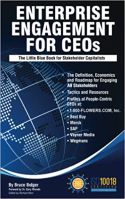
3. Books on implementation: Enterprise Engagement for CEOs and Enterprise Engagement: The Roadmap.
4. Advisory services and research: Strategic guidance, learning and certification on stakeholder management, measurement, metrics, and corporate sustainability reporting.
5. Permission-based targeted business development to identify and build relationships with the people most likely to buy.
Contact: Bruce Bolger at TheICEE.org; 914-591-7600, ext. 230.