

Two New Tools Seek to Connect Stakeholder Performance With Financial Results But From Different Directions
 Two new analytics tools focus on helping organizations create more value through people, but from different points of view and for different audiences.
 JUST Capital: Where Stakeholder Performance May Create Financial Opportunity
The EEI: A Public Formula for Measuring Value Creation Through People
How the Tools Relate
Moving From Philosophy to Measurement
Click here to subscribe to the ESM weekly e-newsletter.
Two new measurement tools are attempting to answer one of the most important questions in management and investing: do companies that perform better for workers, customers, communities, the environment, and other stakeholders also perform better financially, and if so, how? The short answer from both tools appears to be yes—but they approach the question from very different directions.
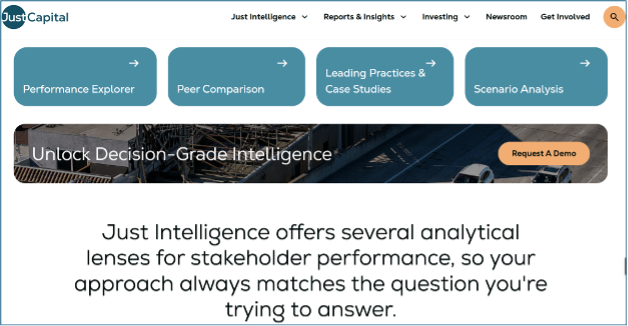
 JUST Capital CEO Martin Whittaker recently highlights the organization’s new Financial Opportunity module within its JustIntelligence platform. The tool enables Russell 1000 companies to measure five stakeholder categories—workers, customers, communities, environment, and shareholders/governance—against four financial outcomes: economic profit margin, excess return, gross margin, and revenue growth. JUST Capital describes it as “a decision-grade analytics platform that helps leaders translate signals from the American public into actionable insights that drive stakeholder performance and business performance.” This is a paid service available only to the 1,000 companies in the Russell Index tracked by JUST Capital.
 The Enterprise Engagement Alliance’s new EEI (Enterprise Engagement Index), by contrast, uses publicly available financial and headcount data to evaluate how effectively companies convert employee, customer, and stakeholder engagement into measurable productivity, profitability, and growth. The index, which consists of a publicly available formula anyone can access, can be used by investors and management to evaluate any public company, or by management of privately held companies using their own private data. Companies can calculate their EEI scores and compare it to industry benchmarks available in the EEA’s ESM media.
JUST Capital: Where Stakeholder Performance May Create Financial Opportunity
The purpose of JUST Capital’s new module is to help companies identify where specific stakeholder practices appear most closely linked to financial performance within their own industries. According to Whittaker’s post, the latest analysis finds that positive relationships between stakeholder and financial performance appear much more frequently than negative ones. Among statistically significant relationships, positive links outnumber negative ones by nearly two to one.
The research also suggests that the strongest relationships vary by industry. In consumer discretionary, financial, and real estate industries, worker-related performance showed particularly strong links with excess returns. In technology, investments in communities, environment, and governance practices were associated with stronger revenue growth. In telecommunications, customer and environmental performance showed the strongest relationship with gross margin.
The key value of the JUST Capital tool is specificity. It does not argue that stakeholder capitalism is good or bad. It asks: which stakeholder factors appear most financially relevant in which industries and against which financial outcomes?
The EEI: A Public Formula for Measuring Value Creation Through People
 The EEA EEI takes a different approach. Instead of starting with stakeholder practice scores, it starts with financial evidence of value creation through people. The EEI uses five data metrics (openly available for publicly held companies): revenue per employee, profit per employee, human capital ROI, profitability efficiency, and three-year revenue growth. Stock market performance is compared separately but is not included in the EEI score. Click here for details.
The purpose, according to Bruce Bolger, Founder of the Enterprise Engagement Alliance, which created the EEI, is to create a transparent, open-source benchmark that anyone can use with public data and a spreadsheet or AI query. The EEI does not claim to prove which specific employee or customer practices cause the results. Rather, it provides a way to identify companies that appear to generate unusually strong financial value through their employees, customers, and operating models.
Its early analyses suggest that companies with higher EEI scores often show stronger combinations of productivity, profitability, growth, and, in many cases, shareholder performance relative to peers, adding up to a 62% higher chance of alpha performance versus the S&P 500. The EEI formula is free and can be used for any public or private company based on easily available data.
How the Tools Relate
The two tools are highly related in purpose but different in method and marketplaces. The JUST Capital tool is only for Russell 1,000 companies and carries a fee; the EEI can be used by any company for free. Both challenge the long-standing assumption that stakeholder performance and financial performance are separate, or that investing in workers and customers necessarily comes at the expense of shareholders.
They both also recognize that the relationship is not universal. Industry matters. Business model matters. Timing matters. In some sectors, customer trust, employee productivity, or community and environmental performance may be central to financial results. In others, patents, market structure, commodity cycles, or capital intensity may dominate.
The JUST Capital tool appears designed primarily for corporate leaders and investors of companies in the Russell 1000 seeking to identify which stakeholder actions may offer the greatest financial opportunity by industry. The EEI is designed as a transparent public benchmark to evaluate whether any company is already converting people-related value into measurable business outcomes.
A main difference is that JUST Capital appears to begin with stakeholder performance data and then compares it with financial outcomes. The EEI begins with financial and workforce productivity data and then invites comparison with employee engagement, customer satisfaction, culture, leadership, and other stakeholder indicators.
In that sense, JUST Capital’s tool is more diagnostic: where might better stakeholder performance improve financial results? The EEI is more evaluative: which companies appear to be creating measurable value through people already?
JUST Capital’s tool is proprietary and platform-based. The EEI is intentionally open and designed for use by journalists, investors, researchers, executives, and practitioners using public information.
Moving From Philosophy to Measurement
Taken together, these tools suggest that stakeholder capitalism is moving from philosophy to measurement. For years, debates over stakeholder capitalism, ESG, purpose, and employee engagement have often suffered from vague language and inconsistent evidence. These two tools point toward a more practical phase: comparing specific stakeholder factors with specific financial outcomes, by industry, over time.
That is an important development for management, investors, and the engagement field. If stakeholder performance can be connected to financial outcomes with greater discipline, then investments in employees, customers, communities, and culture can be evaluated with the same seriousness as capital expenditures, marketing, technology, or mergers and acquisitions.
The most important conclusion is not that stakeholder performance automatically produces superior returns. Neither tool claims that. The more useful conclusion is that stakeholder performance can be financially material—and that companies now have better ways to examine where, how, and under what conditions that value is created.
For the engagement field, this may be the most important implication: recognition, incentives, loyalty, culture, leadership, and customer experience are no longer simply “soft” practices. Properly measured, they may become part of the same financial value-creation conversation as margins, growth, productivity, and shareholder returns.
Enterprise Engagement Alliance Services
 Celebrating our 17th year, the Enterprise Engagement Alliance helps organizations enhance performance through:
1. Information and marketing opportunities on stakeholder management and total rewards:
- ESM Weekly on stakeholder management since 2009. Click here to subscribe; click here for media kit.
- RRN Weekly on total rewards since 1996. Click here to subscribe; click here for media kit.
- EEA YouTube channel on enterprise engagement, human capital, and total rewards since 2020
 Management Academy to enhance future equity value for your organization.
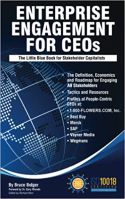
3. Books on implementation: Enterprise Engagement for CEOs and Enterprise Engagement: The Roadmap.
4. Advisory services and research: Strategic guidance, learning and certification on stakeholder management, measurement, metrics, and corporate sustainability reporting.
5. Permission-based targeted business development to identify and build relationships with the people most likely to buy.
Contact: Bruce Bolger at TheICEE.org; 914-591-7600, ext. 230.