

Why I Believe the Enterprise Engagement Index Is a Breakthrough
.jpeg) By Gary Rhoads
By Gary RhoadsRhoads is Ph.D., Professor Emeritus of Marketing and Entrepreneurship, Brigham Young University; Academic Director, Enterprise Engagement Alliance Impact Academy
The Enterprise Engagement Index is the first transparent formula to help investors and organizations better understand how well organizations create value through customers and employees.
Moving Beyond Traditional Financial Metrics
Why This Matters for Marketing
A Valuable Tool for Entrepreneurs and Startups
A New Perspective on Competitive Advantage
The Value of an Open Framework
Turning Engagement Into a Measurable Discipline
Click here to subscribe to the ESM weekly e-newsletter.
After more than four decades studying sales performance, customer loyalty, employee engagement, entrepreneurship, and organizational performance, I have observed a recurring problem in management: we spend enormous amounts of time discussing people as an organization's greatest asset, yet we have remarkably few practical ways to measure how effectively organizations convert human capital into business results.
That is why I believe the Enterprise Engagement Index (EEI) represents a significant breakthrough for boards, management, investors and almost any stakeholder interested in a company’s fortunes.
Moving Beyond Traditional Financial Metrics
What makes the EEI different is not simply that it measures performance. Many metrics do that. What makes it unique is that it evaluates an organization's ability to create value through people using a transparent, publicly available methodology based on financial outcomes that can be compared across companies and industries.
As both a marketing professor and entrepreneur, I have long been fascinated by competitive advantage. In my work with organizations ranging from startups to global enterprises, the most successful companies almost always shared a common characteristic: they consistently generated more value from their relationships with customers, employees, partners, and other stakeholders than their competitors. Yet traditional financial analysis often fails to reveal why.
Revenue, profit, earnings per share, and stock performance tell us what happened. They do not necessarily explain how it happened.
The EEI attempts to bridge that gap by focusing on measures such as revenue per employee, profit per employee, human capital return on investment, ability to translate revenues into profits, and revenue growth. Together, these metrics provide a practical view of how effectively an organization transforms human effort, knowledge, relationships, and engagement into economic results.
Why This Matters for Marketing
From a marketing standpoint, this is particularly important. For decades, marketers have understood that customer loyalty, employee engagement, service quality, and brand trust are interconnected. Research from companies such as Sears in the 1990s and extensive academic studies since have demonstrated links between customer and employee engagement and financial performance. The challenge has always been translating those concepts into a simple benchmark that executives, investors, and managers can easily understand. The EEI provides a step in that direction.
Marketing has increasingly become less about promotion and more about creating experiences and relationships that generate long-term value. The organizations that excel at engaging customers often excel at engaging employees and other stakeholders as well. The EEI provides a practical way to observe the outcomes of those efforts.
A Valuable Tool for Entrepreneurs and Startups
The EEI may be especially useful for entrepreneurs. Most startups have limited financial histories and often lack sophisticated benchmarking tools. Founders are constantly trying to determine whether they are building an organization capable of scaling successfully. While revenue growth is important, growth alone does not necessarily indicate a healthy business model.
The EEI encourages entrepreneurs to focus early on the factors that often distinguish enduring companies from short-lived ones: productivity, profitability, customer value creation, and the efficient use of human capital. It provides a framework for asking whether growth is being achieved in a sustainable way and whether the organization is building the stakeholder relationships necessary for long-term success.
For investors, the EEI may also offer a useful lens for evaluating whether a young company is converting talent, innovation, and customer relationships into measurable economic results.
A New Perspective on Competitive Advantage
From a competitive standpoint, the implications may be even more significant. Companies compete for customers, talent, channel partners, and investor confidence. Organizations that consistently generate more revenue, profit, and growth from their people often possess advantages that competitors find difficult to replicate. Culture, leadership, alignment, engagement, and customer relationships are not easily copied. When these factors are managed systematically, they can become powerful sources of sustainable competitive advantage.
The EEI does not directly measure culture or engagement. Rather, it measures the business outcomes that often result when organizations manage those factors effectively. In that sense, it offers a useful lens through which investors and executives can evaluate organizational performance.
The Value of an Open Framework
Perhaps most importantly, the EEI is open and transparent. Unlike many proprietary ratings systems, the methodology is visible and can be improved over time. That creates opportunities for discussion, research, validation, and refinement.
No single metric can perfectly capture organizational performance. Nor should the EEI be viewed as a crystal ball. Rather, I see it as a practical benchmark that helps managers, investors, entrepreneurs, and advisors ask better questions about how organizations create value through people.
Turning Engagement Into a Measurable Discipline
For years, I have argued that leaders who fail to apply systematic quality-management principles to people management are missing one of the greatest opportunities for performance improvement. The EEI provides a way to begin measuring the results of those efforts.
That is why I believe the Enterprise Engagement Index deserves attention. It shifts the conversation from engagement as a soft concept to engagement as a measurable source of competitive advantage and value creation.
Enterprise Engagement Alliance Services
 Celebrating our 17th year, the Enterprise Engagement Alliance helps organizations enhance performance through:
1. Information and marketing opportunities on stakeholder management and total rewards:
- ESM Weekly on stakeholder management since 2009. Click here to subscribe; click here for media kit.
- RRN Weekly on total rewards since 1996. Click here to subscribe; click here for media kit.
- EEA YouTube channel on enterprise engagement, human capital, and total rewards since 2020
 Management Academy to enhance future equity value for your organization.
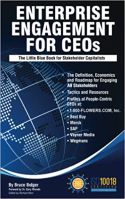
3. Books on implementation: Enterprise Engagement for CEOs and Enterprise Engagement: The Roadmap.
4. Advisory services and research: Strategic guidance, learning and certification on stakeholder management, measurement, metrics, and corporate sustainability reporting.
5. Permission-based targeted business development to identify and build relationships with the people most likely to buy.
Contact: Bruce Bolger at TheICEE.org; 914-591-7600, ext. 230.