

The Women Who Practiced Stakeholder Capitalism Before It Had a Name
Indra Nooyi: Performance With Purpose
Eileen Fisher: Building a Business Around Stewardship
Rose Marcario: Former Patagonia CEO and President
Kendra Scott: Family, Fashion, and Philanthropy
Rosalind Brewer: Former President, CEO Sam’s Club
Angela Ahrendts: Former CEO Burberry
Donna Carpenter: Chair, Burton Snowboards
Helena Helmersson: Former H&M CEO
Colleen Wegman, President and CEO of Wegmans Food Markets
Taylor Swift, Entertainer
What These Leaders Share in Common
Click here to subscribe to the ESM weekly e-newsletter.
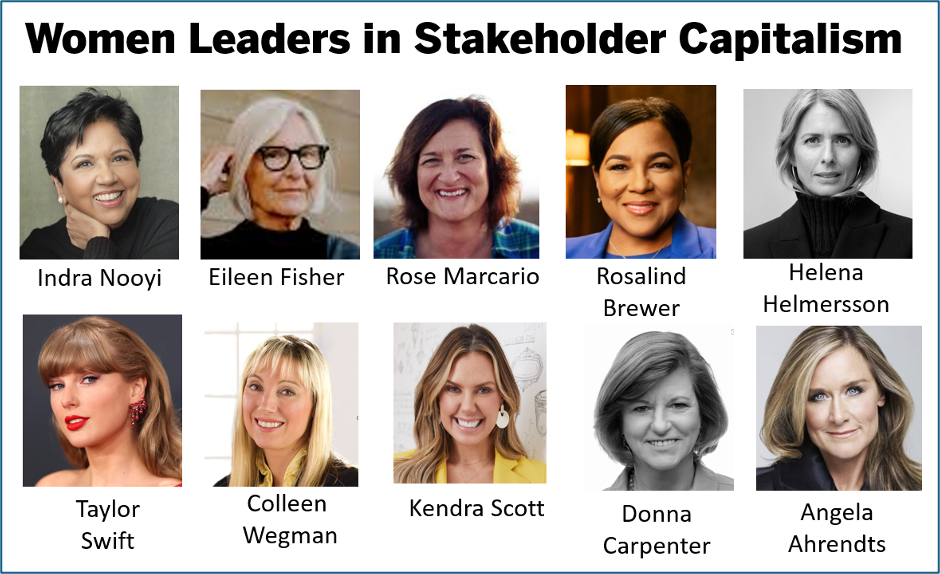 When stakeholder capitalism is discussed, the names most often cited are R. Edward Freeman, Klaus Schwab, Paul Polman, Marc Benioff, or Hubert Joly.
That is not surprising. Most of these individuals are academics, authors, thought leaders, or executives who have publicly championed the idea that businesses should create value not only for shareholders but also for employees, customers, suppliers, communities, and society at large.
Less frequently discussed is the role women have played in putting these ideas into practice.
Many of the organizations most often cited as examples of stakeholder-oriented management have been founded or led by women who rarely used the term stakeholder capitalism at all. Rather than writing books about the concept, they demonstrated its principles through the way they built companies, managed employees, served customers, supported communities, and approached long-term value creation.
In fact, one could argue that while many men helped define stakeholder capitalism, many women helped prove it.
Indra Nooyi: Performance With Purpose
As CEO of PepsiCo, Indra Nooyi launched the company's groundbreaking "Performance with Purpose" strategy years before stakeholder capitalism became a more mainstream topic. The initiative sought to align financial performance with healthier products, environmental stewardship, employee development, and community impact. In discussions with both Boston Consulting Group and Duke University's Fuqua School of Business, Nooyi argued that long-term business success depends on creating value for society as well as shareholders.
Eileen Fisher: Building a Business Around Stewardship
Long before sustainability became fashionable, Eileen Fisher, founder of the fashion company of the same name, built her company around responsible sourcing, environmental stewardship, employee ownership, and long-term thinking.
Her company became a certified B Corporation and later transferred a significant ownership stake to employees through an Employee Stock Ownership Plan. Today it remains one of the most frequently cited examples of a purpose-driven company balancing the interests of customers, employees, communities, and investors.
Rose Marcario: Former Patagonia CEO and President
Under Rose Marcario's leadership, Patagonia became one of the world's most admired examples of stakeholder-oriented business. The company strengthened its environmental initiatives, expanded ethical sourcing standards, invested in employee well-being, and deepened its commitment to community impact while continuing to grow profitably.Kendra Scott: Family, Fashion, and Philanthropy
Kendra Scott built her Kendra Scott jewelry company around a philosophy of "Family, Fashion, and Philanthropy," integrating charitable giving, employee support, and community engagement into the business model from its earliest days.
The company and foundation have donated millions of dollars to charitable causes while maintaining a strong focus on employee culture and customer relationships.
Rosalind Brewer: Former President, CEO Sam’s Club
Now serving as Interim President of Spelman College, Rosalind Brewer earned her reputation as a practitioner of stakeholder capitalism principles through a distinguished career leading some of America's largest consumer businesses.
As President and CEO of Sam's Club, Chief Operating Officer of Starbucks, and later CEO of Walgreens Boots Alliance, Brewer consistently emphasized that long-term business success depends on investing in employees, earning customer trust, strengthening supplier relationships, and supporting the communities businesses serve. Throughout her career, she has championed inclusive leadership, workforce development, supplier diversity, and ethical business practices as drivers of sustainable growth. Her record demonstrates that creating value for employees, customers, suppliers, communities, and shareholders is not only compatible with strong business performance but essential to achieving it.
Angela Ahrendts: Former CEO Burberry
As CEO of Burberry, Angela Ahrendts became known for emphasizing culture, purpose, employee engagement, and values-driven leadership. She frequently argued that organizations perform best when employees understand and connect with a larger mission and see how their work contributes to organizational success.
Donna Carpenter: Chair, Burton Snowboards
As CEO and later Chair of Burton Snowboards, Donna Carpenter helped transform the company into one of the most respected purpose-driven businesses in the outdoor industry. Burton has consistently emphasized employee well-being, environmental stewardship, community involvement, and stakeholder governance.
Under Carpenter's leadership, Burton became a certified B Corporation and developed a reputation for putting people and purpose at the center of decision-making.
Helena Helmersson: Former H&M CEO
Former H&M Group CEO Helena Helmersson earned international recognition for making sustainability, responsible sourcing, and ethical business practices central to the strategy of one of the world's largest fashion retailers. After leading H&M's sustainability initiatives for a decade before becoming CEO, she championed greater supply chain transparency, circular fashion, employee development, and collaboration across the industry to reduce environmental impact while keeping fashion accessible. Helmersson consistently argued that long-term business success requires balancing the interests of customers, employees, suppliers, communities, and shareholders. Her leadership demonstrated that even large global companies can embed stakeholder principles into their business strategy while pursuing sustainable growth.
Colleen Wegman, President and CEO of Wegmans Food Markets
Colleen Wegman exemplifies stakeholder capitalism by demonstrating that long-term business success comes from creating value for everyone connected to the enterprise—not only customers, but employees, suppliers, communities, and the environment. Wegmans is a recipient of the Enterprise Engagement Alliance’s Golden Rule designation.
Under her leadership, Wegmans has built one of the nation's strongest reputations for customer service while consistently earning recognition as one of America's best employers. The company's investment in employee development, generous benefits, career opportunities, work-life balance, and community engagement reflects a belief that exceptional customer experiences begin with engaged people.
At the same time, Wegmans emphasizes sustainable sourcing, healthy living, and environmental stewardship, showing that commercial success and social responsibility can reinforce one another. Rather than viewing stakeholder interests as competing priorities, Colleen Wegman has demonstrated that aligning them creates enduring value, strong customer loyalty, and sustainable business growth—making her an outstanding example of Golden Rule leadership in practice.
Taylor Swift, Entertainer
Taylor Swift belongs on a list of stakeholder capitalist women because she has consistently demonstrated that extraordinary business success can be achieved by creating value for multiple stakeholders rather than focusing solely on financial returns. Throughout her career, she has cultivated unusually strong relationships with fans through transparency and direct engagement, rewarded employees and tour crews with significant bonuses and public recognition, collaborated closely with business partners across her global tours, and invested in the communities she visits through substantial charitable donations.
Swift is a recipient of the Enterprise Engagement Alliance’s Golden Rule designation.
Her decision to re-record her early albums to regain ownership of her work also highlighted the importance of fair treatment and long-term value creation for creators. Together, these actions reflect a leadership philosophy that aligns commercial success with the interests of customers, employees, partners, and communities—the defining characteristics of stakeholder capitalism.
What These Leaders Share in Common
These women come from different industries, countries, and backgrounds. Some led public corporations. Others built privately held businesses, foundations, or social enterprises. Yet their approaches share striking similarities.
They emphasize long-term value creation over short-term optimization. They view employees as assets rather than costs. They focus intensely on customer trust and loyalty. They recognize the importance of communities and environmental stewardship. Most importantly, they reject the notion that profitability and responsibility are mutually exclusive.
None achieved success by ignoring financial performance. Rather, they sought to improve financial performance by strengthening relationships with the stakeholders who contribute to business success.
One criticism of stakeholder capitalism is that it is often portrayed as a movement led by male academics, consultants, and CEOs. The reality is more nuanced. While many of the most visible advocates may be men, many of the most compelling practitioners have been women. They may not have written books about stakeholder capitalism or spoken frequently about the concept itself. Instead, their leadership has demonstrated the principles stakeholder advocates promote: creating value for employees, customers, communities, investors, and society as a whole.
Enterprise Engagement Alliance Services
 Celebrating our 17th year, the Enterprise Engagement Alliance helps organizations enhance performance through:
1. Information and marketing opportunities on stakeholder management and total rewards:
- ESM Weekly on stakeholder management since 2009. Click here to subscribe; click here for media kit.
- RRN Weekly on total rewards since 1996. Click here to subscribe; click here for media kit.
- EEA YouTube channel on enterprise engagement, human capital, and total rewards since 2020
 Management Academy to enhance future equity value for your organization.
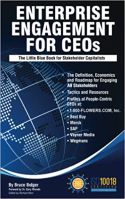
3. Books on implementation: Enterprise Engagement for CEOs and Enterprise Engagement: The Roadmap.
4. Advisory services and research: Strategic guidance, learning and certification on stakeholder management, measurement, metrics, and corporate sustainability reporting.
5. Permission-based targeted business development to identify and build relationships with the people most likely to buy.
Contact: Bruce Bolger at TheICEE.org; 914-591-7600, ext. 230.