

HBR: Stop Merely Surveying Employees—Start Solving Problems With Them
 A new Harvard Business Review article outlines a six-step process for turning frontline employee knowledge into practical improvements in productivity, customer experience, technology adoption, and organizational performance.
Why Traditional Engagement Surveys Fall Short
A Six-Step Process for Turning Ideas Into Action
A Core Principle of Total Quality Management
Click here to subscribe to the ESM weekly e-newsletter.
Organizations frequently spend heavily on engagement surveys, consultants, technology, and transformation programs while overlooking the people most likely to understand what is actually getting in the way: employees closest to the work. A new Harvard Business Review article argues that frontline workers see customer frustrations,
 inefficient processes, unnecessary tasks, and poorly designed technologies before senior leaders do. The challenge is not simply getting employees to speak up but creating a disciplined process that turns their knowledge into tested solutions—a finding that directly reinforces the EEA Impact Academy’s focus on involving employees in all major organizational initiatives, as has long been standard practice in Total Quality Management.
The article, “Frontline Workers Know How to Solve Your Organization’s Biggest Problems,” was published July 20, 2026 and was written by Constance Noonan Hadley and Deborah Lovich. Hadley is an organizational psychologist, founder of the Institute for Life at Work, and a fellow of the Institute for Leadership & Work at Boston University’s Questrom School of Business. Lovich is a managing director and senior partner in the Boston office of Boston Consulting Group and a former Future of Work fellow at the BCG Institute.
Why Traditional Engagement Surveys Fall Short
Hadley and Lovich argue that traditional engagement surveys may measure how employees feel without revealing enough about the operational barriers preventing them from performing at their best. Even when surveys uncover useful information, many organizations fail to discuss the findings thoroughly with employees or involve them in designing and testing the response.
This can create a familiar cycle: employees are asked for feedback, management reviews the results, and little visible change follows. Over time, employees may conclude that participating is pointless.
The authors propose replacing this largely transactional approach with a structured listening and problem-solving process. Their central point is that frontline employees do more than provide opinions. They shape the customer experience, encounter operational friction firsthand, and can tell whether a new process or technology makes work better—or simply adds another layer of complexity.
A Six-Step Process for Turning Ideas Into Action .png)
The article recommends a disciplined six-step approach:
- Conduct structured, confidential interviews to understand employee experiences and identify issues that standard surveys may miss.
- Develop customized surveys based on what was learned rather than relying solely on generic engagement questions.
- Share the findings with employees and continue the conversation to verify the conclusions and explore root causes.
- Bring employees and leaders together to co-create potential solutions.
- Pilot proposed changes as experiments, with defined measures that make it possible to evaluate what works.
- Repeat and extend the process into other departments and business challenges.
A Core Principle of Total Quality Management
This approach closely reflects the principles of Total Quality Management, which treats continuous improvement as the responsibility of everyone involved in producing value—not simply senior executives or a specialized quality department.
The EEA Impact Academy applies those same principles to people management. Its curriculum emphasizes engaging employees and other relevant stakeholders in the practical work of setting goals, improving processes, testing solutions, and measuring results. Engagement, in this model, is not an annual survey, communications campaign, or recognition program. It is a management system for involving people in achieving measurable organizational objectives.
The HBR article therefore provides another reminder that organizations cannot sustainably impose productivity, customer-experience, cultural, or AI transformations from the top down. The people expected to implement a change should be involved from the beginning—not only to build support, but because they often possess information and practical knowledge unavailable anywhere else in the organization.
Enterprise Engagement Alliance Services
 Celebrating our 17th year, the Enterprise Engagement Alliance helps organizations enhance performance through:
1. Information and marketing opportunities on stakeholder management and total rewards:
- ESM Weekly on stakeholder management since 2009. Click here to subscribe; click here for media kit.
- RRN Weekly on total rewards since 1996. Click here to subscribe; click here for media kit.
- EEA YouTube channel on enterprise engagement, human capital, and total rewards since 2020
 Management Academy to enhance future equity value for your organization.
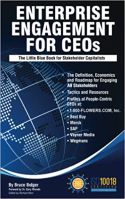
3. Books on implementation: Enterprise Engagement for CEOs and Enterprise Engagement: The Roadmap.
4. Advisory services and research: Strategic guidance, learning and certification on stakeholder management, measurement, metrics, and corporate sustainability reporting.
5. Permission-based targeted business development to identify and build relationships with the people most likely to buy.
Contact: Bruce Bolger at TheICEE.org; 914-591-7600, ext. 230.