

WorldatWork Study: Recognition, Well-Being and Growth Predict Retention Better Than Pay Alone
Satisfaction Does Not Necessarily Mean Engagement
Recognition and Well-Being Have Greater Strategic Importance
Managers May Be Confidently Misreading Employees
What the Study Measures Economically—and What It Does Not
Implications for Senior Management
Click here to subscribe to the ESM weekly e-newsletter.
Employees report relatively high satisfaction with benefits, well-being programs and compensation, yet fewer than half say they are extremely likely to remain with their employer over the next year. The research finds that recognition, career development and well-being—areas with lower satisfaction ratings—are more closely associated with retention and employee advocacy than compensation and benefits. It also identifies a potentially costly disconnect between what employees value and what managers believe they value.
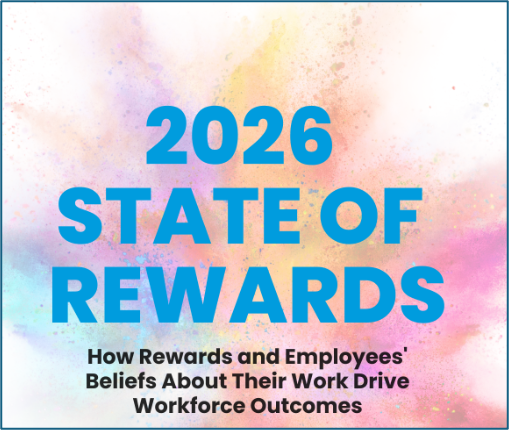 Published by WorldatWork in April 2026, The 2026 State of Rewards was conducted in partnership with the Human Resources Certification Institute and the International Thought Leader Network.
 The report does not directly address the financial impacts of its findings but notes the importance of connecting employees to focus on work with the most meaningful outcomes.
The findings are based on an online survey distributed through the WorldatWork, HRCI and ITLN databases from January 19 through February 25, 2026. The study received 1,316 completed responses and reports a margin of error of plus or minus 2.7% at the 95% confidence level. The sample included 500 individual contributors, 324 mid-level managers and 492 senior leaders. Almost all respondents were full-time employees, and 83% worked in human resources or people operations. The data were evaluated using univariate, cross-tabulation and multivariate analyses.
The heavy concentration of HR and people professionals should be considered when applying the findings to the broader workforce.
Satisfaction Does Not Necessarily Mean Engagement
The report identifies what it calls the “Rewards Paradox.” Employee satisfaction is reasonably strong for benefits at 77%, well-being at 73% and compensation at 69%. Satisfaction is lower for recognition at 58% and career development at about 50%.
Despite the relatively positive ratings for foundational rewards, only 44% of employees say they are extremely likely to stay with their employer during the next year. Among those considering leaving, 75% have searched for another job, 52% have applied and 38% have interviewed elsewhere. Employee advocacy is similarly weak. The study reports that promoters, passive employees and detractors are divided almost evenly, producing a mean employee Net Promoter Score of only 2.1. In other words, satisfaction with pay and benefits does not automatically translate into enthusiasm, engagement or loyalty to the organization.
Recognition and Well-Being Have Greater Strategic Importance
The report’s regression analysis provides one of its most significant findings. Compensation and benefits receive the highest satisfaction scores but are the weakest predictors of retention. Career development, recognition and well-being are more closely associated with whether employees intend to remain and whether they recommend the organization.
Employees dissatisfied with career development are about 1.9 times more likely to say they are extremely unlikely to stay. Those dissatisfied with well-being are approximately 1.7 times more likely to report low retention intent, while employees dissatisfied with recognition are about 1.5 times more likely to do so. Well-being, career development and recognition also emerge as the strongest drivers of employee Net Promoter Scores.
The implication is not that compensation is unimportant. Competitive pay remains essential for attracting, engaging and retaining people, but the study suggests that it increasingly functions as a baseline expectation rather than a reliable source of differentiation. The differentiators are whether employees find their work meaningful, believe they matter, see opportunities to grow and feel that their contributions are noticed.
Managers May Be Confidently Misreading Employees
Nearly seven in 10 managers say they are very or extremely confident that they understand what employees value. The findings suggest otherwise. Managers overestimate the importance employees place on career advancement by 15 percentage points while underestimating flexibility by 14 points, benefits by eight points and paid time off by six points.
The situation is complicated by the finding that managers themselves report comparatively weak satisfaction with compensation, recognition and career development and have the lowest percentage of employee Net Promoter Score promoters among the role levels studied.
This matters because managers are the primary channel through which recognition, career development, communication and the broader rewards strategy become part of employees’ daily experience. A strategy designed at headquarters can lose much of its value if managers are unsupported, dissatisfied or working from incorrect assumptions about their people.
What the Study Measures Economically—and What It Does Not
The report places rewards in an economic context, noting that employers spend approximately $77,000 per employee annually on compensation and citing estimates that disengagement costs the US economy $1.9 trillion in lost productivity. It also cites estimates that replacing an employee can cost from one-half to twice the individual’s annual salary.
Within its own survey, however, the principal outcome measures are employee satisfaction, retention intent, job-search behavior, eNPS and perceptions of meaning, mattering and growth. Organizational financial performance is captured only through broad, self-reported descriptions such as whether the organization “did very well,” “did pretty well” or “just got by.” The study does not directly correlate rewards practices with independently verified productivity, revenue growth, profitability, quality, customer satisfaction or other operating outcomes. It therefore provides valuable directional evidence about workforce attitudes and retention risk, but not a complete financial impact model.
Implications for Senior Management
Senior management should avoid treating high satisfaction with compensation and benefits as proof that the workforce is fully engaged or likely to stay. The findings support a more integrated approach that combines competitive pay with meaningful work, flexibility, employee well-being, relevant development opportunities, regular recognition and stronger manager communication. Leaders also need feedback systems that identify what different employee groups value rather than relying solely on management assumptions.
Perhaps most importantly, organizations should connect recognition and rewards to measurable business and employee outcomes. Satisfaction and eNPS are useful indicators, but senior leaders also should examine turnover, productivity, quality, innovation, absenteeism, customer satisfaction and financial performance.
The report’s broader message is that rewards create greater value when employees understand how their work matters, see opportunities for growth and feel genuinely recognized. Compensation may bring people into an organization, but the daily experience of purpose, support and appreciation is more likely to determine whether they contribute, advocate and remain.
Enterprise Engagement Alliance Services
 Celebrating our 17th year, the Enterprise Engagement Alliance helps organizations enhance performance through:
1. Information and marketing opportunities on stakeholder management and total rewards:
- ESM Weekly on stakeholder management since 2009. Click here to subscribe; click here for media kit.
- RRN Weekly on total rewards since 1996. Click here to subscribe; click here for media kit.
- EEA YouTube channel on enterprise engagement, human capital, and total rewards since 2020
 Management Academy to enhance future equity value for your organization.
3. Books on implementation: Enterprise Engagement for CEOs and Enterprise Engagement: The Roadmap.
4. Advisory services and research: Strategic guidance, learning and certification on stakeholder management, measurement, metrics, and corporate sustainability reporting.
5. Permission-based targeted business development to identify and build relationships with the people most likely to buy.
Contact: Bruce Bolger at TheICEE.org; 914-591-7600, ext. 230.