

HR Priorities Shift— Engagement, Well-Being, and Recognition Need to Demonstrate Impact on Business Results
BCG’s global 2026 HR study finds growing emphasis on workforce planning, leadership, skills, and technology, even as evidence mounts that engagement and well-being are essential to retention and financial performance.
Engagement Falls in the Rankings—but Not in Strategic Importance
About the Report
HR’s Focus Moves Toward Business Execution
The Financial Case Continues to Strengthen
Implications for Recognition and Incentive Providers
Engagement and Analytics Must Move Beyond Scores
Click here to subscribe to the ESM weekly e-newsletter.
Engagement Falls in the Rankings—but Not in Strategic Importance
About the Report
HR’s Focus Moves Toward Business Execution
The Financial Case Continues to Strengthen
Implications for Recognition and Incentive Providers
Engagement and Analytics Must Move Beyond Scores
Click here to subscribe to the ESM weekly e-newsletter.
The most important conclusion from Creating People Advantage 2026: Four Power Moves for the CHRO is not that employee engagement, well-being, and recognition matter less. It is that these practices can no longer stand alone as programs, benefits, or technology features. They must be connected directly with workforce performance, retention, productivity, customer outcomes, and financial results.
That shift has major implications for senior management and for the recognition, incentives, engagement, and people analytics fields. Organizations are investing heavily in artificial intelligence, HR platforms, workforce planning, leadership development, and new technology features. Unless those investments improve employee behavior, capability, commitment, and performance, they risk becoming expensive infrastructure without a clearly demonstrated return.
BCG’s own findings reinforce the business case. Organizations reporting strong employee engagement and well-being capabilities had an average annual turnover rate of 10.9%, compared with 16.2% among organizations with weak capabilities. Recognition and rewards, meanwhile, fell in HR’s priority rankings, suggesting that providers can no longer rely primarily on claims about culture, appreciation, participation, or employee satisfaction. They increasingly must show how their solutions affect measurable business outcomes.
Engagement Falls in the Rankings—but Not in Strategic Importance
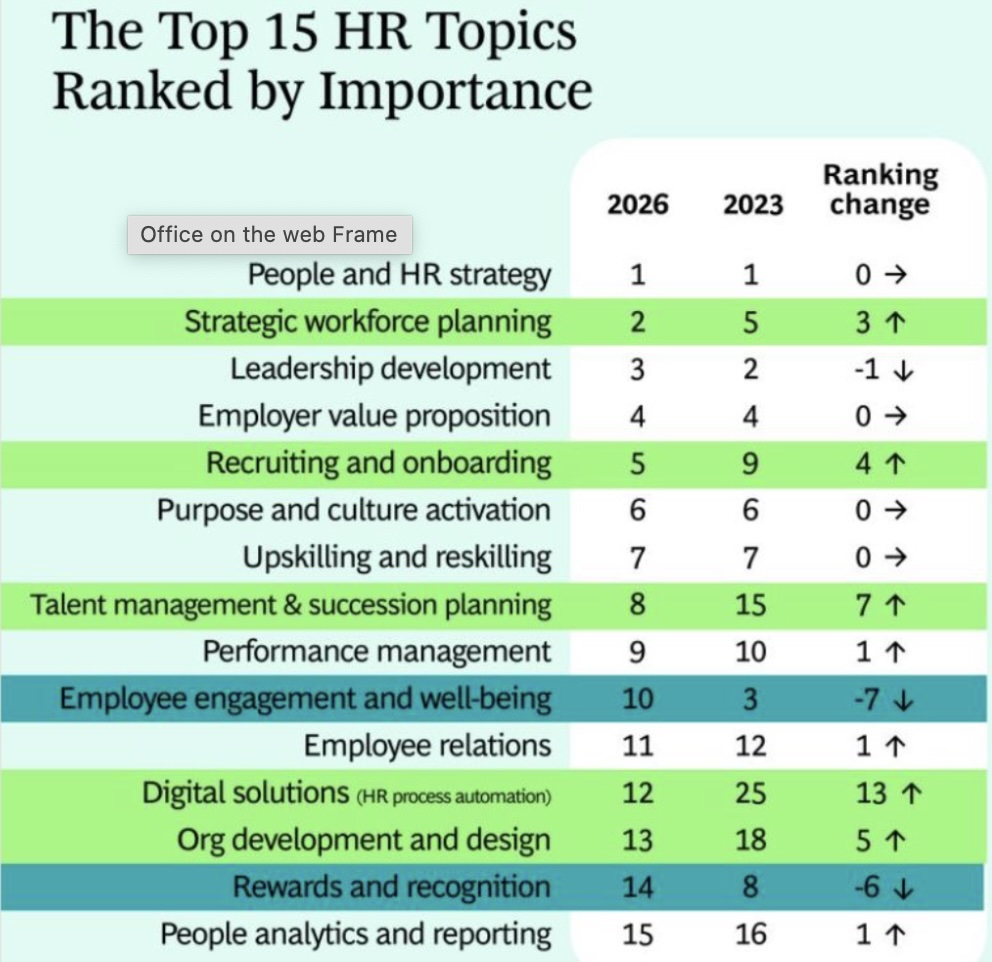
Employee engagement and well-being fell from third to tenth among HR’s future priorities, while rewards and recognition declined from eighth to fourteenth. At the same time, strategic workforce planning, recruiting, leadership development, talent management, process automation, and skills development moved upward.
At first glance, the rankings could suggest declining interest in employee-centered strategies. A more meaningful interpretation is that engagement and well-being are becoming foundational rather than differentiating.Organizations increasingly assume that they must have a reasonably engaged, healthy, and aligned workforce. The new priority is using that foundation to address pressing business needs, including skills shortages, artificial intelligence adoption, succession planning, organizational restructuring, productivity, and workforce capacity.
This creates a potential risk. Management may interpret the lower rankings as a reason to move resources from engagement and well-being into technology. The report suggests that would be a mistake. Technology and artificial intelligence are tools, not ends in themselves. Their value ultimately depends on whether employees understand, accept, and effectively use them.
About the Report
 Published in March 2026, Creating People Advantage 2026: Four Power Moves for the CHRO was produced by Boston Consulting Group, a global management consulting firm, in partnership with the World Federation of People Management Associations, a global network of national and regional HR organizations. The authors are Philipp Kolo, Jens Baier, Frank Breitling, Fang Ruan, and Suketu Shah of BCG, together with WFPMA contributors Peck Kem Low, Anthony Ariganello, Aida Troncoso, Lucas van Wees, Amy Dufrane, Ulrik S. Brix, and Kai Helfritz.
 The findings are based on a proprietary online survey of 7,115 participants across 115 countries and administrative regions and 25 industries. Respondents assessed 28 people-management topics based on their anticipatedimportance during the next two to three years and their organizations’ current capabilities. The sample included 1,418 C-suite and vice president-level respondents. However, 92% of all respondents worked in HR, meaning that the rankings primarily reflect the HR profession’s view of its evolving responsibilities. BCG also used multiple regression analysis to examine relationships between HR capabilities, employee turnover, and the time required to fill critical positions. The authors appropriately caution that these associations do not necessarily prove causation.
HR’s Focus Moves Toward Business Execution
People and HR strategy remain the top-ranked priorities, followed by strategic workforce planning, leadership development, employer value proposition, recruiting and onboarding, purpose and culture activation, upskilling and reskilling, talent management, performance management, and employee engagement and well-being. The largest increase involved digital solutions such as HR process automation, which rose 13 places to twelfth. Talent management and succession planning rose seven positions, recruiting and onboarding four, and strategic workforce planning three.
By contrast, engagement and well-being fell seven positions, rewards and recognition six, flexible work seven, and diversity, equity, and inclusion management six. These shifts suggest that HR is under growing pressure to become more closely involved in business execution. Companies are asking how many people they will need, which skills will be required, how technology will alter jobs, where leadership gaps exist, and how quickly critical roles can be filled.
Engagement remains essential, but it increasingly must contribute to answering those questions.
The Financial Case Continues to Strengthen
BCG found that companies reporting strong engagement and well-being capabilities had annual employee turnover averaging 10.9%, versus 16.2% among companies reporting weak capabilities—a difference of 5.3 percentage points. The statistical model has limited explanatory power and cannot establish that engagement alone caused the difference. Nevertheless, the association is significant because employee turnover creates measurable costs through recruiting, onboarding, lost productivity, disruption, and the loss of institutional knowledge.
The findings are consistent with a growing body of research connecting employee experience with organizational performance. Gallup’s large-scale engagement research has found relationships between engagement and productivity, profitability, customer loyalty, retention, absenteeism, safety, and quality. Research from Oxford University’s Wellbeing Research Centre involving 1,782 publicly listed companies also found associations between higher workplace well-being and stronger return on assets, gross profits, company valuation, and subsequent performance.
None of these studies proves that engagement or well-being alone produces financial success. Taken together, however, they make it increasingly difficult to argue that workforce experience and business performance can be managed separately.
Implications for Recognition and Incentive Providers
The decline of rewards and recognition from eighth to fourteenth should serve as a warning to the recognition industry. Recognition can no longer be justified primarily through platform participation, award volume, employee testimonials, points issued, or claims that employees appreciate being appreciated. These measures may demonstrate activity, but they do not establish business impact.
Providers must show how recognition reinforces behaviors related to retention, productivity, customer satisfaction, safety, quality, innovation, learning, sales, or successful organizational change. Adding more features to recognition technology may improve the user experience, but features alone do not answer the questions increasingly asked by finance and senior management: What changed, what value was created, and how do we know?
The same principle applies to incentive programs. Incentives should be positioned as behavior-change and performance-management tools rather than simply mechanisms for distributing rewards. Programs should begin with business objectives, identify the behaviors capable of influencing those objectives, and measure whether changes in behavior correspond with changes in results.
Engagement and Analytics Must Move Beyond Scores
For engagement solution providers, the findings support a move beyond annual surveys, dashboards, and benchmark scores. Employee listening and engagement efforts must be connected with leadership, communications, job design, learning, recognition, performance management, well-being, and access to the information employees need to contribute to organizational goals.
The opportunity for people analytics is equally significant. BCG urges HR to move beyond functional measures such as time-to-hire or engagement scores. The next generation of analytics must connect people data with operational and financial information, establish meaningful baselines, track changes over time, and distinguish credible evidence from convenient correlations.
The report’s larger message is that engagement, well-being, recognition, incentives, technology, and analytics cannot continue to operate as separate disciplines. Organizations that integrate them into business planning and measurement will be better positioned to improve performance and demonstrate value. Those that continue to invest primarily in technology features and promotional claims may find that senior management increasingly views their offerings as discretionary expenses rather than strategic business tools.
Enterprise Engagement Alliance Services
 Celebrating our 17th year, the Enterprise Engagement Alliance helps organizations enhance performance through:
1. Information and marketing opportunities on stakeholder management and total rewards:
 Management Academy to enhance future equity value for your organization.
3. Books on implementation: Enterprise Engagement for CEOs and Enterprise Engagement: The Roadmap.
4. Advisory services and research: Strategic guidance, learning and certification on stakeholder management, measurement, metrics, and corporate sustainability reporting.
5. Permission-based targeted business development to identify and build relationships with the people most likely to buy.
Contact: Bruce Bolger at TheICEE.org; 914-591-7600, ext. 230.
Enterprise Engagement Alliance Services
Celebrating our 17th year, the Enterprise Engagement Alliance helps organizations enhance performance through:1. Information and marketing opportunities on stakeholder management and total rewards:
- ESM Weekly on stakeholder management since 2009. Click here to subscribe; click here for media kit.
- RRN Weekly on total rewards since 1996. Click here to subscribe; click here for media kit.
- EEA YouTube channel on enterprise engagement, human capital, and total rewards since 2020
Management Academy to enhance future equity value for your organization.3. Books on implementation: Enterprise Engagement for CEOs and Enterprise Engagement: The Roadmap.
4. Advisory services and research: Strategic guidance, learning and certification on stakeholder management, measurement, metrics, and corporate sustainability reporting.
5. Permission-based targeted business development to identify and build relationships with the people most likely to buy.
Contact: Bruce Bolger at TheICEE.org; 914-591-7600, ext. 230.