

Private Equitys Old Model Is Breaking the Next Opportunity Is Value Creation Not Extraction
 The enormous backlog of private-equity-owned companies that cannot be sold at expected returns may signal more than a temporary exit problem. It could point to a new investment opportunity: identifying companies that are unusually ineffective at converting their customer relationships and human capital into revenue, profits and future equity value.
Look for the Value-Creation Gap
The Data to Find These Companies Already Exists
A Different Private-Equity Playbook
From Financial Engineering to Management Engineering
What the EEI Comparisons Suggest for Private Equity
Click here to subscribe to the ESM weekly e-newsletter.
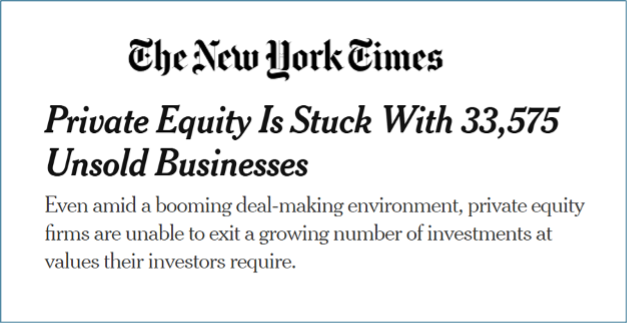
A recent New York Times report, Private Equity Is Stuck With 33,575 Unsold Businesses, provides a striking snapshot of the problem facing the private-equity industry. As of June 30, 2026, private-equity firms reportedly held 33,575 companies they had not exited, up from 32,451 at the end of 2025 and only 15,923 a decade ago.
The traditional formula has generally been to acquire a company, frequently using significant leverage; improve financial performance; and sell or take the company public within roughly five to seven years. For many years, falling interest rates, readily available leverage and expanding valuation multiples provided enormous tailwinds. Those conditions have changed. McKinsey's Global Private Markets Report 2026 notes that the conditions that once amplified private-equity returns—including declining interest rates, expanding multiples and abundant leverage—have passed. Increasingly, McKinsey concludes, superior returns will have to come from disciplined asset selection and actual operational value creation. Shouldn’t that include the ability to create tangible value through investments in people?
Based on the current stalemate until more favorable interest rates reappear, what if one of the greatest remaining sources of private-equity alpha is sitting in plain sight—the enormous amount of customer and employee value that poorly managed companies fail to convert into economic performance?
Look for the Value-Creation Gap
This article suggests a different way to hunt for acquisitions. Instead of focusing primarily on companies where costs can be cut, assets sold, debt added or financial structures optimized, look for companies with potentially valuable businesses that are simply not very good at converting their resources into value. Call it the value-creation gap. Imagine two competitors employing roughly similar numbers of people and serving comparable markets. One generates twice the profit per employee, substantially higher margins and stronger sustained growth.
Why? Traditional financial analysis identifies the difference. It does not necessarily explain it. The answer may lie in how effectively the companies manage the people who actually create the results: employees who design, sell and deliver products; customers who decide whether to buy again or recommend the company; distribution and supply-chain partners who affect quality and availability; and the managers who coordinate all of them. This is the opportunity that conventional due diligence can easily overlook because most of these assets never appear on a balance sheet.
The Data to Find These Companies Already Exists
The emerging field of human-capital analytics makes this thesis increasingly testable. The Enterprise Engagement Alliance's experimental Enterprise Engagement Index (EEI), for example, uses readily available financial and head-count data to compare companies based on revenue per employee, profit per employee, human-capital return on investment, profitability and sustained revenue growth. Its preliminary analysis suggests the strongest relationships are with profitability, profit per employee, operating margins and sustained growth. The EEA emphasizes that the findings demonstrate associations, not causation.
Customer and employee sentiment can then provide another layer of information. The EEA's Stakeholder Management Research Library compiles research going back decades connecting employee satisfaction, customer loyalty and organizational performance. The classic Service-Value Profit Chain, developed by professors at the Harvard Business School in the 1990s, for instance, connects employee satisfaction and productivity with customer value, customer satisfaction and loyalty, and ultimately growth and profitability.
More recent evidence reinforces the potential importance of human capital. An Oxford University Wellbeing Research Centre study covering more than one million employee responses at 1,782 publicly traded US companies found workplace wellbeing associated with stronger profitability, firm value and subsequent financial performance. Irrational Capital has gone further by developing its Human Capital Factor to identify relationships between employee experience and future equity performance. J.P. Morgan quantitative analysts found significant historical outperformance associated with the factor, providing additional evidence that information about how companies manage people may contain investment signals not fully captured in conventional financial analysis.
None of these measures should be viewed in isolation as a stock-picking or acquisition formula. Together, however, they suggest a potentially powerful additional lens for due diligence.
A Different Private-Equity Playbook
Consider what an acquisition strategy built around this concept might seek. The ideal candidate could have a recognizable brand, established customers, capable employees, useful products, viable markets and perhaps even respectable revenue—yet substantially underperform competitors in profit per employee, revenue per employee, margins, customer loyalty, employee engagement or growth. Instead of asking first, “What can we cut?”, this investor asks: “Why isn't this organization creating more value from the people and relationships it already has?”
That leads to a very different 100-day plan. Examine leadership quality. Identify obstacles preventing employees from serving customers effectively. Study turnover, quality, innovation, customer complaints, referrals and retention. Determine whether incentives encourage the right behaviors. Look at training, communications, job design, recognition, sales effectiveness and channel relationships. Find the friction that prevents willing employees and customers from creating greater economic value.
Then measure whether fixing those problems improves productivity, customer retention, growth, margins and ultimately equity value. This is essentially applying the principles of Total Quality Management to people: identify the causes of performance gaps, improve the processes and continuously measure the results.
From Financial Engineering to Management Engineering
There will always be a role for leverage, restructuring, procurement efficiencies and cost control. The New York Times data do not prove that private equity as an asset class is broken. They do suggest that a model overly dependent on cheap capital, financial engineering and favorable exits is increasingly difficult to sustain. The next great private-equity opportunity may therefore look almost like the original idea behind capitalism itself: buy an underperforming business and make it genuinely better. The difference is that investors now have far more data with which to identify where that potential improvement may reside.
Rather than merely finding companies with excess costs to remove, investors could search systematically for organizations with the largest value-creation gap—businesses with customers, employees, brands and market positions whose economic potential is being poorly realized. In a world where cheap leverage and expanding multiples can no longer be counted upon to manufacture returns, perhaps the most sustainable source of alpha is also the simplest: Create more value.
What the EEI Comparisons Suggest for Private Equity
The EEA's experimental EEI analysis provides a practical illustration of the potential opportunity. Across 47 industry comparisons, roughly two-thirds of the companies examined scored below the strongest competitor in their peer group, while about one-third ranked last among the companies selected. Because the EEI measures revenue per employee, profit per employee, human-capital ROI, profitability and sustained revenue growth, such gaps can serve as signals—not proof—that some organizations are substantially less effective than competitors at converting their people and customer relationships into economic value.
For private equity, the implication could be significant. A large competitive gap can become a screening tool for identifying acquisition candidates with viable products, customers and market positions but potentially fixable management-system weaknesses. Rather than assuming that underperformance requires cost cutting, due diligence can investigate whether the gap stems from leadership, turnover, incentives, training, sales effectiveness, customer retention, communications, channel relationships or other people-related factors. If those problems are structural, there may be little opportunity. If they are managerial and fixable, however, the performance gap itself could represent untapped equity value.
Most of the EEI comparisons use publicly available company data, providing benchmarks against which private acquisition candidates can be evaluated. Once a prospective buyer has access to a target company's financial and workforce information, the same analysis can be applied privately—potentially giving PE firms a systematic way to search for companies where better management of people and customers, rather than financial engineering alone, can become the investment thesis.
Here are 10 examples from the EEA Enterprise Engagement Index illustrate substantial differences among major competitors in their ability to convert human capital and other operating resources into measurable business results. All share having strong brand names. The EEI is a diagnostic indicator and does not establish that people-management practices alone caused the performance differences. In the technology space, short term spectacular growth should be considered an aberration not necessarily attributable to effective measurement.
| Industry | EEI Winner | Score | Trailing Competitor | Score | Lowest-Ranked Competitor | Score |
|---|---|---|---|---|---|---|
| Pharmaceuticals | Merck | 95.3 | Johnson & Johnson | 77.4 | Pfizer | 58.6 |
| High Technology | Microsoft | 95.6 | Alphabet/Google | 93.7 | Oracle | 64.5 |
| Streaming & Entertainment | Netflix | 100 | Walt Disney | 43 | Warner Bros. Discovery | 30 |
| Payments & Business Services | Stripe* | 89.9 | Fiserv | 72.3 | Deluxe | 38.5 |
| Small Home Appliances | SharkNinja | 89 | De'Longhi | 54 | Groupe SEB | 34 |
| Dating Apps | Grindr | 98 | Match Group | 82 | Bumble | 49 |
| Memory Semiconductors | SK Hynix | 100 | Micron | 80 | Samsung Electronics | 67 |
| Homebuilders | PulteGroup | 83.8 | D.R. Horton | 72.8 | Lennar | 69.2 |
| Airlines | Delta Air Lines | 64.2 | United Airlines | 60.9 | American Airlines | 42.2 |
| Big-Box Retail | Costco | 74–77 | Walmart | 60–65 | Target | 50–55 |
Enterprise Engagement Alliance Services
 Celebrating our 17th year, the Enterprise Engagement Alliance helps organizations enhance performance through:
1. Information and marketing opportunities on stakeholder management and total rewards:
- ESM Weekly on stakeholder management since 2009. Click here to subscribe; click here for media kit.
- RRN Weekly on total rewards since 1996. Click here to subscribe; click here for media kit.
- EEA YouTube channel on enterprise engagement, human capital, and total rewards since 2020
 Management Academy to enhance future equity value for your organization.
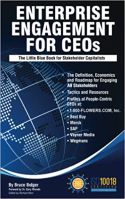
3. Books on implementation: Enterprise Engagement for CEOs and Enterprise Engagement: The Roadmap.
4. Advisory services and research: Strategic guidance, learning and certification on stakeholder management, measurement, metrics, and corporate sustainability reporting.
5. Permission-based targeted business development to identify and build relationships with the people most likely to buy.
Contact: Bruce Bolger at TheICEE.org; 914-591-7600, ext. 230.