

ICEE Independent Impact Measurement Service for Incentives, Recognition and Engagement
Applying Statistical Process Controls to People Investments
Independent Validation of Case Studies and Claims
Measuring the Organization as Well as the Program
Click here to subscribe to the ESM weekly e-newsletter.
The Enterprise Engagement Alliance, through its affiliate the International Center for Enterprise Engagement (ICEE), has launched an independent impact measurement and validation service designed to help organizations move beyond participation rates, satisfaction scores and anecdotal case studies to determine what their engagement investments accomplish in real terms.
.jpeg) The service is designed both for corporations seeking an independent assessment of their incentive, rewards, recognition, loyalty, event or other total rewards or other engagement programs and for solution providers wishing to independently validate client case studies or performance claims before publication. ICEE says its process can be used for employee incentives and recognition, customer loyalty, channel and supply-chain engagement, motivational events, training and other engagement initiatives.
The service is designed both for corporations seeking an independent assessment of their incentive, rewards, recognition, loyalty, event or other total rewards or other engagement programs and for solution providers wishing to independently validate client case studies or performance claims before publication. ICEE says its process can be used for employee incentives and recognition, customer loyalty, channel and supply-chain engagement, motivational events, training and other engagement initiatives.Darwin Hanson, CEO of ICEE and of TM Evolution, Brainerd, MN, a human capital analytics and total rewards firm, heads up the service. According to Hanson, “I see lots of general claims about the impact of recognition and rewards program but almost never any connection to C-suite level metrics aligned with the organization’s purpose, goals, objectives, and values. I see many ratings systems for technology in terms of ease of use and customer satisfaction, but few if any that independently validate impact using transparent processes.
Applying Statistical Process Controls to People Investments
Rather than creating a proprietary research methodology, the approach draws upon statistical process controls long used in Total Quality Management. The objective is to compare activities and behaviors with actual outcomes over time—including sales, productivity, value added, retention, loyalty and other measures relevant to the purpose and goals of the program. Using standardized rather than a proprietary process makes it easier to benchmark results.
The process uses data organizations often already maintain in financial, HR, sales, customer or program-management systems. Depending on the available information, the analysis can help distinguish correlations from stronger evidence of causation and identify which actions appear most closely associated with improvements in performance. This makes the service potentially useful not only for proving that a program worked, but for identifying why it worked, where it did not, and what could be improved.
Independent Validation of Case Studies and Claims 
For incentive, rewards, recognition, event or any type of marketing services or human resources consulting firms, the service provides a way to have client results evaluated by an independent third party rather than relying entirely on internally produced case studies. ICEE specifically offers solution providers the ability to validate case studies for publication without necessarily identifying the client publicly. That distinction could become increasingly important as corporate buyers ask for stronger evidence that engagement technologies and programs create financial or operational value rather than simply generating high participation, redemption or satisfaction rates.
Measuring the Organization as Well as the Program
The service can also examine engagement at the enterprise level. The EEA's Enterprise Engagement Index (EEI) provides a framework for evaluating how effectively organizations translate their investments in people and customers into productivity, profitability and growth. The index incorporates revenue per employee, profit per employee, Human Capital ROI, profitability and three-year revenue growth.
Used together, these approaches enable management to look at two different questions: Is a specific incentive, recognition or engagement program creating measurable value, and how effectively is the organization overall creating value through people? More information about the independent impact measurement and validation services is available from the International Center for Enterprise Engagement.
Enterprise Engagement Alliance Services
 Celebrating our 17th year, the Enterprise Engagement Alliance helps organizations enhance performance through:
1. Information and marketing opportunities on stakeholder management and total rewards:
- ESM Weekly on stakeholder management since 2009. Click here to subscribe; click here for media kit.
- RRN Weekly on total rewards since 1996. Click here to subscribe; click here for media kit.
- EEA YouTube channel on enterprise engagement, human capital, and total rewards since 2020
 Management Academy to enhance future equity value for your organization.
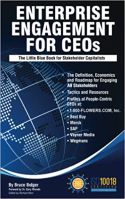
3. Books on implementation: Enterprise Engagement for CEOs and Enterprise Engagement: The Roadmap.
4. Advisory services and research: Strategic guidance, learning and certification on stakeholder management, measurement, metrics, and corporate sustainability reporting.
5. Permission-based targeted business development to identify and build relationships with the people most likely to buy.
Contact: Bruce Bolger at TheICEE.org; 914-591-7600, ext. 230.