

AIHR’s 2027 HR Priorities Put Business Impact at the Center of Work Redesign
From AI Adoption to Better Work Design
Impact Measurement Is Explicit and Repeated
Engagement Is Embedded in the Recommendations
Well-Being Is Not Developed as a Distinct Priority
An Agenda for Enterprise Contribution
Click here to subscribe to the ESM weekly e-newsletter.
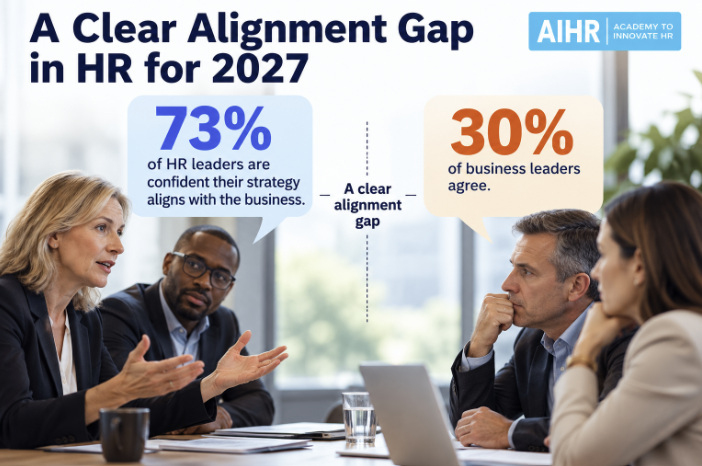
The 2027 HR Priorities: Redesigning for the Future report argues that HR must redesign work, talent development, decision-making authority, its own operating model, and investment priorities to deliver greater business value. Impact measurement is a recurring theme, with recommendations to establish baselines, test changes, and replace activity measures with business outcomes.
Employee engagement, it asserts, is addressed through meaningful work, motivation, trust, communication, feedback, and development opportunities, rather than through a separate engagement strategy. Well-being receives little explicit attention. These distinctions reflect the report’s purpose: an agenda for adapting HR to an increasingly interconnected human and AI workplace, rather than a comprehensive guide to every HR responsibility.
Published by AIHR, an HR training and development provider, the report names three authors: Dr. Marna van der Merwe, Research & Insights Lead; Dr. Dieter Veldsman, Chief Scientist; and Erik van Vulpen, Founder and Dean, all at AIHR Founder and Dean. It combines findings from AIHR research with external reports from organizations including Deloitte, Microsoft, the World Economic Forum, Boston Consulting Group, Bain, Mercer, and Talent Strategy Group. It is best understood as a research-informed strategic analysis. The document does not present a single new survey with a unified sample and methodology; its statistics come from multiple underlying sources.
From AI Adoption to Better Work Design
 The report’s central argument is that adding AI to existing jobs does not necessarily improve the work system. Employees may save time on individual tasks while spending additional time prompting, checking, and correcting outputs. Responsibilities can become less clear even when execution becomes faster.
AIHR recommends selecting one or two consequential workflows, mapping their tasks, decisions, and handoffs, and determining where AI adds value, where human judgment remains essential, and who verifies results. Organizations should pilot the redesigned workflow before expanding it.
Technology investment becomes a management process involving job design, accountability, learning, and feedback. The report also recognizes that organizations must preserve opportunities for employees to develop expertise as AI absorbs tasks that previously provided practical learning experiences.
Its second priority extends this thinking to talent. Rather than managing hiring, learning, succession, and mobility as separate processes, organizations should develop and deploy capabilities where the business needs them. Recommended actions include internal talent markets, rotations, apprenticeships, deliberate knowledge transfer, and the removal of outdated job requirements.
Impact Measurement Is Explicit and Repeated
The report clearly addresses impact measurement. In its work-redesign recommendations, AIHR calls for measuring effects on productivity, quality, trust, employee experience, and business outcomes. Its talent recommendations include establishing a baseline and tracking capability growth, internal mobility, succession readiness, and how quickly capabilities reach strategic priorities.
The section on HR’s decision-making authority makes the strongest distinction between activity and impact. It recommends replacing activity-based success measures with outcomes linked to commercial and business performance. Workforce analytics and scenario planning should help shape investment and transformation decisions before those decisions are finalized.
Measurement also appears in the recommendations for HR’s operating model. Organizations should assess role clarity, the administrative burden on strategic roles, and business impact. In the investment section, the authors recommend tracking where released budget and capacity are reinvested and what that reinvestment produces.
This is a substantive measurement agenda, but it is not a complete financial measurement methodology. The report does not supply a standardized ROI calculation, a detailed approach to attributing business results to particular interventions, or a common dashboard connecting workforce outcomes with financial performance. Its contribution is to establish what HR should demonstrate and where measurement belongs in management decisions.
Readers can use the report to frame an evidence-based transformation agenda, while still needing to develop the measures, data, and evaluation methods appropriate to their organizations.
Engagement Is Embedded in the Recommendations
Although employee engagement is not presented as a separate priority, several recommendations address conditions relevant to it. The authors explicitly call for tracking meaningful work and motivation, maintaining employee communication and feedback during transitions, and measuring trust and employee experience.
AIHR warns that automating entry-level work can remove the experiences through which employees build judgment, creativity, and critical thinking. Its response is to redesign development pathways deliberately, rather than assume that traditional career progression will continue to function.
These recommendations connect engagement with how work is organized and experienced. They suggest that motivation cannot be considered separately from responsibilities, opportunities to learn, confidence in decisions, and the ability to contribute.
However, the report does not provide a comprehensive engagement framework. It does not develop an employee-listening methodology, engagement survey system, or coordinated recognition and rewards strategy. Rewards and culture appear among the advisory responsibilities of HR business partners but are not explored in detail. Its engagement contribution therefore lies primarily in work design and capability development.
Well-Being Is Not Developed as a Distinct Priority
Employee well-being is largely absent as an explicit subject. The report does not develop recommendations or measures for mental health, burnout, physical health, work-life balance, or employee well-being programs.
Some proposed changes could affect well-being, including clearer responsibilities, reduced administrative burdens, meaningful work, and more deliberate management of AI transitions. Those are potential implications of the recommendations, rather than outcomes demonstrated by the report.
For organizations applying its agenda, this leaves a practical question: does redesigned work improve performance while sustaining employees’ ability to perform over time? Measures of workload, stress, and well-being could complement the report’s proposed productivity, quality, trust, and employee-experience measures. That is an ESM implementation consideration, rather than a recommendation explicitly developed by AIHR.
An Agenda for Enterprise Contribution
The report’s remaining priorities reinforce its central message. HR needs shared authority over consequential workforce decisions, an operating model that allocates work effectively among people and technology, and investment directed toward capabilities that create business value.
Its conclusion makes organizational performance the ultimate test of transformation. For ESM readers, the report offers a useful agenda for connecting workforce management with business execution. Its strongest contribution is the repeated demand for evidence of impact; engagement-related conditions are embedded in the proposed work systems, while total rewards and well-being remain an area organizations would need to address more explicitly than indicated in this report.
Enterprise Engagement Alliance Services
 Celebrating our 18th year, the Enterprise Engagement Alliance helps organizations enhance performance through:
1. Information and marketing opportunities on stakeholder management and total rewards:
- ESM Weekly on stakeholder management since 2009. Click here to subscribe; click here for media kit.
- RRN Weekly on total rewards since 1996. Click here to subscribe; click here for media kit.
- EEA YouTube channel on enterprise engagement, human capital, and total rewards since 2020
 Management Academy to enhance future equity value for your organization.
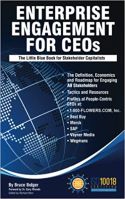
3. Books on implementation: Enterprise Engagement for CEOs and Enterprise Engagement: The Roadmap.
4. Advisory services and research: Strategic guidance, learning and certification on stakeholder management, measurement, metrics, and corporate sustainability reporting.
5. Permission-based targeted business development to identify and build relationships with the people most likely to buy.
Contact: Bruce Bolger at TheICEE.org; 914-591-7600, ext. 230.