

EU CSRD Update: Major Simplifications Underway, a New Knowledge Hub to Track Them
.png) Here’s an update on the European Union Corporate Sustainability Reporting Directive, requiring major organizations to disclose the risks and opportunities they create for employees, customers, distribution and supply chain partners, communities, and the environment and vice versa.
Here’s an update on the European Union Corporate Sustainability Reporting Directive, requiring major organizations to disclose the risks and opportunities they create for employees, customers, distribution and supply chain partners, communities, and the environment and vice versa. Double Materiality Remains Foundational
Thousands of US and European Firms in US Affected
A Single Source Information Hub on Sustainability Reporting
Click here to subscribe to the ESM weekly e-newsletter.
If your company does business with large US companies or with any one of thousands of large European Union companies in the US take note: thousands of them are or soon will be complying the a new European Union law that requires detailed reporting on how they engage with and the metrics they use in their management of customers, employees, distribution and supply chain partners, communities, and the environment.
Thousands of companies operating in the US still will be subject to the updated and scaled back Europe Union Corporate Sustainability Reporting Directive. Although largely scaled back for European companies, the disclosure law still applies to many of the largest US enterprises public and private, as well as to thousands of European companies operating in the US.
As a result of major pushback by member countries, the European Union has rolled back significant elements of Corporate Sustainability Reporting Directive and launched a new information hub to help organizations keep up with the latest developments. Because the standards redesign process remains in effect, the final rules may not appear until next year.
Following months of consultation and political debate, the European Commission and EFRAG (European Financial Reporting Advisory Group) are rewriting the ESRS (European Sustainability Reporting Stardards) to reduce the reporting burden and narrow the number of companies in scope. At the same time, EFRAG has launched the ESRS Knowledge Hub, giving companies a single authoritative place to track changes, interpretations, and implementation tools.
Investors, salespeople, marketers, sustainability experts and other interested parties can find these reports along with the annual reports of public companies and on the web sites of any organization that publishes sustainability reports. Because the EU CSRD is a law applicable to so many companies worldwide, many believe it will become the de facto standard in sustainability reporting, whether required or voluntary.
Double Materiality Remains Foundational
Importantly, the core concept of double materiality remains intact and central to the CSRD framework, even as the reporting requirements themselves are streamlined. Companies must report financial materiality–--sustainability matters that affect enterprise value and financial performance and Impact materiality, the company’s actual or potential impacts on employees, customers, their distribution and supply chain partners, and the environment.
The most consequential change is the proposed reduction in the number of companies required to report under CSRD. Originally estimated to cover around 50,000 companies, the revised proposed thresholds would limit coverage to roughly 10,000 of the largest firms in the EU: those with more than 1,000 employees and with more than €50 million in annual turnover or €25 million in assets. For US and other multinationals, the threshold is now over €450 million in turnover.
Just as significant is the simplification of the reporting structure itself. The original ESRS reportedly contained approximately 1100 datapoints; the new draft framework reduces this to around 350 datapoints, including far fewer mandatory disclosures.
Thousands of US and European Firms in US Affected
From the standpoint of US firms, the law will likely apply to anywhere from 250 to 400 of the nation’s largest companies, based on various estimates of how many public and private US companies do business in the EU. On the other hand, potentially thousands of European Union companies subject to the law do business in the US.
To date, Pulse Experiential Travel, a Manassas, VA-based experiential travel firm, is the only one to publish a corporate sustainability report consistent with the EU CSRD framework. Patagonia and Salesforce both reportedly are moving toward the EU CSRD framework as well.
A Single Source Information Hub on Sustainability Reporting
The new ESRS Knowledge Hub provides comprehensive access to all documents in the EU sustainability standard-setting process. Given that this new law likely will set the standard for sustainability reporting worldwide, it’s a useful resource for anyone in the field. The hub reportedly provides:
- Authoritative sources issued or validated by EFRAG
- Interactive navigation across the adopted ESRS: datapoints, explanations, XBRL tags, and cross-references
- Digital tools and guidance to support implementation
- Real-time visibility into draft and developing materials from EFRAG SRB and SR TEG
- Connectivity mapping between sustainability and financial information
- Historical versions for retrospective reference
- The hub includes a fully interactive edition of the 2023 ESRS, currently still in force pending adoption of simplified standards under the 2025 Omnibus Proposal.
Enterprise Engagement Alliance Services
 Celebrating our 15th year, the Enterprise Engagement Alliance helps organizations enhance performance through:
1. Information and marketing opportunities on stakeholder management and total rewards:
- ESM Weekly on stakeholder management since 2009. Click here to subscribe; click here for media kit.
- RRN Weekly on total rewards since 1996. Click here to subscribe; click here for media kit.
- EEA YouTube channel on enterprise engagement, human capital, and total rewards since 2020
 Management Academy to enhance future equity value for your organization.
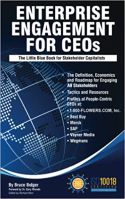
3. Books on implementation: Enterprise Engagement for CEOs and Enterprise Engagement: The Roadmap.
4. Advisory services and research: Strategic guidance, learning and certification on stakeholder management, measurement, metrics, and corporate sustainability reporting.
5. Permission-based targeted business development to identify and build relationships with the people most likely to buy.
Contact: Bruce Bolger at TheICEE.org; 914-591-7600, ext. 230.