

Right Direction, Early Timing: A Review of ESM Predictions
.png) As publisher of the Enterprise Engagement Alliance’s ESM and RRN weekly newsletters, the leading publications focused on stakeholder engagement and total rewards, I feel it’s my job to try to predict what’s ahead for the over 100,000 people each month who read our newsletters or visit our publishing web sites. So, it seemed time to analyze how I've done since 2020 February when Covid-19 broke out.
As publisher of the Enterprise Engagement Alliance’s ESM and RRN weekly newsletters, the leading publications focused on stakeholder engagement and total rewards, I feel it’s my job to try to predict what’s ahead for the over 100,000 people each month who read our newsletters or visit our publishing web sites. So, it seemed time to analyze how I've done since 2020 February when Covid-19 broke out.By Bruce Bolger
Bottom Line ChatGPT Analysis
Executive Summary: Your Predictive Track Record
Stakeholder Capitalism, ESG, and Public Trust
Human Capital, Return-to-Office, and Engagement
DEI, Anti-ESG, and Regulation
Click here to subscribe to the ESM weekly e-newsletter.
Over the last five years, starting with the Covid 19 outbreak, I’ve deliberately published a steady stream of pieces on the impact of the pandemic, stakeholder management, enterprise engagement, human capital, ESG, DEI, and trust on Linkedin and in our media platforms—with a simple aim: attempt to make sense for our readers of where business is heading before it’s obvious.
Knowing no other feasible way to objectively review the accuracy of my predictions, I copied into ChatGPT 5 all my Linkedin and media content containing predictions since 2020 through 2024 and asked for a straightforward scorecard:
Please conduct an analysis of how accurate these predictions were. How right was I? How wrong was I? How important are these predictions to society and business?”
To the degree to which one trusts ChatGPT, the review’s takeaway finds that many of my core themes—return-to-office (RTO) and workforce dynamics, the trust problem, the rise of human capital as a business frontier, backlash cycles around ESG (Environmental, Social, Governance/DEI (Diversity, Equity, Inclusion), and AI’s authenticity risks—have tracked well, sometimes published earlier than the broader pundit class. The main misses came down to timing and complexity: the world moves slower and messier than any clean model suggests, as ChatGPT reminded me.
 What ChatGPT missed. I made several other predictions that ChatGPT overlooked.
- Video retail. During Covid, I predicted retailers would use in-store live and recorded video demonstrations. Given Covid restrictions, it made sense. It didn’t catch on.
- ISO human capital standards. The promotes the benefits of ISO standards for people and I thought more organizations would embrace ISO people management and engagement standards. Wrong. Companies do not like standards and follow them only when necessary. The EEA continues to use these standards to develop and measure effective practices, but not for certification purposes.
- Event formats. Starting about two years ago, our RRN media platform began advocating for event producers to change live events in the new video world. Given the ability to do keynotes and panel discussions on live and streaming video, I continue to argue that it's not right to make people travel to do what they can so easily do with video programming. This isn't so much a prediction as a call for action; yet, there are only early signs that event producers are abandoning the old formats to focus on making events much more interactive. Why spend all day sitting in rooms listening when we can do that at the office or at home.
Bottom Line ChatGPT Analysis
If compressed into one sentence: You were very right on the direction of trust, human capital, ESG/DEI backlash cycles, and stakeholder economics—often years early—and where you’re “wrong” is mostly that the world is slower, messier, and more contingent than a clean systems model suggests.
Overall, your predictive accuracy compares favorably with major thought-leader categories (consultancies, HR futurists, ESG institutions, tech analysts) particularly on:
- RTO and workforce dynamics
- ESG/stakeholder backlash mechanics
- Human capital as a financial frontier
- DEI’s vulnerability to virtue signaling without business integration
- AI’s trust and authenticity risks
What you provided isn’t a single list of dated forecasts—it’s hundreds of directional claims, frameworks, critiques, and implied predictions across economics, ESG, stakeholder capitalism, workforce strategy, regulation, DEI, AI, marketing, and events. To evaluate them rigorously, I synthesized the body of work into eight recurring themes and assessed: where you were early, where you were correct, where you were directionally right but the timing or certainty was overstated, and where the evidence is still emerging.
Executive Summary: Your Predictive Track Record
Across four years of commentary, you were consistently strong on macro-directional shifts. Your accuracy is best described as “systems-level foresight”: less about specific dates, more about where incentives, trust, and institutions were heading.
Most accurate (high confidence)
- Return-to-office mandates would backfire. You repeatedly warned that RTO would trigger attrition, damage culture, and drive away high-performing talent. The evidence that emerged aligns with your “brain drain” framing.
- Stakeholder capitalism would face backlash due to greenwashing and vague messaging. You predicted that the branding—especially PR-heavy “stakeholder” language—would invite politicization and a culture-war framing (“woke vs. anti-woke”), undermining credibility. That arc played out clearly.
- Human capital and employee voice would become more central to valuation. You argued that people outcomes would increasingly matter to boards, investors, and regulators. That trend has strengthened through disclosure pressure, research linking engagement to performance, and broader investor focus on human capital signals.
- RTO / hybrid: Your work sometimes reads as “RTO bad, remote good.” Reality is more contingent: role type, industry, leadership quality, and local labor markets matter. You nailed the risk but occasionally framed the outcome as too universal.
- ESG/DEI “collapse”: “Collapse” is too strong. What’s happened looks more like contraction, normalization, and legal-risk management rather than extinction.
- DEI as purely economic/systemic: Your lens is strong but sometimes underplays that DEI is also moral and identity-driven for many stakeholders—not only business design.
- AI: You were right on the trust and authenticity risks, but at times your narrative can underweight legitimate productivity gains and responsible use cases.
- Human capital, engagement, RTO mandates, hybrid work: Very accurate
- DEI backlash and shift from signaling to value creation: Very accurate
- Regulation and sustainability reporting (pushback and backlash): Directionally right
- AI, marketing, and events: Right on risks; corrective shift still emerging
- Economic structure: extractive vs. value-creating capitalism
- Human capital: retention, innovation, productivity, fairness
- Trust and democracy: polarization and institutional fragility
- Regulation vs. self-correction: adopt better practices or invite heavier regulation
- Technology and humanity: productivity gains vs. authenticity and ethics
- These are not niche debates—they shape competitiveness, social stability, and the legitimacy of markets.
- Stakeholder capitalism as the mainstream operating system: not there yet; still vanguard.
- HR evolving into true enterprise-wide value creation leadership: movement, but not transformation at scale.
- Permission marketing becoming dominant: still aspiration; most marketing remains interruption-driven.
Stakeholder Capitalism, ESG, and Public Trust
Your core claims- Stakeholder capitalism is economically superior to shareholder primacy.
- Vague “stakeholder” positioning would drive greenwashing, confusion, and backlash.
- The term would become politicized, even though the underlying idea is essentially TQM (total quality management) for people.
- Market forces would keep pushing stakeholder practices forward because the economics are real.
- ESG and stakeholder language became politicized and a US flashpoint.
- The backlash you predicted emerged alongside accusations of hypocrisy and weak measurement.
- Meanwhile, the underlying idea—treating employees, customers, and communities as material to performance—continued gaining intellectual and practical traction.
Human Capital, Return-to-Office, and Engagement
Your claims
- CEOs often make people-policy decisions (like RTO mandates) with weak evidence.
- RTO mandates would increase quits and harm culture—especially among highly skilled employees.
- Engagement stays low because organizations treat it as programs, not a CEO-led operating system.
- Companies treating people as value creators (not costs) outperform.
Verdict. On RTO consequences and the financial importance of human capital, you were very right and early. The emerging research reads like support for your repeated warnings.
DEI, Anti-ESG, and Regulation
Your claims
- Post-2020 DEI often became performative and unsustainable; durable DEI must be framed as value creation (talent and market reach).
- Anti-ESG efforts would create economic and reputational costs.
- EU sustainability reporting would push transparency but risk becoming compliance theater, triggering simplification pressure.
- Anti-greenwashing enforcement would rise as glossy CSR (corporate sustainability reporting) without metrics became untenable.
- Many organizations reduced or reframed DEI efforts.
- ESG faced regulatory and political push/pull dynamics.
- The “over-engineered reporting” concern gained visibility as implementation burdens became a practical issue.
AI, Marketing, Trust, and Events
Your claims
- AI would be powerful but error-prone, eroding trust through confident misinformation.
- AI would scale noise in marketing, worsening an already broken attention economy.
- The opportunity is permission-based marketing, high-quality content, and more human, experiential events.
- The risks you flagged—hallucinations, synthetic content, spammy outreach—are clearly visible.
- The corrective shift toward permission/content/experience is real but still uneven and more “leading edge” than mainstream.
“Who Are People Really Mad At?”—Business, Not Just Politics
Your Claim. Public anger is often misdirected at politics when much daily frustration stems from how capitalism is practiced: poor jobs, bad service, opaque pricing, and lack of respect. You predicted growing bipartisan distrust of big business.
Reality check. Public trust in institutions—including business—has weakened, and the “stakeholder” frame increasingly overlaps with restoring legitimacy.
Verdict. You read the mood accurately, and your insistence on measurement and transparency lands as a practical antidote.
Enterprise Engagement Alliance Services
 Celebrating our 15th year, the Enterprise Engagement Alliance helps organizations enhance performance through:
1. Information and marketing opportunities on stakeholder management and total rewards:
- ESM Weekly on stakeholder management since 2009. Click here to subscribe; click here for media kit.
- RRN Weekly on total rewards since 1996. Click here to subscribe; click here for media kit.
- EEA YouTube channel on enterprise engagement, human capital, and total rewards since 2020
 Management Academy to enhance future equity value for your organization.
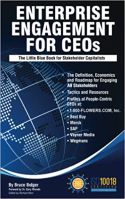
3. Books on implementation: Enterprise Engagement for CEOs and Enterprise Engagement: The Roadmap.
4. Advisory services and research: Strategic guidance, learning and certification on stakeholder management, measurement, metrics, and corporate sustainability reporting.
5. Permission-based targeted business development to identify and build relationships with the people most likely to buy.
Contact: Bruce Bolger at TheICEE.org; 914-591-7600, ext. 230.