

Notice to CEOs: EU Study Suggests Low-Profile Political Activities Work Better in Procurement
.png) One of the first rules of stakeholder capitalism is to stay out of politics. While this study was conducted in the European Union, with multiple member states and governments and a regulatory environment unique from current US circumstances, it provides useful insights for US firms doing business in the current political environment.
One of the first rules of stakeholder capitalism is to stay out of politics. While this study was conducted in the European Union, with multiple member states and governments and a regulatory environment unique from current US circumstances, it provides useful insights for US firms doing business in the current political environment. A Practical Approach for Government Procurement Based on EU Study
The Role of Political Connections in Europe
Recommendations
Click here to subscribe to the ESM weekly e-newsletter.
The political landscape in Europe may differ markedly from the US, but this paper by Tony L. He, Assistant Professor at Rutgers Business School, “Low Profile, High Impact: How the Visibility of Political Agents Shapes Corporate Political Influence” suggests that in the 28 countries of the European Union, at least, it pays to keep a low profile.
The headline lesson for leaders is not “connections matter.” It’s more specific—and more useful: in systems designed to be transparent, influence doesn’t vanish; it relocates to the least visible actors and the least visible stages. For firms selling to government, that means the competitive game is often won (or lost) long before bids are opened—and often far from the elected officials everyone is watching.
For US executives with a long-term view, the study suggests it’s best to focus on the lower-key brass tacks approach to government procurement than public involvement in politics. Will some of the public supporters of either party live to regret getting involved with partisan politics outside of their purpose, goals, objectives, and values?
A Practical Approach for Government Procurement Based on EU Study .png)
A major study of public procurement across 28 European democracies finds that corporate political influence is most effective where it’s least visible. Firms connected to unelected insiders—especially aides, advisors, chiefs of staff, and administrative staff—see stronger procurement advantages than firms connected to elected politicians. Elected officials, when they matter, tend to influence outcomes “upstream” by shaping rules and requirements that narrow competition before bids are even evaluated.
The research, published in the Strategic Management Journal in November 2025, examines procurement outcomes across 28 European countries from 2011 to 2017.
To do this, the author combined:
- Corporate leadership data for 6,522 publicly listed firm
- EU public procurement award data
- A database of politically exposed persons (PEPs) used for compliance screening
The Role of Political Connections in Europe
When executives think “political connections,” they usually picture prominent elected officials: ministers, members of parliament, mayors. This research suggests that assumption is often backward—at least in developed democracies with strong transparency rules.
Across Europe’s highly regulated public procurement system, the strongest procurement advantage isn’t linked to connections with elected leaders. It’s linked to connections with unelected political insiders—the people who work close to decision-makers but outside the spotlight: aides, advisors, chiefs of staff, and administrative staff.
The logic is straightforward: visibility changes behavior. Elected politicians face press scrutiny, political opposition, electoral risk, and formal oversight—making overt favoritism harder and riskier. Staffers and behind-the-scenes personnel tend to operate with lower public visibility, and the study shows they appear able to shape outcomes more broadly across procurement situations—both competitive and uncompetitive.
The paper distinguishes between two patterns of influence:
- Elected politicians: When they have an effect, it shows up mainly in uncompetitive or restricted/negotiated procurements—settings where fewer firms bid, or only invited firms can bid. The interpretation: elected officials may be more likely to shape the “upstream” design of procurement—priorities, eligibility rules, specifications—because that offers political cover. If you narrow the pool before the process begins, you don’t have to interfere in the more visible bid evaluation stage. Although the author makes no reference to the situation, this appears to mirror the influence of the Trump administration on matters of keen interest to the president.
- Unelected insiders (especially staffers): Their influence shows up across both competitive and uncompetitive cases. That pattern is consistent with an “information and access” advantage: being closer to how priorities are interpreted, how criteria are applied, and what a procuring authority informally values—without needing to visibly overrule a process.
Recommendations
What executives at companies that sell to the government should do with this insight.
1) Stop treating political risk as a “top-of-house” relationship issue. Senior relationships matter—but this research implies that procurement advantage can be shaped by people below the marquee names.
2) Focus on the upstream steps that determine who can compete. If elected influence often operates by shaping requirements and narrowing competition early, then the “real contest” may happen before the tender is public. Build internal discipline around early signals: upcoming policy priorities, eligibility/specification changes, how requirements are being framed, timing and procedure choices (open vs restricted/negotiated).
3) Compete ethically by becoming the “low-friction choice.” The safest, most repeatable advantage, the author asserts, is still operational: credible delivery, clean compliance, strong past performance, and proposals that match what the buyer truly needs. Make it easy for procurement teams to choose you on merit: tighten bid quality control; strengthen proof of capability, document delivery outcomes, reduce contractual and execution risk.
4) Upgrade compliance for the “low-visibility channel” risk. If influence is more likely where it’s less visible, then the reputational and legal risk is also harder to spot internally. Pressure-test your controls: conflict-of-interest disclosure (including close relationships), third-party and advisor due diligence, meeting documentation and bid integrity logs, training for business development teams on “soft influence” red flags.
5) Assume competitors may exploit information advantages—plan accordingly. Even if your firm never seeks inside influence, rivals might. The practical implication is competitive, not just ethical.
Build resilience: diversify pipeline (avoid dependence on a handful of opaque tenders), insist on bid/no-bid criteria that screen for process risk, watch for overly tailored requirements and unusually narrow competitions.
Enterprise Engagement Alliance Services
 Celebrating our 15th year, the Enterprise Engagement Alliance helps organizations enhance performance through:
1. Information and marketing opportunities on stakeholder management and total rewards:
- ESM Weekly on stakeholder management since 2009. Click here to subscribe; click here for media kit.
- RRN Weekly on total rewards since 1996. Click here to subscribe; click here for media kit.
- EEA YouTube channel on enterprise engagement, human capital, and total rewards since 2020
 Management Academy to enhance future equity value for your organization.
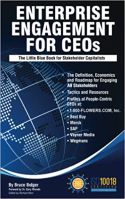
3. Books on implementation: Enterprise Engagement for CEOs and Enterprise Engagement: The Roadmap.
4. Advisory services and research: Strategic guidance, learning and certification on stakeholder management, measurement, metrics, and corporate sustainability reporting.
5. Permission-based targeted business development to identify and build relationships with the people most likely to buy.
Contact: Bruce Bolger at TheICEE.org; 914-591-7600, ext. 230.