

EEA Releases Study Guide to Support Enterprise Engagement Certification
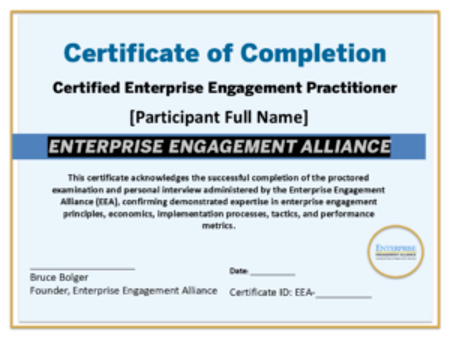 The Enterprise Engagement Alliance (EEA) Academy has released a comprehensive Study Guide for Enterprise Engagement Certification, designed to help professionals prepare for certification while deepening their understanding of how Total Quality Management (TQM) principles can be applied to stakeholder management in real-world settings in business and in personal life.
The Purpose of the Certification
What the Study Guide Provides
A Systems-Based Approach to Achieving Purpose
Foundations, Economics, and Measurement
Stakeholder Inter-Relationships and Engagement Design
Integration, Measurement, and Continuous Improvement
Supporting Global Access to Learning
Click here to subscribe to the ESM weekly e-newsletter.
The study guide supports the EEA’s broader educational mission: to build credible, practical capability in designing, managing, and continuously improving stakeholder engagement efforts across business, government, not-for-profit, and organized endeavors of any kind. Rather than promoting ideology, isolated tactics, or a proprietary system, the certification and its supporting materials focus on disciplined, evidence-based management practices that align purpose, people, and performance based on decades of use in business around the world.
Click here for the study guide.
The Purpose of the Certification 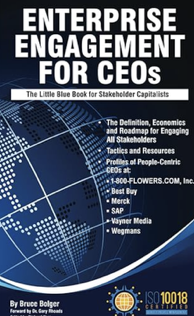
At its core, the Enterprise Engagement certification teaches professionals at all levels of management how to apply the proven principles of Total Quality Management to achieve clear, measurable purpose, goals, objectives, and values. Participants learn how to design strategies and tactics that align the interests of all relevant stakeholders—customers, employees, partners, communities, and investors—using transparent processes and data-driven decision-making.
The certification emphasizes application over abstraction. Candidates are expected to understand how to design, implement, measure, review, and continuously improve engagement efforts intended to produce reliable and meaningful outcomes. These principles apply not only to organizations, engagement, rewards, recognition and other people management efforts but also to teams, projects, and even family and personal goal setting.
In this way, the certification reflects the extension of TQM—long established in manufacturing, engineering, and operational environments—to the complex realities of managing people, stakeholders, and performance in modern systems.
What the Study Guide Provides
The new study guide outlines what candidates are expected to understand to achieve basic certification, with an emphasis on comprehension and applied judgment rather than technical specialization or rote memorization. It serves as both a preparation tool for the exam and a structured roadmap for learning and the practical application of its principles in business and in life.
Certified practitioners, as defined by the guide, will be able to:
- Explain the logic and value of TQM-based stakeholder management to boards, senior leaders, colleagues, or students
- Design transparent engagement operating systems aligned with purpose, goals, objectives, and values
- Evaluate tactics and metrics for alignment and effectiveness
- Use data and structured feedback to support continuous improvement
The guide makes clear that certification is not about mastering every tactic, but about understanding how systems work, how stakeholder interests interact, and how disciplined processes improve outcomes over time.
A Systems-Based Approach to Achieving Purpose 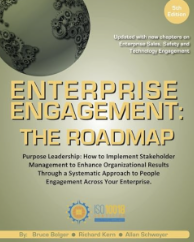
A central theme of the study guide is the systems-based nature of enterprise engagement. Candidates learn a structured approach to achieving purpose, drawing on the same management principles used daily in manufacturing plants, laboratories, and engineering organizations worldwide.While these principles are widely applied in operational settings, they are rarely taught in traditional business education as they relate to people and stakeholder engagement. The certification fills that gap by equipping practitioners to:
- Present a credible, evidence-based framework to decision-makers and stakeholders
- Apply TQM principles to organizational, team, or personal challenges
- Adapt the same structured approach across sectors and contexts
Candidates are assessed not only on conceptual understanding, but also on their ability to apply principles appropriately in different situations.
Foundations, Economics, and Measurement
To apply TQM principles credibly, practitioners must understand their intellectual foundations. The study guide provides a roadmap to obtaining a working knowledge of the historical roots of TQM and enterprise engagement, including why these principles emerged and how they were validated through practice.
Candidates are introduced to the contributions of key thinkers such as W. Edwards Deming, Peter Drucker, R. Edward Freeman, Leonard Schlesinger Jr., and the Gallup Human Sigma research, along with early organizational practitioners such as Costco, Whole Foods, and Delta Airlines. Equally important is understanding economics and impact measurement. Because stakeholder-related decisions compete for resources, candidates learn why economic evidence matters, how to distinguish inference from research-supported claims, and the role of basic impact measurement and Statistical Process Controls (SPCs). The emphasis is on knowing when and why these tools are used, rather than technical mastery.
Stakeholder Inter-Relationships and Engagement Design 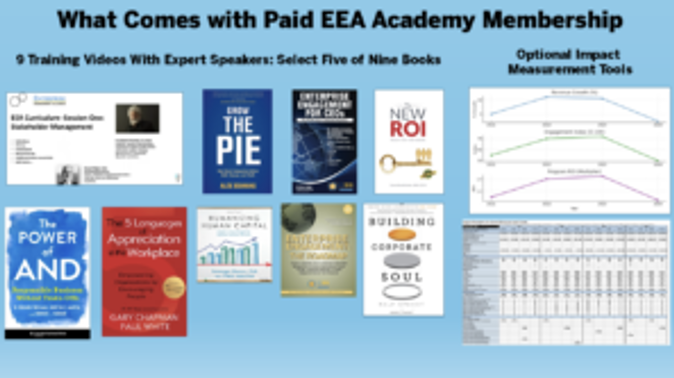
A defining feature of the certification is its focus on how stakeholder interests interrelate. Candidates are expected to understand the general interests of customers, employees, partners, and communities, how those interests align or conflict, and why unmanaged tradeoffs often undermine performance.
The study guide points candidates to the information they will need to implement a disciplined engagement design process, including:
- Defining purpose, goals, objectives, and values
- Identifying relevant stakeholder groups
- Gathering structured input
- Selecting and aligning tactics
- Defining metrics, deployment schedules, and accountability
- Documenting review and continuous improvement
Candidates are introduced to tools such as the Nominal Group Technique and tested on their ability to describe engagement design at a practical, high level.
Integration, Measurement, and Continuous Improvement
Rather than treating engagement tactics in isolation, the study guide emphasizes the need for integration and alignment across areas such as leadership development, communications, rewards and recognition, DEI, analytics, loyalty strategies, and business operating systems, pointing the way to where to find the necessary resources.
Measurement and reporting are treated as essential components of TQM-based management. Candidates are expected to understand the purpose of metrics, differences between internal and external reporting, and the role of major reporting frameworks such as GRI, ISSB, ISO, and CSRD—without memorizing technical standards.
Finally, the guide reinforces that enterprise engagement is iterative. Continuous improvement depends on feedback, documentation, learning, and adaptation over time—not one-time initiatives.
Supporting Global Access to Learning
To make certification accessible globally, the EEA Academy offers multiple learning paths, including the free, self-directed EEXAdvisors program, recommended books, and Academy memberships that provide study materials, recorded expert discussions, practice exams, and
optional coaching sessions.
Together, the study guide is designed provide a structured, credible pathway for professionals seeking to apply proven management principles to the realities of stakeholder engagement—building capability that endures beyond trends, tactics, ideology, or time.
Enterprise Engagement Alliance Services
 Celebrating our 17th year, the Enterprise Engagement Alliance helps organizations enhance performance through:
1. Information and marketing opportunities on stakeholder management and total rewards:
- ESM Weekly on stakeholder management since 2009. Click here to subscribe; click here for media kit.
- RRN Weekly on total rewards since 1996. Click here to subscribe; click here for media kit.
- EEA YouTube channel on enterprise engagement, human capital, and total rewards since 2020
 Management Academy to enhance future equity value for your organization.
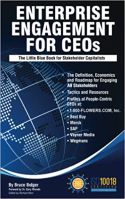
3. Books on implementation: Enterprise Engagement for CEOs and Enterprise Engagement: The Roadmap.
4. Advisory services and research: Strategic guidance, learning and certification on stakeholder management, measurement, metrics, and corporate sustainability reporting.
5. Permission-based targeted business development to identify and build relationships with the people most likely to buy.
Contact: Bruce Bolger at TheICEE.org; 914-591-7600, ext. 230.