

Stakeholder Management, Stakeholder HR, and Enterprise Engagement: Getting the Distinctions Right Before Confusion Sets In
By Bruce Bolger
Stakeholder Management: A General Discipline for Decision-Making
Stakeholder HR: Applying Stakeholder Thinking to Human Capital
Enterprise Engagement: Systems to Harmonize Stakeholder Interests
A Common Framework: Different Applications
Click here to subscribe to the ESM weekly e-newsletter.
 What began as a largely academic and philosophical shift to stakeholder thinking is now influencing how companies approach ESG, strategy, risk management, governance, and performance. It is a different way of thinking that affects how organizations manage stakeholders and which can be applied to many applications in business, including the enterprise itself, human resources, enterprise engagement, or any discipline.
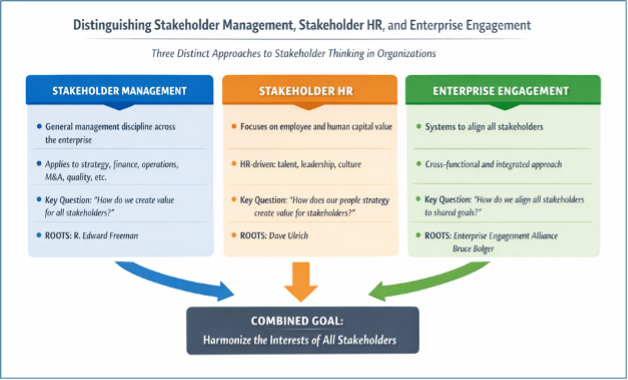
 At the center of this issue is the need to clearly distinguish among three related but fundamentally different ideas: stakeholder management, stakeholder HR, and enterprise engagement.
Among the best examples of the recent application of stakeholder thinking to various parts of business is the work of Dave Ulrich, considered one of the visionaries in the field of human resources and a relentless advocate of what he calls stakeholder HR. He is Rensis Likert Professor, Ross School of Business, University of Michigan, and Co-founder and Principal, The RBL Group, a human capability research and advisor firm. He has rigorously applied stakeholder thinking—the focus of orienting the entire organization toward value creation for customers—to the professional framework of human resources management.
Strategic HR, he says, looks in the mirror and aligns people to the business strategy. Stakeholder HR, he says, looks out the window—to customers, investors, and communities—and builds the organization to deliver value to them. That’s the shift that matters to him. Strategic HR helps execute the strategy. Stakeholder HR starts with the customer and asks: what do we need inside the company to get them to buy, stay, and trust us?”
With this shift to stakeholder thinking comes an opportunity—and a risk. The opportunity is clear: a more complete and sustainable model for value creation that aligns the interests of customers, employees, partners, communities, and investors. The risk is more subtle. As stakeholder language becomes more widely adopted, there is a growing possibility that key concepts will be used loosely or interchangeably before their distinctions are fully understood. The nomenclature confusion either reflected or was the cause of the delay of effective implementation of total quality management in the US in the last century.
When nomenclature confusions arise, organizations may inadvertently delay or dilute a powerful management discipline into a collection of well-meaning but disconnected initiatives.
Stakeholder Management: A General Discipline for Decision-Making
The philosophical foundation for stakeholder management can be traced to the work of R. Edward Freeman, whose Strategic Management: A Stakeholder Approach reframed the definition of strategic management. In fact, Freeman earned his Ph. D in philosophy. Freeman did not propose a new function or a set of engagement practices. He described a way of thinking about management itself.
Stakeholder management, in this sense, is not about managing relationships in isolation. It is an approach to decision-making that can be applied to virtually any business or organizational issue. Whether addressing quality in manufacturing, designing processes in engineering, structuring financial strategy, or evaluating mergers and acquisitions, the discipline requires leaders to consider the interests of all relevant stakeholders and to seek solutions that create value across that system by harmonizing their interests toward a common purpose, goals, objectives, and values. The purpose is both to enhance the probability for long-term success and reduce risks.
It operates at the level of general management—alongside other enterprise-wide disciplines such as financial management or quality management. It is not confined to communications, CSR (Corporate, Social Responsibility), or any single function. It is a lens through which the organization or any team is managed.
Stakeholder HR: Applying Stakeholder Thinking to Human Capital 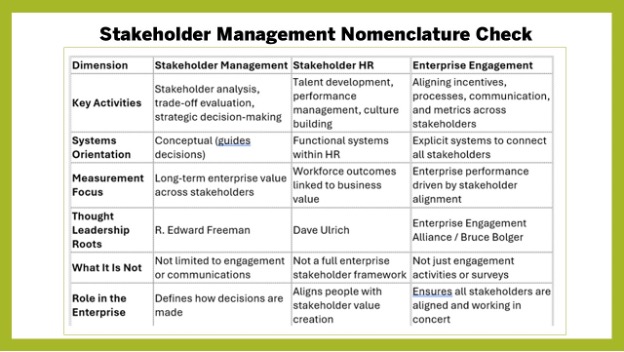
As stakeholder thinking has evolved, it has also been applied within specific domains—most notably human resources. As described above, the work of Dave Ulrich has been instrumental in redefining HR as a value-creating function. By emphasizing that HR must deliver value not only to employees but also to customers and investors, Ulrich brought stakeholder logic directly into the practice of human capital management.
This perspective—what he calls stakeholder HR—focuses on using stakeholder-based value creation principles to guide decisions about talent, leadership, culture, and organization design. It represents an important advance in the profession, aligning HR more closely with business outcomes and external impact rather than simply resources management.
At the same time, it is important to recognize its scope. Stakeholder HR is a functional application of stakeholder thinking to an entire profession and all its strategies and tactics. It focuses on how HR contributes to value creation across stakeholders, but it does not attempt to manage or align all stakeholders across the enterprise. Its domain is human capital, even when its impact extends directly to both internal and external customers.
Enterprise Engagement: Systems to Harmonize Stakeholder Interests
A third concept, enterprise or stakeholder engagement, addresses a different challenge altogether.
Developed through the work of the Enterprise Engagement Alliance, enterprise engagement focuses specifically on the systems required to harmonize the interests of stakeholders in an organization or a team. The job of fostering the proactive involvement of stakeholders in the purpose, goals, objectives, and values of an organization or team is simply another application of stakeholder thinking.
As outlined in the Enterprise Engagement Alliance’s Stakeholder Management Library, the premise is that organizations cannot fully realize stakeholder value creation without integrated and aligned systems that connect people, processes, incentives, and metrics across stakeholder groups.
Where stakeholder management defines the need to consider all stakeholders in decision-making, enterprise or stakeholder engagement focuses on how to operationalize that intent. It brings together what are often separate efforts—employee engagement, customer experience, partner programs, and brand strategy—as well as multiple tactics, such as brand architecture, leadership, communications, learning, and other engagement tools, into a coordinated system designed to align stakeholder interests, actions, and outcomes.
The emphasis here is not simply on engagement as an activity, but on alignment and harmonized interests as an outcome. Organizations do not succeed by optimizing one stakeholder at a time. Efforts to improve employee engagement, for example, may fall short if they are not connected to customer experience or partner performance. Similarly, customer-focused initiatives may be undermined by disengaged employees or misaligned incentives.
Enterprise engagement addresses this challenge by creating systems that recognize and manage these interdependencies.
A Common Framework: Different Applications
Taken together, these three concepts form a complementary but distinct framework. Stakeholder management, the underlying theory in the work of R. Edward Freeman, provides the overarching discipline—a way of approaching any business, organizational or team issue through the lens of stakeholder value creation. Stakeholder HR applies that thinking within the domain of human capital, ensuring that people strategies contribute to broader stakeholder outcomes. Enterprise engagement builds the systems already used by most organizations but better aligned to harmonize stakeholder interests across the enterprise, translating strategy into coordinated action.
As stakeholder thinking becomes more embedded in management practice, maintaining clarity among these concepts will be essential. The risk is not that organizations will ignore stakeholders, but that they will embrace the language without fully adopting the discipline. Without clear distinctions, stakeholder management could be reduced to engagement activities, or confined to individual functions, rather than applied as a comprehensive approach to managing the enterprise.
The opportunity, by contrast, is to get it right early. By understanding stakeholder management as a general management discipline, leveraging stakeholder HR to align human capital with value creation, and adopting enterprise engagement systems to harmonize stakeholder interests, organizations can build a more integrated and effective model of performance. In doing so, they will not only advance stakeholder thinking—they will operationalize it in ways that deliver measurable and sustainable results for everyone. It’s a framework long proven in total quality management.
Enterprise Engagement Alliance Services
 Celebrating our 17th year, the Enterprise Engagement Alliance helps organizations enhance performance through:
1. Information and marketing opportunities on stakeholder management and total rewards:
- ESM Weekly on stakeholder management since 2009. Click here to subscribe; click here for media kit.
- RRN Weekly on total rewards since 1996. Click here to subscribe; click here for media kit.
- EEA YouTube channel on enterprise engagement, human capital, and total rewards since 2020
 Management Academy to enhance future equity value for your organization.
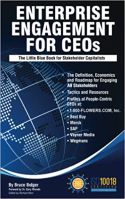
3. Books on implementation: Enterprise Engagement for CEOs and Enterprise Engagement: The Roadmap.
4. Advisory services and research: Strategic guidance, learning and certification on stakeholder management, measurement, metrics, and corporate sustainability reporting.
5. Permission-based targeted business development to identify and build relationships with the people most likely to buy.
Contact: Bruce Bolger at TheICEE.org; 914-591-7600, ext. 230.