

Engagement Jobs Demand the Skills Taught by EEA Curriculum
 Recent postings emphasize integrated planning, employee and customer insights, change management, recognition, learning, and measurable business outcomes—disciplines brought together in the Enterprise Engagement Alliance’s education program. Here’s a review of job requirements and EEA and other education programs that address a strategic approach to stakeholder engagement.
 Employers Are Asking for an Integrated Skill Set
Measurement Moves Beyond Participation
Engagement Extends Across Stakeholder Groups
A Curriculum That Connects the Pieces
Education for a Broader Profession
Click here to subscribe to the ESM weekly e-newsletter.
Recent openings compiled for the EEA Engagement Job Board reinforce the emergence of a profession extending well beyond employee surveys, incentives, recognition or events. From the job descriptions, employers seek professionals who can translate feedback into action, connect culture and recognition with organizational priorities, coordinate across departments, and measure results. The latest analysis of available jobs finds explicit requirements for workforce analytics, change adoption, customer partnerships, community impact, and AI-enabled program delivery. These responsibilities closely track the Enterprise Engagement Alliance’s course syllabus, which connects engagement disciplines across employees, customers, channel partners, and other stakeholders.
Click here for information on the certification options.
Employers Are Asking for an Integrated Skill Set
Earlier openings illustrate the breadth of these assignments. Major League Soccer’s Director, People & Engagement combines employee engagement and internal communications with culture, belonging, retention, events, leadership forums, volunteer programs, and employee resource groups. The Senior Director, Employee Engagement & Recognition at the Metropolitan Transportation Authority encompasses engagement frameworks, employee feedback, recognition, and organizational alignment across the employee lifecycle.
The latest postings further connect these activities with organizational change. Philip Morris International US’s Sr Manager Culture & Employee Experience translates culture strategy into employee programs and leader behaviors, combining recognition, employee resource groups, communications, readiness planning, and reinforcement. AstraZeneca’s Director, Employee Experience and Talent Strategy brings together succession planning, leadership development, employee listening, culture, and engagement, using workforce data to develop practical action plans.
These assignments require more than expertise in a single engagement tactic. Professionals must understand how management practices, communications, learning opportunities, and employee experiences work together to support organizational objectives.
Measurement Moves Beyond Participation
The earlier Abby Care People Experience and Engagement Manager opening connects surveys, action planning, performance reviews, and internal communications with engagement, attrition, and performance measures. GEICO’s Director, IA Sales Incentive Compensation applies rewards, recognition, communications, and performance modeling to independent-agent engagement and channel productivity.More recent openings make analytical responsibilities particularly explicit. Atrium Health’s Senior Consultant, Experience Listening & Intelligence combines survey design, quantitative and qualitative analysis, benchmarking, and executive reporting to translate employee feedback into organizational recommendations. Elevance Health’s People Strategy Partner uses workforce analytics to develop measurable workforce plans aligned with business priorities.
The distinction is important: participation, sentiment, retention, adoption, and financial impact are different measures. The postings show employers seeking stronger connections between engagement work and organizational results, although they do not all require formal ROI analysis or establish how results should be attributed to particular interventions.
Engagement Extends Across Stakeholder Groups
The latest group also demonstrates that engagement skills apply beyond HR. Zoetis’ Regional Corporate Liaison coordinates commercial, marketing, and medical teams to strengthen veterinary customer partnerships and improve regional performance. Dow’s Thriving Communities & Employee Engagement Program Manager connects employee volunteerism, nonprofit partnerships, philanthropic investment, and social impact measurement.
Palo Alto Networks’ Talent Engagement Program Manager adds another dimension: external partnerships serving talent and market objectives, cross-functional collaboration with marketing and product teams, program budget management, and AI tools that reduce administrative work. The posting explicitly connects inclusion and talent engagement with measurable operational and business outcomes.
These roles serve different stakeholders and require distinct technical knowledge. Their common management skills include planning, communication, collaboration, relationship development, feedback, and measurement.
A Curriculum That Connects the Pieces
The EEA syllabus addresses organizational purpose and culture; employee, customer, channel partner, volunteer, and community engagement; assessment and communication; learning and collaboration; rewards, recognition, loyalty, and analytics. It incorporates ISO-based management principles and practical work involving an Engagement Business Plan.
That structure reflects the connections described in the postings. Improving retention involves more than administering surveys. Recognition requires an understanding of values, manager behavior, and performance. Channel incentives depend on communications and learning as well as rewards. The curriculum provides a management framework for connecting these activities and evaluating whether they support a common purpose.
According to the EEA’s certification study guide, the organization is a SHRM Recertification Provider, enabling eligible programs to award Professional Development Credits toward maintaining SHRM credentials. This status concerns continuing education credits; the EEA’s certification remains a separate credential.
Education for a Broader Profession
Universities and professional organizations offer substantial education in related fields. The Indian Institute of Management Mumbai’s Executive Certificate Program on Valuing Stakeholder Engagement is a relevant comparison: its 15-hour program connects brands, customers, employees, firms, and shareholders, emphasizing engagement value, profitability, and stakeholder well-being.
The SMU Cox Customer Engagement Specialization provides education in loyalty, analytics, AI applications, customer preferences, and applied consulting. Its published focus is customer engagement within an MBA marketing concentration. Neither program’s published description presents the same combination of stakeholder breadth, engagement tactics, ISO-based management principles, and engagement-plan development described in the EEA course syllabus. This supports a distinction in scope, rather than a claim of superiority over other programs.
The job postings provide a practical reason for this integrated education. Employers are combining responsibilities across traditional functional boundaries and asking professionals to translate insights into coordinated action. The EEA curriculum addresses that shared management foundation, alongside the specialized experience each position requires.
Enterprise Engagement Alliance Services
 Celebrating our 18th year, the Enterprise Engagement Alliance helps organizations enhance performance through:
1. Information and marketing opportunities on stakeholder management and total rewards:
- ESM Weekly on stakeholder management since 2009. Click here to subscribe; click here for media kit.
- RRN Weekly on total rewards since 1996. Click here to subscribe; click here for media kit.
- EEA YouTube channel on enterprise engagement, human capital, and total rewards since 2020
 Management Academy to enhance future equity value for your organization.
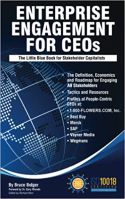
3. Books on implementation: Enterprise Engagement for CEOs and Enterprise Engagement: The Roadmap.
4. Advisory services and research: Strategic guidance, learning and certification on stakeholder management, measurement, metrics, and corporate sustainability reporting.
5. Permission-based targeted business development to identify and build relationships with the people most likely to buy.
Contact: Bruce Bolger at TheICEE.org; 914-591-7600, ext. 230.