

EEA Show: Moving From People Data to Enterprise Value
The Implementation Gap: Belief Has Outpaced Practice
Irrational Capital: Translating Culture Into Investment Information
Private Equity: Measure What Is Material to the Business
Breaking Down Silos Through Shared Accountability
Investors Need Better Questions—and Better Incentives
Material to Whom? A Critical Question
Could Government Mandates Stakeholder Management
Most business leaders say people are their most important asset. How many can demonstrate how their investments in people contribute to revenues,
 profitability, customer outcomes, and enterprise value?
Click here to watch the show or read on for a comprehensive summary.
Organizations have more data than ever on employees and other stakeholders, yet many still struggle to translate that information into better decisions and measurable financial results. In this Enterprise Engagement Alliance show, experts in investment management, private equity, human capital analytics, and employee and customer experience explore how to close that gap through meaningful metrics, shared accountability, and a systematic approach to management. They also examine whether investors and market forces can drive change on their own—or whether government could become more involved through disclosure requirements and broader corporate accountability.
Click here to view the show.
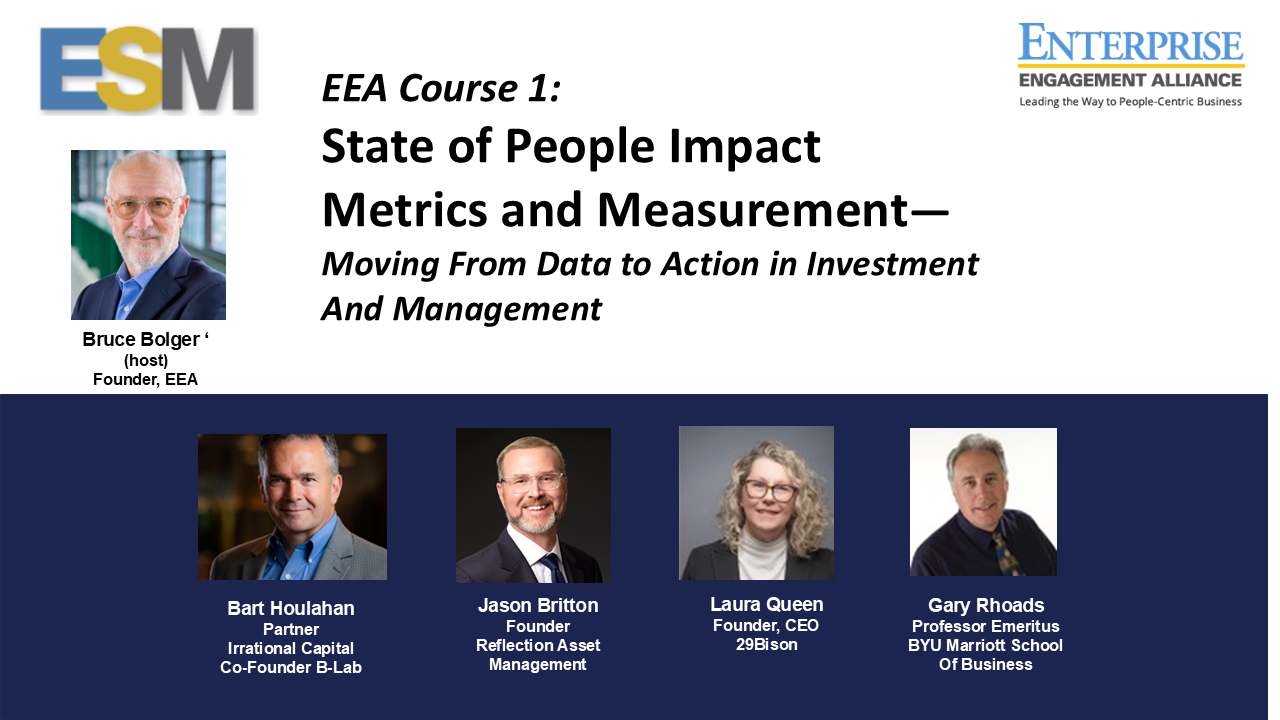
That question anchors the Enterprise Engagement Alliance show, “State of Impact Metrics and Measurement: Moving From Data to Action in Investment and Management.” The discussion brings together four perspectives on a common challenge: turning evidence about stakeholder relationships into decisions that improve performance.
The panel features:
- Gary Rhoads, Professor Emeritus of Marketing and Entrepreneurship at the Marriott School of Business, Brigham Young University, and Chief Academic Advisor to the Enterprise Engagement Alliance.
- Bart Houlahan, Partner at Irrational Capital and Co-Founder of B Lab.
- Laura Queen, Founder and CEO of 29Bison, a human capital advisory firm serving private equity investors and their portfolio companies.
- Jason Britton, Founder and Chief Investment Officer of Reflection Asset Management.
The show launches the EEA’s 2026–2027 education program on systems-based leadership and enterprise engagement, connecting research and investment analysis with practical management implementation. Show announcement and program background.
The Implementation Gap: Belief Has Outpaced Practice
For Rhoads, the connection between employee experience, customer experience, and business performance has been evident for decades. The difficulty lies in getting organizations to manage those relationships together. He recalls research connecting employees and customers at Cummins, as well as his experience building Allegiance, a business focused on linking employee and customer engagement. Even when leaders recognize the relationships, he says, relatively few consistently connect employee, customer, and supplier contributions to financial outcomes.
One obstacle is the way organizations—and business education—divide responsibilities. Finance, marketing, human resources, and operations develop their own expertise, measures, and language. Managing stakeholder relationships requires understanding how those functions affect one another.
Britton offers an important qualification to the discussion of business schools. Drawing on his experience as a Yale School of Management graduate, he points to its integrated curriculum as an example of teaching business through the perspectives of different participants, including customers, investors, employees, and society. The challenge, the discussion suggests, is making that integrated perspective routine in management and investment decisions.
Irrational Capital: Translating Culture Into Investment Information
Houlahan describes Irrational Capital’s starting premise: if people are central to organizational success but their contribution is inadequately measured, equity markets may also inadequately price that contribution.
He distinguishes between compensation and benefits, which matter, and the intrinsic factors that influence motivation, including trust, transparency, recognition, and appreciation. According to Houlahan, Irrational Capital applies research on those factors to a large collection of employee sentiment data, including public and proprietary sources. Its Human Capital Factor is designed to identify relationships between workplace experience and subsequent equity performance.
He reports that the research has been examined in six J.P. Morgan research reports. In one analysis, he says, a hypothetical portfolio using a different benchmark and construction approach produced average annual outperformance of approximately four percentage points over 14 years. The figure describes the historical research he discussed, rather than the live return of a particular fund.
Irrational Capital uses its research both to develop indexes underlying investment products and to assess individual companies. At the company level, Houlahan says, the analysis can identify strengths and areas of misalignment within departments, demographic groups, or geographic locations that could affect a value creation strategy.
His central recommendation is to change the language used to present people-related information.“The language of the boardroom or the C-suite is enterprise value,” Houlahan says.Employee engagement, well-being, and retention remain important. The opportunity is to explain how those measures relate to the financial and operational outcomes that CEOs, CFOs, and investors are trying to achieve.
Private Equity: Measure What Is Material to the Business
Queen cautions against generalizing about private equity as a sector focused exclusively on cost cutting. In the middle and lower middle markets where her firm works, she encounters investors actively seeking opportunities to create value through leadership, organizational design, culture, and people operations. Nonetheless, she says, systematic attention to these opportunities is “not normal enough.”
 For Queen, useful measurement starts with the investment thesis and the business model. A standard workforce dashboard cannot substitute for understanding how a particular organization creates—or loses—value. She offers the example of a strategy involving the acquisition and combination of clinical practices. Financial measures such as earnings before interest, taxes, depreciation, and amortization matter, but patient satisfaction and patient outcomes are also critical to evaluating the business.
Those outcomes, she explains, are influenced by how employees are treated, what they are rewarded for doing, and whether the organization’s operating practices support its stated purpose. Similarly, an overall turnover rate reveals relatively little without examining where departures occur, why people leave, and what those departures mean for customer relationships, service quality, productivity, or risk.
Queen also emphasizes that measures shape culture. What an organization tracks and rewards signals what it actually values. Measures can reinforce the behaviors needed to create value or encourage decisions that erode it. Her recommendation is to understand the system, identify the outcomes that matter, and investigate the underlying causes before deciding what action to take.
Breaking Down Silos Through Shared Accountability
Rhoads provides a practical example of what an integrated approach looks like. When working with organizations, he brought finance, operations, engineering, and other departments into discussions about employee and customer engagement. Participants sometimes questioned why those subjects were their responsibility.The answer became clearer when customer feedback was directed to the departments creating the problems.
If confusing bills generated complaints, the accounting department needed to hear from and respond to customers. If product problems originated in engineering, engineers needed to participate in addressing the feedback. The purpose was to make the relationship between departmental decisions and stakeholder outcomes visible.
Leadership support is essential, Rhoads says. Employees recognize when an organization’s stated commitment to people is disconnected from how managers make decisions. Bolger connects this approach to Total Quality Management: define the purpose, goals, objectives, and values; identify the stakeholders involved; understand their needs and capabilities; align the supporting processes; establish measures; and use feedback for continuous improvement. He also distinguishes between measuring results and measuring the activities that produce them. A sales organization, for example, may need to track training and sales activity alongside revenues. The goal is to embed engagement in an ongoing management system.
Investors Need Better Questions—and Better Incentives
Britton says mainstream investment analysis still gives insufficient attention to how companies create value through people and stakeholder relationships. His approach supplements financial analysis with information about the organization behind the numbers: its workforce, know-how, relationships, and capacity to execute. Public information can provide useful starting points, he says, including workforce size, wages, benefits, litigation, fines, and penalties. Inconsistent disclosures, however, make systematic comparisons difficult.
Executive incentives also matter. If compensation rewards only a narrow set of financial outcomes, management has little reason to give other measures equivalent attention. Britton suggests that independently measured and disclosed employee experience could influence executive behavior if incorporated into compensation decisions.He also raises the question of costs transferred outside the company. A business may improve its reported profitability by shifting burdens to employees, communities, taxpayers, or the environment. Evaluating those decisions requires looking beyond the immediate financial benefit to the organization.
Bolger points to artificial intelligence as a potential tool for making public information easier to analyze and compare. He describes exploratory EEA work examining measures such as revenue and profit per employee and per customer, together with human capital return on investment. Queen’s emphasis on business context remains relevant: the meaning of a measure depends on the organization, its operating model, and the outcomes being evaluated.
Material to Whom? A Critical Question
Houlahan broadens the measurement discussion with a question: material to whom?
Financial relevance to investors is essential, he says, but companies also affect workers, communities, supply chains, and the environment. He introduces double materiality as a way to consider both financial implications for the business and the business’s effects on others.
The closing discussion explores whether market incentives alone can drive more responsible stakeholder management or whether legal changes are also necessary. Rhoads favors incentives that encourage adoption and questions how effectively mandates would translate into practice. Queen warns about the difficulty of legislating good behavior and the damage to trust when organizational promises are not fulfilled.
Britton sees a case for stronger accountability and common expectations for public companies, while recognizing that rules can generate efforts to circumvent them. Houlahan argues that shareholder primacy itself requires reconsideration. In his view, lasting change will require broader legal accountability for corporate effects on stakeholders, a transition he describes as generational.
Bolger closes this discussion by returning to the EEA’s definition of stakeholder capitalism: enhancing returns for investors by creating value for customers, employees, distribution and supply chain partners, communities, and the environment. For management, the immediate task is concrete: identify how those relationships affect performance, connect the measures across departments, and use the findings to improve decisions.
Could Government Mandate Stakeholder Management?
The panel’s discussion of Senator Elizabeth Warren’s Accountable Capitalism Act raises the possibility that government could move beyond disclosure requirements to mandate broader stakeholder accountability. The proposal would require federal charters for corporations with more than $1 billion in annual revenue, consideration of stakeholder interests, and employee selection of at least 40% of directors.
Bolger questions whether mandates are appropriate, suggesting that better investment returns could drive voluntary adoption. Rhoads favors incentives over requirements that companies might circumvent. Queen cautions that legislating good behavior is difficult and unfulfilled promises can undermine trust.
Britton sees merit in consistent corporate standards and questions whether markets alone can prevent companies from shifting costs onto society. Houlahan arts government intervention as a possibility alongside investor pressure and voluntary management improvements.gues that broader legal accountability may ultimately be necessary to address shareholder primacy, while describing the transition as generational and Warren’s approach as potentially too much too soon.
The panel reaches no consensus on the Act, but highlights government intervention as a possibility alongside investor pressure and voluntary management improvements. The unresolved question is whether evidence of better business results will accelerate stakeholder management—or whether broader legal requirements will be needed.