

Why Companies Need a Chief People Officer to Run the People Operating System
.jpeg) Far from adding another layer of bureaucracy, a strategically empowered Chief People Officer could help companies finally measure and be accountable for the return on much of their spending in HR, sales, marketing and communications while allowing the Chief Operating Officer to focus on operational excellence.
Far from adding another layer of bureaucracy, a strategically empowered Chief People Officer could help companies finally measure and be accountable for the return on much of their spending in HR, sales, marketing and communications while allowing the Chief Operating Officer to focus on operational excellence. By Bruce Bolger
The People Equivalent of the COO
One Company, Too Many People Silos
Turning People Costs Into Measurable Investments
Freeing the COO to Focus on Operations
A People Operating System for the Enterprise
Click here to subscribe to the ESM weekly e-newsletter.
The most obvious objection to creating an expanded Chief People Officer role is also the most important one to address: Why add another senior executive, more cost and potentially more bureaucracy? The answer is that the objective should be exactly the opposite: to reduce costs by making the organization more efficient and accountable. The vision for this position is articulated in today's ESM Weekly artticle, Why Employee Engagement Should Be an Operating Disclipline, Not an HR Program, by a human resources operations director.
In many organizations, HR, sales, marketing, communications and related people-management activities can represent 60% or more of total costs, particularly in people-intensive businesses. Yet much of this spending is measured far less rigorously than investments in production, acquisitions, technology, logistics or finance. Companies know what they spend on compensation, recruitment, incentives, advertising, sales programs, training, recognition and customer engagement, but often have little ability to determine how these expenditures work together or what financial return they collectively produce.
A Chief People Officer responsible for the people operating system would give one senior executive accountability for aligning these investments with organizational purpose, goals, objectives and values and for measuring their impact. At the same time, it would enable the Chief Operating Officer to concentrate on the operational systems, productivity, quality, technology, logistics and execution traditionally associated with that position. The goal is not to create another silo. It is to reduce the cost and inefficiency of the silos that already exist.
Many organizations already have Chief People Officers, but most have authority only over human resources. This definition envisions a CPO responsible for coordinating the people-related systems that create value for all stakeholders.
Most organizations would never intentionally operate production, finance, logistics and technology without clear accountability, common goals and meaningful performance measures. Yet that is essentially how many companies manage people. Human resources, sales, marketing, customer engagement and communications frequently operate separately, each with its own leadership, budgets, technologies, agencies and metrics. The result can be conflicting messages, duplicated investments and little ability to determine how these activities collectively contribute to organizational performance. The EEA's Stakeholder Management Implementation framework specifically identifies organizational silos as a major obstacle to aligning stakeholders around common objectives and calls for cross-functional management with shared metrics.
The proposed Chief People Officer structure also provides a practical organizational mechanism for implementing the stakeholder-oriented human-capability framework advanced by Dave Ulrich, Rensis Likert Professor at the University of Michigan’s Ross School of Business and co-founder of The RBL Group, one of the field’s most influential thinkers on human resources and organizational effectiveness. Ulrich argues that HR should move beyond disconnected programs and focus instead on integrating talent, leadership, organization and HR practices to create measurable value for employees, customers, investors and other stakeholders. In Six Actions for HR to Create More Stakeholder Value, he specifically calls for an integrated human-capability framework focused on stakeholder outcomes. The CPO model proposed here supplies an organizational structure for putting that principle into practice across the people-related functions of the enterprise.
The People Equivalent of the COO
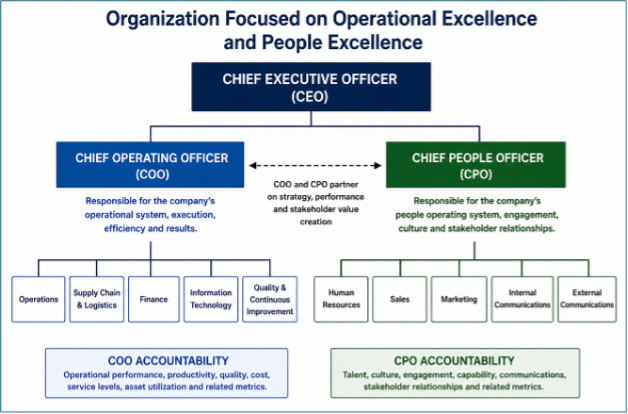
The comparison with the Chief Operating Officer helps clarify the concept. The COO generally is not expected to personally perform every operational activity. The job is to ensure that processes work together, responsibilities are clear, performance is measured and issues crossing departmental boundaries get addressed. The Chief People Officer would perform a similar function for the human side of the enterprise. The CEO would remain ultimately accountable for the organization’s purpose, goals, objectives and vaues. The COO would oversee the operational dimension of performance. The CPO would oversee the people dimension of performance.
This does not mean taking responsibilities away from existing functions. Human resources would continue to manage talent acquisition, compensation, benefits, development and workforce management. Sales would remain accountable for revenue generation. Marketing would manage markets, customers and the brand. Communications professionals would continue to manage internal and external communications.The Chief People Officer's responsibility would be to ensure that these functions are working from the same strategic playbook rather than independently optimizing their own activities.
This approach builds on concepts ESM previously addressed in The Model for the New Chief People Officer and The Role of the Chief Engagement Officer, which envision an executive responsible for managing an enterprise engagement operating system, gathering stakeholder feedback, coordinating communications, talent, training, rewards and recognition, and monitoring results.
This Chief People Officer would require a much broader skill set than traditional HR management. Based on the Enterprise Engagement Alliance Impact Academy curriculum, the role would require an understanding of the economics of stakeholder management and how to apply a business operating system that aligns people and functions around the organization’s purpose, goals, objectives, and values. The CPO would need expertise in leadership and culture, communications, employee and customer voice, job design, innovation, rewards and recognition, incentives, loyalty and other engagement practices, as well as the ability to establish meaningful measures of behavior and outcomes. Just as important would be a systems-oriented understanding of metrics and continuous improvement so that people investments can be evaluated and continually refined based on their contribution to organizational performance and stakeholder value creation.
One Company, Too Many People Silos
 Consider what happens without such coordination. Employees can hear one message about organizational values from HR, encounter another through the compensation system and experience something entirely different from their managers. Marketing can make promises to customers that employees or distribution partners have never been prepared to deliver. Sales incentives can encourage behavior inconsistent with customer experience objectives. Recognition programs can achieve high participation without any connection to measurable business priorities.
Marketing may optimize leads while sales optimizes transactions. HR may optimize retention while finance concentrates on labor costs. Communications may maximize readership or impressions without anyone determining whether those messages influence behavior or performance.
Each function can therefore appear successful according to its own metrics while the enterprise underperforms.
The problem is that no one owns the system connecting them. The EEA implementation model calls for recruiting, marketing and sales, human resources, operations, communications and other functions to align their activities and measures with organizational purpose, goals, objectives and values rather than operate independently.
Turning People Costs Into Measurable Investments
Perhaps the strongest argument for the position is measurement. Companies devote enormous resources to people. Beyond payroll and benefits are recruiting, training, sales compensation, advertising, incentives, recognition, communications, customer engagement, meetings, events, technology platforms and consulting services; yet, these investments often receive less rigorous return-on-investment scrutiny than a factory, technology platform or piece of equipment. Sales measures sales. Marketing measures leads and awareness. HR measures turnover and engagement. Communications measures readership and impressions. Recognition programs measure participation and redemptions. These measures can be useful, but they rarely answer the larger question: Are the organization's collective investments in people creating measurable value?
The EEA's Meaningful Metrics framework calls for connecting people-management and marketing activities with outcomes rather than relying principally on activity measures. The Chief People Officer should therefore establish a common framework linking people investments to such outcomes as revenue and profit per employee, Human Capital ROI, productivity, quality, retention, referrals, customer satisfaction and sales performance. The role should in part be judged on its ability to identify duplication, eliminate expenditures that cannot demonstrate value and improve the effectiveness of spending already taking place.
Freeing the COO to Focus on Operations
There is another benefit. The growing complexity of people management increasingly overlaps with the responsibilities of the traditional COO. Operational leaders already must manage productivity, quality, technology, supply chains, facilities, processes and execution. Increasingly, they are also expected to address talent shortages, culture, employee experience, customer experience, incentives and stakeholder relationships. A clearer division could improve accountability on both sides. The COO would concentrate primarily on how the organization operates. The CPO would concentrate primarily on how the organization mobilizes people to achieve its objectives. The two functions would work closely together because operational systems ultimately depend on people and people strategies must support operational requirements.
A People Operating System for the Enterprise
The objective is not another layer of bureaucracy. It is a management system designed to reduce bureaucracy, duplication and poorly measured spending. A well-designed people operating system would create a regular process through which HR, sales, marketing, communications and other functions affecting stakeholders review common objectives, stakeholder feedback, performance measures, risks and opportunities. EEA's "Perfect Company" model illustrates how an organization might systematically manage employees, customers, supply chain and distribution partners and communities within one framework rather than as unrelated constituencies.
The CEO remains ultimately accountable for organizational performance. The COO makes sure the business operating system executes against strategy. The Chief People Officer makes sure the people operating system does the same. The test should be straightforward. If the role merely adds meetings, staff and another layer of management, it has failed. If it helps companies align and measure a major share of their expenditures, eliminate duplication and enable the COO to focus more effectively on operations, it may reduce bureaucracy rather than increase it. Both the COO and CPO participate in all operating system meetings--none other are required.
If companies truly believe people are among their most important sources of value creation, putting one senior executive in charge of ensuring that the systems affecting those people work together—and measuring whether they contribute to results—looks less like a new management theory than basic organizational design.
Enterprise Engagement Alliance Services
 Celebrating our 17th year, the Enterprise Engagement Alliance helps organizations enhance performance through:
1. Information and marketing opportunities on stakeholder management and total rewards:
- ESM Weekly on stakeholder management since 2009. Click here to subscribe; click here for media kit.
- RRN Weekly on total rewards since 1996. Click here to subscribe; click here for media kit.
- EEA YouTube channel on enterprise engagement, human capital, and total rewards since 2020
 Management Academy to enhance future equity value for your organization.
3. Books on implementation: Enterprise Engagement for CEOs and Enterprise Engagement: The Roadmap.
4. Advisory services and research: Strategic guidance, learning and certification on stakeholder management, measurement, metrics, and corporate sustainability reporting.
5. Permission-based targeted business development to identify and build relationships with the people most likely to buy.
Contact: Bruce Bolger at TheICEE.org; 914-591-7600, ext. 230.